OPEN-SOURCE SCRIPT
TRADLEWARE-HODL
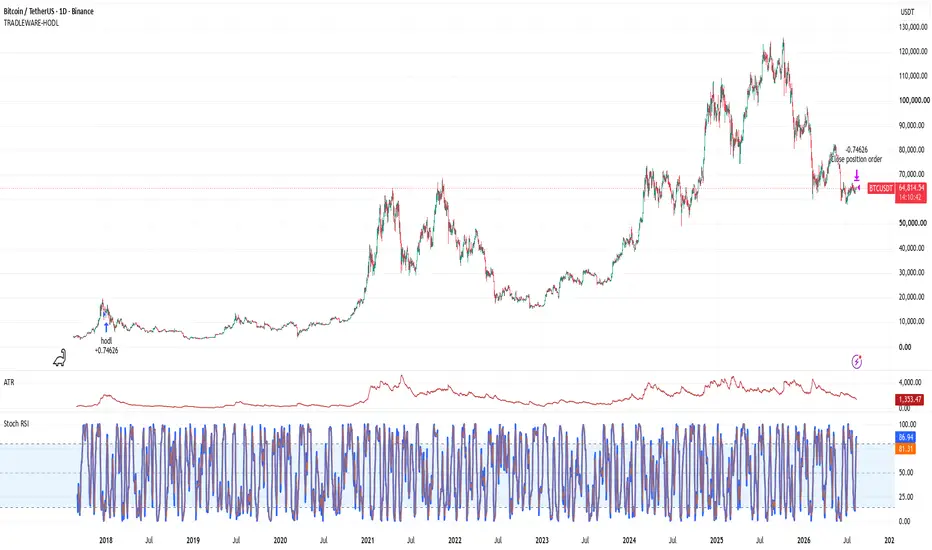
Buy and Hold Benchmark
This is a passive reference strategy, not a signal-based trading system. It exists to give an honest baseline: buy once, hold through everything, and see what an active strategy actually needs to beat.
How it works
Buy-and-hold ("HODL") is the simplest possible approach to markets: put the money in once and do nothing else, regardless of what price does afterward. There is no attempt to time entries or exits, no reaction to drawdowns, and no risk management of any kind. Any active strategy that cannot beat this, risk-adjusted, over the same period has not demonstrated an edge.
Entry
The entire starting capital is deployed in a single buy, on the first bar at or after the start date.
Exit
The position is held until the end date, or the end of the chart's available history, whichever comes first — at which point it is closed once so the backtest can report a final equity figure. This is bookkeeping, not a trading decision; the whole point of the strategy is that it does not exit early.
Parameters
- Start Date / End Date: the single buy fires on the first bar at or after the start date; the position is held until the end date
Position sizing is set to 99.95% of equity rather than a full 100%. That small gap avoids a TradingView position-sizing rounding artifact that can otherwise show up as an extra "Margin call" row even on a strategy with only one real trade; the effect on the actual result is negligible.
Costs modelled
0.1% commission per side, 3 ticks slippage.
Intended assets and timeframe
Works on any asset or timeframe — there is no technical logic to adapt, just a buy date and a hold period.
Known limitations
Full exposure to every drawdown the asset experiences, for the entire holding period, by design. This is not a flaw to fix — it is the deliberate point of comparison for any strategy that claims to manage risk better than doing nothing.
Script open-source
Nello spirito di TradingView, l'autore di questo script lo ha reso open source, in modo che i trader possano esaminarne e verificarne la funzionalità. Complimenti all'autore! Sebbene sia possibile utilizzarlo gratuitamente, ricordiamo che la ripubblicazione del codice è soggetta al nostro Regolamento.

Declinazione di responsabilità
Le informazioni e le pubblicazioni non sono intese come, e non costituiscono, consulenza o raccomandazioni finanziarie, di investimento, di trading o di altro tipo fornite o approvate da TradingView. Per ulteriori informazioni, consultare i Termini di utilizzo.
Script open-source
Nello spirito di TradingView, l'autore di questo script lo ha reso open source, in modo che i trader possano esaminarne e verificarne la funzionalità. Complimenti all'autore! Sebbene sia possibile utilizzarlo gratuitamente, ricordiamo che la ripubblicazione del codice è soggetta al nostro Regolamento.
Declinazione di responsabilità
Le informazioni e le pubblicazioni non sono intese come, e non costituiscono, consulenza o raccomandazioni finanziarie, di investimento, di trading o di altro tipo fornite o approvate da TradingView. Per ulteriori informazioni, consultare i Termini di utilizzo.