
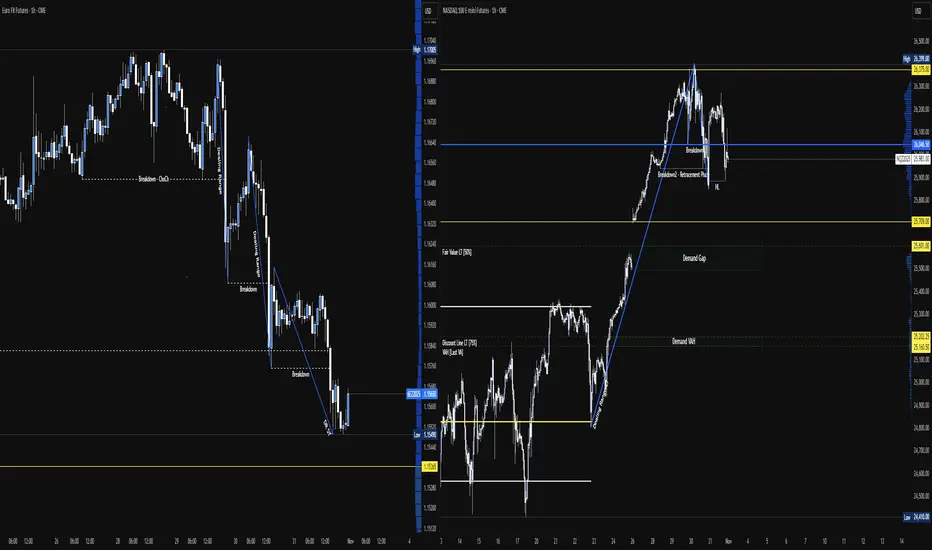
The trader’s work is not to predict, but to identify and repeat statistical edges.
We are not paid for time or effort — trading is not a conventional job where more work means more income.
We are compensated for analytical precision and disciplined execution.
Every trading system lives or dies by its risk management.
Capital protection is not defensive; it is strategic — because only preserved capital can compound.
Patience is not passivity; it is the highest expression of confidence in one’s own method.
There is no consistent profit outside of a system with proven positive expectancy.
The Stop Loss is not a punishment, but the technical boundary where an idea loses validity — respecting it preserves both capital and clarity.
The Take Profit is not greed; it is discipline in harvesting the statistical payoff that maintains long-term profitability.
Risk–Reward asymmetry is one of the most important principles of professional trading.
However, it must be calibrated: win rate and R:R are inversely correlated in most systems.
High R:R setups can be profitable even with low accuracy,
but the real question is whether the trader’s psychology can endure long sequences of losses without emotional erosion.
Market rumors and sentimental analysis are traps — they feed volatility, not precision.
Professional traders operate from objective data, structure, and impartial interpretation,
letting probability — not emotion — dictate the outcome.
Trading is a craft of asymmetry, probability, and restraint.
Profit is the by-product of method — not the reward for effort.
We are not paid for time or effort — trading is not a conventional job where more work means more income.
We are compensated for analytical precision and disciplined execution.
Every trading system lives or dies by its risk management.
Capital protection is not defensive; it is strategic — because only preserved capital can compound.
Patience is not passivity; it is the highest expression of confidence in one’s own method.
There is no consistent profit outside of a system with proven positive expectancy.
The Stop Loss is not a punishment, but the technical boundary where an idea loses validity — respecting it preserves both capital and clarity.
The Take Profit is not greed; it is discipline in harvesting the statistical payoff that maintains long-term profitability.
Risk–Reward asymmetry is one of the most important principles of professional trading.
However, it must be calibrated: win rate and R:R are inversely correlated in most systems.
High R:R setups can be profitable even with low accuracy,
but the real question is whether the trader’s psychology can endure long sequences of losses without emotional erosion.
Market rumors and sentimental analysis are traps — they feed volatility, not precision.
Professional traders operate from objective data, structure, and impartial interpretation,
letting probability — not emotion — dictate the outcome.
Trading is a craft of asymmetry, probability, and restraint.
Profit is the by-product of method — not the reward for effort.

免責事項
これらの情報および投稿は、TradingViewが提供または承認する金融、投資、取引、またはその他の種類の助言もしくは推奨であることを意図したものではなく、またこれらに該当するものでもありません。詳細は利用規約をご覧ください。
免責事項
これらの情報および投稿は、TradingViewが提供または承認する金融、投資、取引、またはその他の種類の助言もしくは推奨であることを意図したものではなく、またこれらに該当するものでもありません。詳細は利用規約をご覧ください。