
One of the most common mistakes investors make is surprisingly simple:
They invest all of their planned capital at a single price.
They find a stock they like, decide that the current price looks attractive, and enter the entire position at once.
But what happens if the market moves lower?
Suddenly, there is no flexibility left.
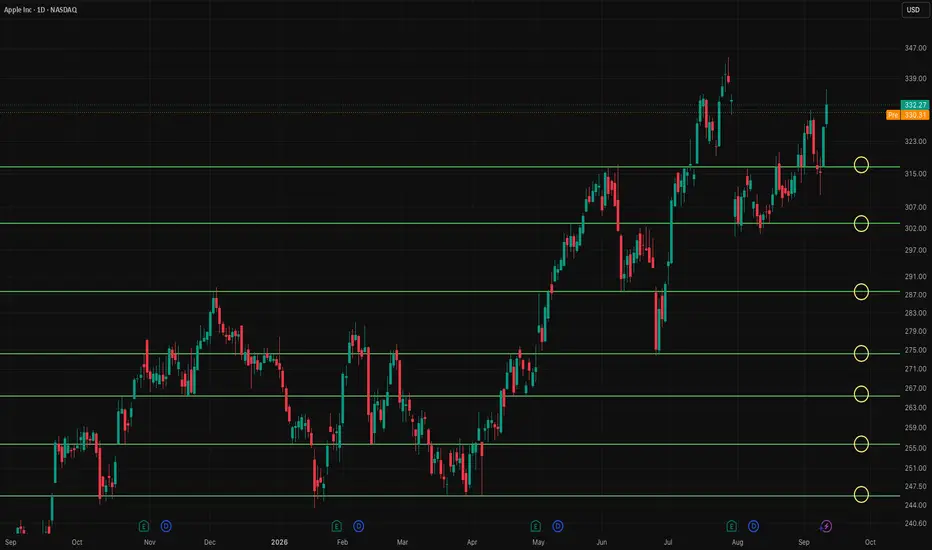
Let’s use Apple (AAPL) as a simple example.
🎯 You Don’t Need to Find the Perfect Entry
Looking at the chart, we can identify several important price zones where Apple has previously reacted.
These areas can act as potential support and resistance levels.
Instead of asking:
“What is the perfect price to buy Apple?”
A more useful question could be:
“At which price levels would I be interested in gradually building a position?”
That small change in thinking can make investing much more structured.
💰 Divide Your Capital Instead of Your Attention
Imagine you have a certain amount of capital that you have already decided to allocate to Apple.
You don’t necessarily have to deploy all of it immediately.
Instead, that capital could be divided into several portions.
On the chart, we can see potential areas around:
$316 → $303 → $288 → $275 → $266 → $256 → $246
These aren’t predictions that Apple will reach those prices.
And they aren’t automatic buy signals.
They are simply predefined areas that can help create a plan before emotions enter the equation.
If the stock continues higher, you already have exposure.
If it moves lower, you still have capital available to evaluate opportunities at lower levels.
📉 A Falling Price Doesn’t Automatically Mean a Better Investment
There is one important distinction.
Dividing capital across different levels does not mean blindly buying every time a stock falls.
Support can break.
Market conditions can change.
And the fundamental reason for owning a company can change as well.
Technical levels should therefore be viewed as part of a broader decision-making process — not as guarantees.
🧠 The Real Advantage Is Having a Plan
Investing doesn’t always need complicated indicators or dozens of signals.
Sometimes a chart, a few meaningful price levels and a predefined capital allocation plan are enough to bring structure into the process.
Instead of trying to predict the exact bottom, you prepare for multiple possibilities.
If price stays strong → you already have exposure.
If price pulls back → you know which areas you want to reassess.
If the market structure changes → you can reconsider the plan.
That’s a very different approach from putting everything into one entry and hoping the timing was perfect.
The takeaway
Don’t obsess over finding the perfect entry.
Identify meaningful areas, decide beforehand how much capital you are willing to allocate, and keep enough flexibility to react if the market gives you another opportunity.
Sometimes, investing can be much simpler than people make it.
This analysis is for educational purposes only and does not constitute financial or investment advice. The levels shown are examples based on the chart and should not be interpreted as recommendations to buy or sell Apple.

ProTrado Education | Master the Markets — From Scalper to Investor. We cover all major markets: Crypto, Futures, Stocks & Commodities. Beginner to Advanced. The only AI-powered intensive learning program. Practical tools & real human support.
免責事項
これらの情報および投稿は、TradingViewが提供または承認する金融、投資、取引、またはその他の種類の助言もしくは推奨であることを意図したものではなく、またこれらに該当するものでもありません。詳細は利用規約をご覧ください。
ProTrado Education | Master the Markets — From Scalper to Investor. We cover all major markets: Crypto, Futures, Stocks & Commodities. Beginner to Advanced. The only AI-powered intensive learning program. Practical tools & real human support.
免責事項
これらの情報および投稿は、TradingViewが提供または承認する金融、投資、取引、またはその他の種類の助言もしくは推奨であることを意図したものではなく、またこれらに該当するものでもありません。詳細は利用規約をご覧ください。