
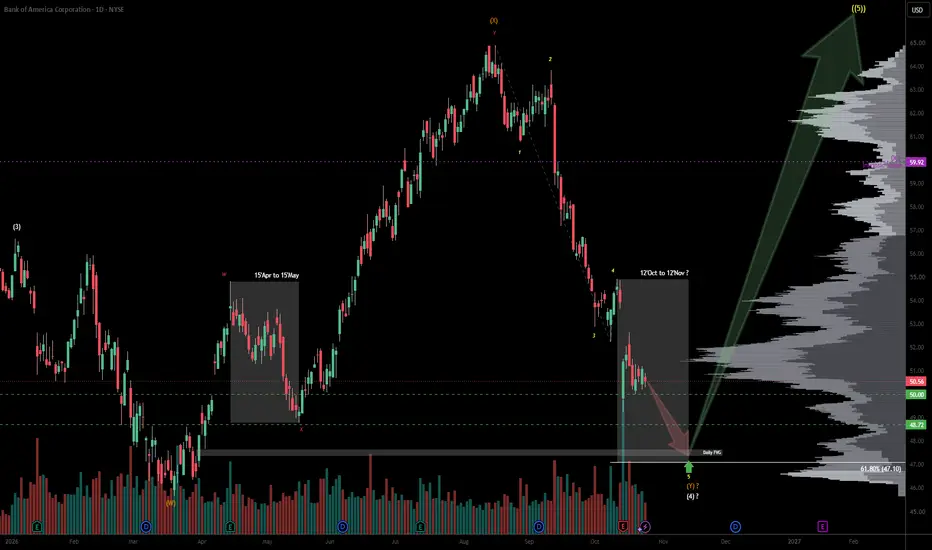
A time-symmetry comparison between the April 15 – May 15 consolidation phase and the projected October 12 – November 12 window, coupled with steadily declining volume,
provides a compelling rationale for why a secondary liquidity flush could still materialize.
Current price action in BAC points to passive institutional absorption rather than active distribution. However, aggressive institutional buyers have not yet stepped in to initiate the markup phase.
Decreasing volume during an extended consolidation typically indicates a drying up of supply,
a technical pattern that frequently precedes a rapid sell-side liquidity sweep (stop-run) before
a true, sustainable impulse wave expands to the upside.
provides a compelling rationale for why a secondary liquidity flush could still materialize.
Current price action in
BAC points to passive institutional absorption rather than active distribution. However, aggressive institutional buyers have not yet stepped in to initiate the markup phase. Decreasing volume during an extended consolidation typically indicates a drying up of supply,
a technical pattern that frequently precedes a rapid sell-side liquidity sweep (stop-run) before
a true, sustainable impulse wave expands to the upside.

関連の投稿
免責事項
これらの情報および投稿は、TradingViewが提供または承認する金融、投資、取引、またはその他の種類の助言もしくは推奨であることを意図したものではなく、またこれらに該当するものでもありません。詳細は利用規約をご覧ください。
免責事項
これらの情報および投稿は、TradingViewが提供または承認する金融、投資、取引、またはその他の種類の助言もしくは推奨であることを意図したものではなく、またこれらに該当するものでもありません。詳細は利用規約をご覧ください。