
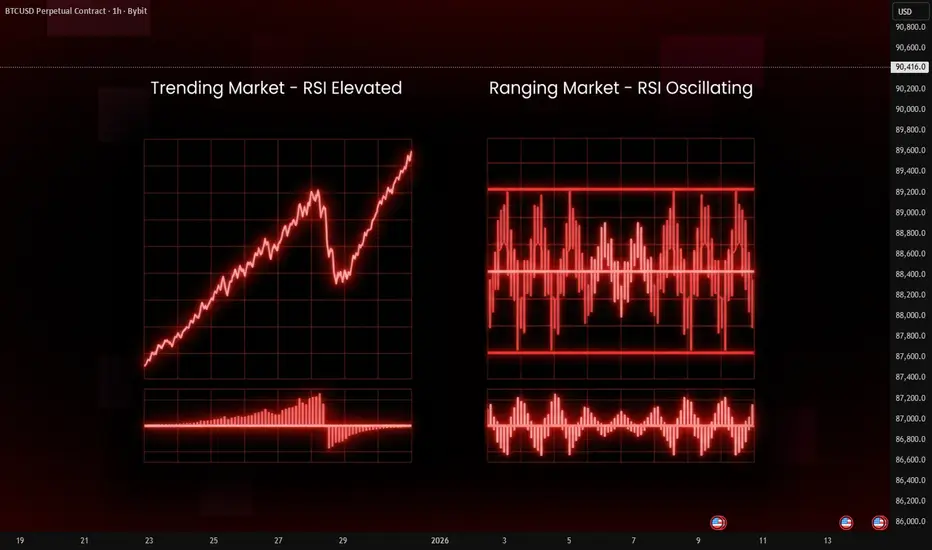
RSI behaves very differently depending on how the market is structured. Traders who treat it the same way in every condition usually end up confused, taking trades that look justified on the indicator but make little sense on price.
In a trending market, price moves with intent. Higher highs and higher lows in an uptrend, or the opposite in a downtrend, create sustained directional pressure. In these conditions, RSI tends to stabilize within a higher or lower zone rather than oscillating between traditional extremes. Pullbacks in RSI often reflect pauses in momentum while the trend resets, not signals that the move is ending. Many traders mistake these pauses for reversals and repeatedly trade against the trend.

This is why strong trends often feel “overbought” or “oversold” for long periods. Momentum stays elevated because participation remains consistent. RSI mirrors that persistence. When price structure remains intact, fading RSI extremes usually means fighting the dominant flow.
Ranging markets operate under a different logic. Price rotates between established highs and lows, liquidity is built on both sides, and directional commitment is limited. Momentum naturally expands near the edges of the range and contracts near the middle. In this environment, RSI tends to swing more symmetrically, and extreme readings often align with temporary exhaustion rather than continuation.
Problems arise when traders fail to identify which environment they are in. Applying range-based RSI logic during trends leads to early exits and repeated stop-outs. Applying trend-based logic during ranges leads to overholding and missed rotations. The indicator is not changing. The market is.
RSI becomes meaningful once structure is defined. Start by identifying whether price is expanding or rotating. Then observe how RSI behaves within that context. Over time, patterns emerge that are far more reliable than fixed levels or generic rules. Understanding this relationship turns RSI from a source of noise into a tool for alignment and patience.
In a trending market, price moves with intent. Higher highs and higher lows in an uptrend, or the opposite in a downtrend, create sustained directional pressure. In these conditions, RSI tends to stabilize within a higher or lower zone rather than oscillating between traditional extremes. Pullbacks in RSI often reflect pauses in momentum while the trend resets, not signals that the move is ending. Many traders mistake these pauses for reversals and repeatedly trade against the trend.
This is why strong trends often feel “overbought” or “oversold” for long periods. Momentum stays elevated because participation remains consistent. RSI mirrors that persistence. When price structure remains intact, fading RSI extremes usually means fighting the dominant flow.
Ranging markets operate under a different logic. Price rotates between established highs and lows, liquidity is built on both sides, and directional commitment is limited. Momentum naturally expands near the edges of the range and contracts near the middle. In this environment, RSI tends to swing more symmetrically, and extreme readings often align with temporary exhaustion rather than continuation.
Problems arise when traders fail to identify which environment they are in. Applying range-based RSI logic during trends leads to early exits and repeated stop-outs. Applying trend-based logic during ranges leads to overholding and missed rotations. The indicator is not changing. The market is.
RSI becomes meaningful once structure is defined. Start by identifying whether price is expanding or rotating. Then observe how RSI behaves within that context. Over time, patterns emerge that are far more reliable than fixed levels or generic rules. Understanding this relationship turns RSI from a source of noise into a tool for alignment and patience.

関連の投稿
免責事項
これらの情報および投稿は、TradingViewが提供または承認する金融、投資、取引、またはその他の種類の助言もしくは推奨であることを意図したものではなく、またこれらに該当するものでもありません。詳細は利用規約をご覧ください。
免責事項
これらの情報および投稿は、TradingViewが提供または承認する金融、投資、取引、またはその他の種類の助言もしくは推奨であることを意図したものではなく、またこれらに該当するものでもありません。詳細は利用規約をご覧ください。