
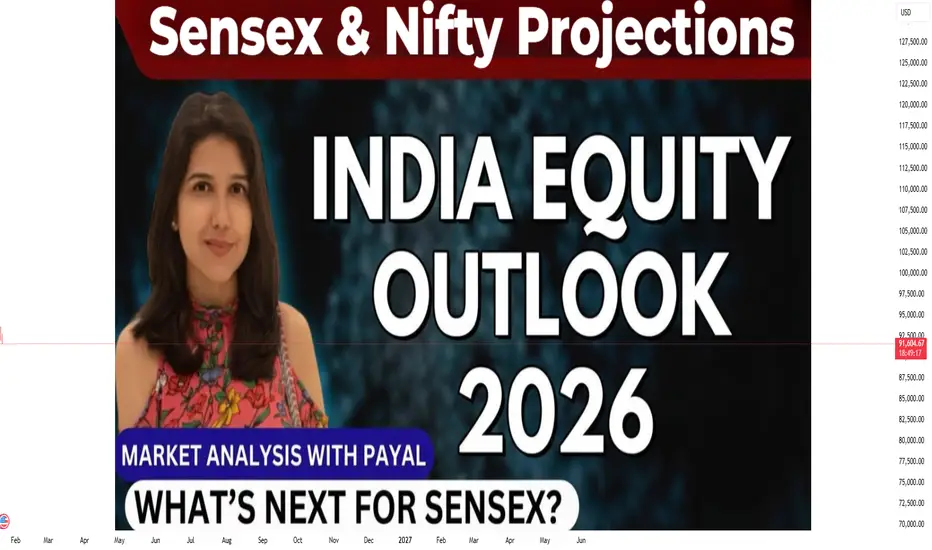
📈1. Broad Market Outlook: 2025 Recap and 2026 Expectations
🧭 Where Things Stand
Indian equities (Sensex and Nifty 50) have had a mixed performance over 2025:
Markets underperformed global peers and emerging markets, with foreign institutional investors (FIIs) pulling funds due largely to tariff shocks and earnings downgrades.
While local domestic investment has provided some support, volatility has been elevated.
Early 2026 sessions saw indices consolidate with geopolitical and macro risks still influencing sentiment.
Still, analysts broadly expect positive momentum to return by mid-2026, supported by Indian macro resilience and corporate earnings stabilization.
📊 Macro Tailwinds
India’s economy remains one of the fastest-growing among major markets:
The IMF revised India’s growth outlook for FY 2026 to 7.3% — a strong relative pace versus global averages.
Strong nominal GDP growth and inflation within the RBI’s target range are expected to underpin corporate earnings and valuations.
These fundamentals matter because equity markets are ultimately a reflection of economic growth + corporate profit growth.
📌2. Sensex & Nifty 50: Forecasts and Target Ranges for 2026
Numerous brokers and strategists have published prices bands for the major indices by end-2026 or mid-2026. These vary somewhat based on scenario assumptions — but the picture is mostly constructive:
🔹 Consensus Target Ranges
Sensex
Bull case: ~105,000–107,000 by Dec 2026 (reflecting ~20–26% upside).
Base case: ~90,000–95,000 by Dec 2026.
Conservative/neutral: ~89,000–92,000 by mid-2026.
Nifty 50
Bullish targets: ~30,000–32,000 by Dec 2026.
Base case: ~28,500–29,300 by year-end.
Mid-year range: ~27,200 by mid-2026 in some surveys.
These projections aren’t precise predictions — they’re conditional on economic growth, corporate profits, interest rate trends, and global conditions.
🧠3. What’s Driving This Outlook?
📌 A. Earnings Growth Resumption
A key theme underpinning these forecasts is the expectation of a resurgence in corporate earnings growth after a period of downgrades:
Morgan Stanley expects earnings growth of ~17–19% annually through FY28, which supports higher valuations.
JPMorgan highlights domestic demand and fiscal policy as supportive for earnings expansion in 2026.
Stronger earnings often translate into higher index levels through rising EPS × valuation multiples.
📌 B. Valuation Normalization
Indian equities underwent a valuation correction post-pandemic and relative to other emerging markets. Some strategists argue this “reset” makes the market a more attractive entry point:
Morgan Stanley’s base case assumes a P/E of ~23–23.5x, close to long-term averages.
Normalized valuations may reduce downside and set the stage for risk-on sentiment if global conditions improve.
📌 C. Domestic Flows and Policy Support
Domestic institutional investors (DIIs) and retail participation have been structural supports, buffering the market against FII volatility:
Indian households and mutual funds haven’t retreated as sharply as FIIs, providing a stabilizing base.
Monetary policy easing or fiscal incentives could further enhance liquidity and investor confidence.
📌 D. Macro Stability
With inflation under control and growth remaining robust, macro conditions look supportive for 2026:
RBI policy is expected to remain accommodative if inflation stays within target.
GDP and consumption data continue to support robust corporate performance.
These core drivers help explain why most analysts maintain a moderate to strong bullish tilt for 2026.
⚠️4. Key Risks and Challenges
Despite the positive tilt, there are significant headwinds that could derail or slow the rally:
❗ Global Trade & Geo-political Risks
Trade tensions (e.g., U.S.–Europe tariff uncertainties) have caused risk-off moves, pushing volatility higher.
Geopolitical events can influence sentiment and capital flows.
❗ Foreign Investor Flows
FPI outflows have been pronounced recently. If this trend continues, it could keep valuations under pressure or slow index gains.
❗ Corporate Earnings Monitor
Weak earnings in key sectors (e.g., recent underperformance in some IT firms) can affect sentiment and index breadth.
❗ Global Macro Conditions
A global slowdown or higher interest rates in developed markets could make risk assets less attractive, impacting inflows.
❗ Valuation Risks
If valuations re-inflate too rapidly without earnings support, markets could become susceptible to corrections.
Taking these risks together implies that market moves won’t be linear — expect corrections, cycles, and periods of volatility even within a generally positive trend.
🏭5. Sector and Thematic Drivers
Equity performance won’t be uniform across sectors. Some key industry trends likely to influence 2026:
🔹 Financials & Banks
Banks often benefit from higher credit growth, rate stability, and improved asset quality — a backbone of the Indian index structure.
🔹 Technology and IT Services
IT sector growth is tied to global demand. Weakness in contract wins could generate volatility, as seen in recent earnings.
🔹 Domestic Cyclicals
Consumption-linked sectors (consumer goods, autos) may benefit from strong consumer demand and urbanisation trends.
🔹 Capital Goods/Infrastructure
If capex cycles revive (supported by government infrastructure spend), industrials and capital goods could outperform.
📏6. Practical Takeaways for Investors
🧩 Long-Term Lens
Equities historically reward patient investors. While year-to-year volatility is normal, the structural growth story of India is largely intact.
📊 Diversification Matters
Index gains could be consolidated in certain segments while others lag. Diversification helps mitigate sector-specific risks.
📉 Volatility Is Likely
Short-term fluctuations — due to geopolitical news, earnings surprises, or global risk events — should be expected.
📈 Domestic Flows + Policies
Domestic investor behaviour and policy actions will be key determinants of medium-term trends.
📦7. Summary Projection
Benchmark Base-Case Target (2026) Bull-Case Target (2026) Notes
Sensex ~90,000–95,000 ~105,000–107,000 Earnings rebound + macro tailwinds
Nifty 50 ~28,500–30,000 ~30,000–32,000 Domestic resilience + valuation normalisation
These ranges reflect collective broker views and are conditional, not guaranteed.
📊 Final Thought
India’s equity markets in 2026 appear poised for a continuation of the long-term growth trajectory, though characterized by selective risks and volatility cycles. Solid fundamentals — including strong GDP growth, supportive policy, and a resurgent earnings cycle — underpin the positive outlook. However, external shocks, geopolitical tensions, or slower global recovery could moderate performance or introduce cyclic retracements.
In navigation terms, 2026 likely won’t be a straight rally — but rather a trend with periodic corrections, with significant opportunities for investors who combine long-term conviction with risk awareness.
🧭 Where Things Stand
Indian equities (Sensex and Nifty 50) have had a mixed performance over 2025:
Markets underperformed global peers and emerging markets, with foreign institutional investors (FIIs) pulling funds due largely to tariff shocks and earnings downgrades.
While local domestic investment has provided some support, volatility has been elevated.
Early 2026 sessions saw indices consolidate with geopolitical and macro risks still influencing sentiment.
Still, analysts broadly expect positive momentum to return by mid-2026, supported by Indian macro resilience and corporate earnings stabilization.
📊 Macro Tailwinds
India’s economy remains one of the fastest-growing among major markets:
The IMF revised India’s growth outlook for FY 2026 to 7.3% — a strong relative pace versus global averages.
Strong nominal GDP growth and inflation within the RBI’s target range are expected to underpin corporate earnings and valuations.
These fundamentals matter because equity markets are ultimately a reflection of economic growth + corporate profit growth.
📌2. Sensex & Nifty 50: Forecasts and Target Ranges for 2026
Numerous brokers and strategists have published prices bands for the major indices by end-2026 or mid-2026. These vary somewhat based on scenario assumptions — but the picture is mostly constructive:
🔹 Consensus Target Ranges
Sensex
Bull case: ~105,000–107,000 by Dec 2026 (reflecting ~20–26% upside).
Base case: ~90,000–95,000 by Dec 2026.
Conservative/neutral: ~89,000–92,000 by mid-2026.
Nifty 50
Bullish targets: ~30,000–32,000 by Dec 2026.
Base case: ~28,500–29,300 by year-end.
Mid-year range: ~27,200 by mid-2026 in some surveys.
These projections aren’t precise predictions — they’re conditional on economic growth, corporate profits, interest rate trends, and global conditions.
🧠3. What’s Driving This Outlook?
📌 A. Earnings Growth Resumption
A key theme underpinning these forecasts is the expectation of a resurgence in corporate earnings growth after a period of downgrades:
Morgan Stanley expects earnings growth of ~17–19% annually through FY28, which supports higher valuations.
JPMorgan highlights domestic demand and fiscal policy as supportive for earnings expansion in 2026.
Stronger earnings often translate into higher index levels through rising EPS × valuation multiples.
📌 B. Valuation Normalization
Indian equities underwent a valuation correction post-pandemic and relative to other emerging markets. Some strategists argue this “reset” makes the market a more attractive entry point:
Morgan Stanley’s base case assumes a P/E of ~23–23.5x, close to long-term averages.
Normalized valuations may reduce downside and set the stage for risk-on sentiment if global conditions improve.
📌 C. Domestic Flows and Policy Support
Domestic institutional investors (DIIs) and retail participation have been structural supports, buffering the market against FII volatility:
Indian households and mutual funds haven’t retreated as sharply as FIIs, providing a stabilizing base.
Monetary policy easing or fiscal incentives could further enhance liquidity and investor confidence.
📌 D. Macro Stability
With inflation under control and growth remaining robust, macro conditions look supportive for 2026:
RBI policy is expected to remain accommodative if inflation stays within target.
GDP and consumption data continue to support robust corporate performance.
These core drivers help explain why most analysts maintain a moderate to strong bullish tilt for 2026.
⚠️4. Key Risks and Challenges
Despite the positive tilt, there are significant headwinds that could derail or slow the rally:
❗ Global Trade & Geo-political Risks
Trade tensions (e.g., U.S.–Europe tariff uncertainties) have caused risk-off moves, pushing volatility higher.
Geopolitical events can influence sentiment and capital flows.
❗ Foreign Investor Flows
FPI outflows have been pronounced recently. If this trend continues, it could keep valuations under pressure or slow index gains.
❗ Corporate Earnings Monitor
Weak earnings in key sectors (e.g., recent underperformance in some IT firms) can affect sentiment and index breadth.
❗ Global Macro Conditions
A global slowdown or higher interest rates in developed markets could make risk assets less attractive, impacting inflows.
❗ Valuation Risks
If valuations re-inflate too rapidly without earnings support, markets could become susceptible to corrections.
Taking these risks together implies that market moves won’t be linear — expect corrections, cycles, and periods of volatility even within a generally positive trend.
🏭5. Sector and Thematic Drivers
Equity performance won’t be uniform across sectors. Some key industry trends likely to influence 2026:
🔹 Financials & Banks
Banks often benefit from higher credit growth, rate stability, and improved asset quality — a backbone of the Indian index structure.
🔹 Technology and IT Services
IT sector growth is tied to global demand. Weakness in contract wins could generate volatility, as seen in recent earnings.
🔹 Domestic Cyclicals
Consumption-linked sectors (consumer goods, autos) may benefit from strong consumer demand and urbanisation trends.
🔹 Capital Goods/Infrastructure
If capex cycles revive (supported by government infrastructure spend), industrials and capital goods could outperform.
📏6. Practical Takeaways for Investors
🧩 Long-Term Lens
Equities historically reward patient investors. While year-to-year volatility is normal, the structural growth story of India is largely intact.
📊 Diversification Matters
Index gains could be consolidated in certain segments while others lag. Diversification helps mitigate sector-specific risks.
📉 Volatility Is Likely
Short-term fluctuations — due to geopolitical news, earnings surprises, or global risk events — should be expected.
📈 Domestic Flows + Policies
Domestic investor behaviour and policy actions will be key determinants of medium-term trends.
📦7. Summary Projection
Benchmark Base-Case Target (2026) Bull-Case Target (2026) Notes
Sensex ~90,000–95,000 ~105,000–107,000 Earnings rebound + macro tailwinds
Nifty 50 ~28,500–30,000 ~30,000–32,000 Domestic resilience + valuation normalisation
These ranges reflect collective broker views and are conditional, not guaranteed.
📊 Final Thought
India’s equity markets in 2026 appear poised for a continuation of the long-term growth trajectory, though characterized by selective risks and volatility cycles. Solid fundamentals — including strong GDP growth, supportive policy, and a resurgent earnings cycle — underpin the positive outlook. However, external shocks, geopolitical tensions, or slower global recovery could moderate performance or introduce cyclic retracements.
In navigation terms, 2026 likely won’t be a straight rally — but rather a trend with periodic corrections, with significant opportunities for investors who combine long-term conviction with risk awareness.

関連の投稿
免責事項
これらの情報および投稿は、TradingViewが提供または承認する金融、投資、取引、またはその他の種類の助言もしくは推奨であることを意図したものではなく、またこれらに該当するものでもありません。詳細は利用規約をご覧ください。
関連の投稿
免責事項
これらの情報および投稿は、TradingViewが提供または承認する金融、投資、取引、またはその他の種類の助言もしくは推奨であることを意図したものではなく、またこれらに該当するものでもありません。詳細は利用規約をご覧ください。