
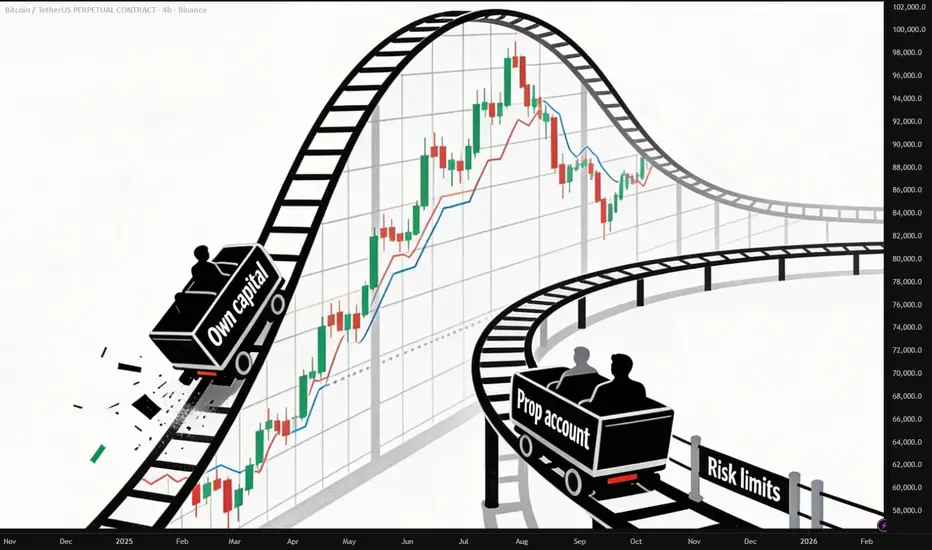
The market is changing rapidly, not gradually — it knows how to switch. Yesterday there were neat breakouts and trend continuations, today there are sudden shoots, sharp reversals, knocking out stops and moving on the news, which you will see after the candle has made a maximum and a minimum at the same time.
There is a lot of talk right now that the market has become more manipulative, nervous and volatile. And let someone argue with the wording, the essence remains: in such conditions, it is not the smartest and not the fastest who survives, but the one who respects the risk .
And here prop trading suddenly stops being a fashionable way to get money fast, and begins to look like ...**a protective contour. And not only for beginners, but also for strong traders who have already seen how easily the market takes away capital from those who decide to break the rules a little.

Disclaimer: the material is educational. Not an investment council.
1) What is prop trading really?
Prop trading (proprietary trading) — trading on the company's capital. In classical logic, everything is simple:
The main truth about prop sounds dry, but it's more important than all the advertising:
A prop firm does not buy signals — it buys manageable risk.
A stable trader is more valuable to a company than a genius who sometimes makes X's, but periodically makes a “peak" in drawdown.
---
2) Why prop has become relevant again right now
There is a feeling that the market has become tougher towards discipline in recent years. And this is evident from the typical stories.
Previously, you could afford to disrupt the risk a little bit: increase the leverage, move the stop, sit out the negative - and sometimes the market returned. Today, such a number increasingly ends the same way: a sharp move against a position, a series of liquidations, and you look at the chart not as a trader, but as a person who has just dropped an important thing from his hands.
Many previously successful traders lost deposits not because they forgot how to analyze, but because:
And against this background, the professionals had a very pragmatic idea.:
what if we stop substituting fixed assets for a series of mistakes or a “bad phase of the market"?
Hence the new perspective on prop: a prop firm is not easy money, but a way to take the risk of capital loss outside, keeping for yourself what you know how to trade.
The meaning is simple:
---
3) The two worlds of prop firms: Don't confuse them
Today, the word prop firm refers to very different models.
A) Classic prop desks (traditional prop)
Advantages: A more transparent model, less marketing, and a higher chance of a real career.
Disadvantages: harder to get in, stricter requirements, sometimes limited markets/instruments.
B) Online prop with challenges (evaluation model)
Advantages: Accessibility, quick start, clear “entrance ticket".
Disadvantages: the rules are sometimes designed so that you compete not with the market, but with the mathematics of the rules.
---
4) A new class of traders: acceleration from $100 to “millions”
There is another reason why the prop theme has become popular: the market has brought a whole wave of people who sincerely believe that trading is overclocking.
You've probably seen these scenarios:
The problem is not that overclocking is impossible as a fact. The problem is that:
The market can deliver a series of victories. But the market has never signed a contract to forgive such maneuvers. Sooner or later, the inevitable happens: one impulse against a position erases everything.
And that's where prop firms turn out to be for different:

5) What are you really paying for in the prop model
Prop is sold as capital, but in reality you are buying a combination of four things:
1. A risk framework (restrictions that cannot be persuaded)
Prop does not allow you to “merge everything to zero”. And sometimes it saves you from the most dangerous enemy— your own impulse.
2. The psychological contract
When you know that you will be turned off for a certain drawdown, you suddenly begin to respect the stop.
3. Infrastructure and access (not always)
Some models have a platform, data, fees, and conditions.
4. Funnel (if the business is built on paying for attempts)
If the company earns mainly on challenges, you are the client. If you are a trader, you are a partner. These are different worlds.
---
6) The advantages of prop trading when it suits your style
✅ Limited worst case scenario
Ideally, you only risk the cost of the attempt, not the entire deposit.
✅ Discipline is built into the rules
You don't need to reassemble your willpower every day. The frame will do it for you.
✅ Rapid growth of responsibility
You start thinking like a risk manager, not an X-hunter.
✅ Potential scalability
If you are stable, the company can increase the limits / give more accounts / improve the conditions.
---
7) Cons and pitfalls: Where even the strong ones break
## The main enemy is not the market, but the rules
Many fail not according to strategy, but according to the mechanics of limits.:
The same regulation can be the norm for a scalper and a death sentence for a swing trader.
❌ Trailing drawdown is a hidden mine
If the maximum drawdown is considered from the peak of equity (and tightens after your profit), an unpleasant paradox arises: you have earned — and the usual rollback of the strategy begins to look like a violation.
This changes behavior: the trader is afraid of normal pullbacks, closes profits too early, and worsens expectations.
## Conflict of interest in the evaluation model
If a company earns mainly by paying for attempts, it is beneficial for it that there are many attempts, but only a few pass.
## Execution, spreads and toxic flow
Delays, widening spreads, paragraphs about “abuse” and latency — all this should be read in advance, not after problems.
❌ Consistency as a KPI trap
Restrictions on an “overly profitable day” can provoke overtrading and trading for the sake of the report.
8) Who is prop suitable for and who is not
### Suitable if you:
### Not suitable if you:
---
9) The checklist: what to watch BEFORE payment
A) The mathematics of constraints
* Drawdown: fixed or trailing? by balance or equity?
* daily limit: on closed trades or on floating PnL?
* what happens in case of violation: closing positions or blocking?
* minimum trading days? a one-day profit limit? consistency?
B) Terms of trade
* fees/spreads, especially on volatility,
* is it possible to trade news,
* is it possible to hold positions through the night/weekend,
* Style restrictions: scalping, arbitration, copying.
C) Payments and legal aid
* payment frequency, minimum threshold, KYC,
* conditions for canceling payments in case of “violations”,
* reputation and payment history (preferably verifiable).
---
10) How to trade prop in an adult way so that it helps, not hinders
1) Choose a company for the style, not the style for the company.
A swing trader in tight daily limits will suffer.
2) Immediately build a risk plan for the limits.
Not “how much I want to earn", but:
3) Not to “finish off the target”, but to protect statistics.
The best prop trader is not the one who made x, but the one who does not break down in a bad week.
4) Keep a journal as a risk manager.
Reason for entry, invalidator, violation of rules, quality of execution.
---
All the arguments about prop trading sound easy on paper. But the market doesn't read the articles — the market checks in practice. Therefore, we decided not to limit ourselves to theory.
Our team also accepted the challenge of the time and decided to go all the way from the inside out on their own experience:
We took a challenge from a popular prop firm and will share with you not only the final results, but also the process itself:
how do we build a risk plan, how do we conduct transactions, what difficulties arise, what needs to be changed, and what is confirmed in practice.
The market has become more complicated. But this is not a reason to play all-in. This is a reason to grow up: build a system, keep the risk and survive where others burn out.
There is a lot of talk right now that the market has become more manipulative, nervous and volatile. And let someone argue with the wording, the essence remains: in such conditions, it is not the smartest and not the fastest who survives, but the one who respects the risk .
And here prop trading suddenly stops being a fashionable way to get money fast, and begins to look like ...**a protective contour. And not only for beginners, but also for strong traders who have already seen how easily the market takes away capital from those who decide to break the rules a little.
Disclaimer: the material is educational. Not an investment council.
1) What is prop trading really?
Prop trading (proprietary trading) — trading on the company's capital. In classical logic, everything is simple:
- the firm allocates capital (or gives a risk limit),
- the trader trades according to the rules,
- profits are divided by agreement,
- Loss is limited: there is a loss limit after which trading stops or conditions become tougher.
The main truth about prop sounds dry, but it's more important than all the advertising:
A prop firm does not buy signals — it buys manageable risk.
A stable trader is more valuable to a company than a genius who sometimes makes X's, but periodically makes a “peak" in drawdown.
---
2) Why prop has become relevant again right now
There is a feeling that the market has become tougher towards discipline in recent years. And this is evident from the typical stories.
Previously, you could afford to disrupt the risk a little bit: increase the leverage, move the stop, sit out the negative - and sometimes the market returned. Today, such a number increasingly ends the same way: a sharp move against a position, a series of liquidations, and you look at the chart not as a trader, but as a person who has just dropped an important thing from his hands.
Many previously successful traders lost deposits not because they forgot how to analyze, but because:
- stopped complying with the risk,
- began to catch up with the market,
- confused confidence in the setup with the right to ignore the stop.
And against this background, the professionals had a very pragmatic idea.:
what if we stop substituting fixed assets for a series of mistakes or a “bad phase of the market"?
Hence the new perspective on prop: a prop firm is not easy money, but a way to take the risk of capital loss outside, keeping for yourself what you know how to trade.
The meaning is simple:
- you risk your capital minimally (the cost of an attempt/subscription),
- and you work at a volume that would otherwise be psychologically and financially too dangerous,
- in fact, you shift the risk of a complete loss of the deposit to the prop rules.
---
3) The two worlds of prop firms: Don't confuse them
Today, the word prop firm refers to very different models.
A) Classic prop desks (traditional prop)
- more often offline or hybrid,
- selection through an interview/internship/verification of real trading,
- capital is really “branded”, relationships are built for a long time.
Advantages: A more transparent model, less marketing, and a higher chance of a real career.
Disadvantages: harder to get in, stricter requirements, sometimes limited markets/instruments.
B) Online prop with challenges (evaluation model)
- entry through a paid assessment,
- Strict drawdown/day/series limits,
- After completing the course, you will receive a “funded” account and profit-split payments.
Advantages: Accessibility, quick start, clear “entrance ticket".
Disadvantages: the rules are sometimes designed so that you compete not with the market, but with the mathematics of the rules.
---
4) A new class of traders: acceleration from $100 to “millions”
There is another reason why the prop theme has become popular: the market has brought a whole wave of people who sincerely believe that trading is overclocking.
You've probably seen these scenarios:
- deposit of $100–$300,
- shoulder 50–100x,
- An all-or-nothing bet,
- a few successful attempts — and the feeling that the grail has been found,
- then one candle, and “why am I always being carried out?”
The problem is not that overclocking is impossible as a fact. The problem is that:
- luck can be repeated a couple of times,
- but system trading cannot be built on a constant huge risk, because mathematics and variance will catch up with you.
The market can deliver a series of victories. But the market has never signed a contract to forgive such maneuvers. Sooner or later, the inevitable happens: one impulse against a position erases everything.
And that's where prop firms turn out to be for different:
- A prop can give a beginner discipline and a loss ceiling (if he is willing to obey the rules),
- experienced — to protect the fixed capital from a period of mistakes, emotions or the wrong phase.
5) What are you really paying for in the prop model
Prop is sold as capital, but in reality you are buying a combination of four things:
1. A risk framework (restrictions that cannot be persuaded)
Prop does not allow you to “merge everything to zero”. And sometimes it saves you from the most dangerous enemy— your own impulse.
2. The psychological contract
When you know that you will be turned off for a certain drawdown, you suddenly begin to respect the stop.
3. Infrastructure and access (not always)
Some models have a platform, data, fees, and conditions.
4. Funnel (if the business is built on paying for attempts)
If the company earns mainly on challenges, you are the client. If you are a trader, you are a partner. These are different worlds.
---
6) The advantages of prop trading when it suits your style
✅ Limited worst case scenario
Ideally, you only risk the cost of the attempt, not the entire deposit.
✅ Discipline is built into the rules
You don't need to reassemble your willpower every day. The frame will do it for you.
✅ Rapid growth of responsibility
You start thinking like a risk manager, not an X-hunter.
✅ Potential scalability
If you are stable, the company can increase the limits / give more accounts / improve the conditions.
---
7) Cons and pitfalls: Where even the strong ones break
## The main enemy is not the market, but the rules
Many fail not according to strategy, but according to the mechanics of limits.:
- daily loss limit,
- maximum drawdown,
- equity calculation (including floating minus),
- bans on news/overnight/weekend,
- requirements for consistency.
The same regulation can be the norm for a scalper and a death sentence for a swing trader.
❌ Trailing drawdown is a hidden mine
If the maximum drawdown is considered from the peak of equity (and tightens after your profit), an unpleasant paradox arises: you have earned — and the usual rollback of the strategy begins to look like a violation.
This changes behavior: the trader is afraid of normal pullbacks, closes profits too early, and worsens expectations.
## Conflict of interest in the evaluation model
If a company earns mainly by paying for attempts, it is beneficial for it that there are many attempts, but only a few pass.
## Execution, spreads and toxic flow
Delays, widening spreads, paragraphs about “abuse” and latency — all this should be read in advance, not after problems.
❌ Consistency as a KPI trap
Restrictions on an “overly profitable day” can provoke overtrading and trading for the sake of the report.
8) Who is prop suitable for and who is not
### Suitable if you:
- you already know how to trade and want to scale the risk without threatening the fixed capital,
- understand the series, the variance, the inevitability of drawdowns,
- ready to live by the rules.
### Not suitable if you:
- looking for “magic capital" without a system,
- trading martingale/averaging without restrictions,
- emotionally “catching up” after the cons,
- not ready to read the rules as a legal document.
---
9) The checklist: what to watch BEFORE payment
A) The mathematics of constraints
* Drawdown: fixed or trailing? by balance or equity?
* daily limit: on closed trades or on floating PnL?
* what happens in case of violation: closing positions or blocking?
* minimum trading days? a one-day profit limit? consistency?
B) Terms of trade
* fees/spreads, especially on volatility,
* is it possible to trade news,
* is it possible to hold positions through the night/weekend,
* Style restrictions: scalping, arbitration, copying.
C) Payments and legal aid
* payment frequency, minimum threshold, KYC,
* conditions for canceling payments in case of “violations”,
* reputation and payment history (preferably verifiable).
---
10) How to trade prop in an adult way so that it helps, not hinders
1) Choose a company for the style, not the style for the company.
A swing trader in tight daily limits will suffer.
2) Immediately build a risk plan for the limits.
Not “how much I want to earn", but:
- what is the risk of the transaction,
- how many cons are allowed in a row,
- where is the stop for the day,
- what I do after the series.
3) Not to “finish off the target”, but to protect statistics.
The best prop trader is not the one who made x, but the one who does not break down in a bad week.
4) Keep a journal as a risk manager.
Reason for entry, invalidator, violation of rules, quality of execution.
---
All the arguments about prop trading sound easy on paper. But the market doesn't read the articles — the market checks in practice. Therefore, we decided not to limit ourselves to theory.
Our team also accepted the challenge of the time and decided to go all the way from the inside out on their own experience:
- test our trading strategy under real-world prop constraints,
- understand where the rules really discipline and protect,
- and where they start to get in the way and require an adaptation of the approach.
We took a challenge from a popular prop firm and will share with you not only the final results, but also the process itself:
how do we build a risk plan, how do we conduct transactions, what difficulties arise, what needs to be changed, and what is confirmed in practice.
The market has become more complicated. But this is not a reason to play all-in. This is a reason to grow up: build a system, keep the risk and survive where others burn out.

Your start in algo trading badrock.capital/
A group with free signals t.me/badrockcapital
Trade on the company's capital app.upscale.trade?ref=B7CUR (Promo Code: B7CUR)
A group with free signals t.me/badrockcapital
Trade on the company's capital app.upscale.trade?ref=B7CUR (Promo Code: B7CUR)
免責事項
これらの情報および投稿は、TradingViewが提供または承認する金融、投資、取引、またはその他の種類の助言もしくは推奨であることを意図したものではなく、またこれらに該当するものでもありません。詳細は利用規約をご覧ください。
Your start in algo trading badrock.capital/
A group with free signals t.me/badrockcapital
Trade on the company's capital app.upscale.trade?ref=B7CUR (Promo Code: B7CUR)
A group with free signals t.me/badrockcapital
Trade on the company's capital app.upscale.trade?ref=B7CUR (Promo Code: B7CUR)
免責事項
これらの情報および投稿は、TradingViewが提供または承認する金融、投資、取引、またはその他の種類の助言もしくは推奨であることを意図したものではなく、またこれらに該当するものでもありません。詳細は利用規約をご覧ください。