
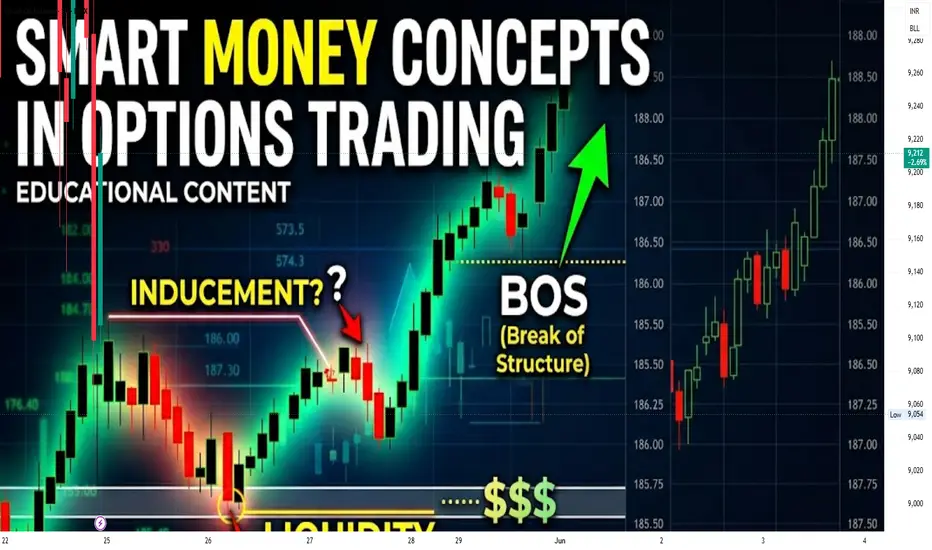
Smart Money Concepts in Options Trading
Liquidity Grab + Inducement + Break of Structure (BOS)
Introduction
Smart Money Concepts (SMC) have become one of the most powerful trading approaches in modern financial markets. In options trading, understanding how institutional players operate can help traders identify high-probability setups instead of relying on random entries.
Institutional traders and large market participants often move the market by targeting liquidity zones where retail traders place stop losses and breakout entries. Three important concepts inside SMC are:
Liquidity Grab
Inducement
Break of Structure (BOS)
When these concepts align together, traders can identify strong momentum opportunities in indices like NIFTY 50 and NIFTY BANK along with stock options.
What is Liquidity Grab?
A liquidity grab happens when price moves aggressively toward an important high or low to trigger stop losses and collect pending orders before reversing direction.
Large institutions require huge liquidity to enter positions. Retail stop losses provide that liquidity.
Common Liquidity Zones
Previous day high/low
Equal highs & equal lows
Support and resistance levels
Trendline breakout areas
Option writers’ zones
Example
If the market creates equal highs near resistance, many retail traders place buy stop orders above that level. Institutions may push price slightly above the highs, trigger breakout buyers, collect liquidity, and then reverse the market downward.
This move is called a liquidity grab.
Understanding Inducement
Inducement is a trap created to attract retail traders into wrong positions before the actual institutional move begins.
The market often creates:
Fake breakouts
False trend continuation
Weak pullbacks
Small bullish candles before bearish expansion
Retail traders think the trend will continue, but institutions use that opportunity to enter opposite positions.
Why Inducement Matters in Options Trading
In options trading, premiums react quickly during fake breakouts. Many traders buy CE or PE options during emotional moves without confirmation.
Institutions use inducement to:
Trap breakout traders
Increase volatility
Capture liquidity
Create panic exits
Understanding inducement helps traders avoid emotional entries and wait for proper confirmation.
What is Break of Structure (BOS)?
Break of Structure (BOS) confirms a shift in market direction.
A BOS happens when price breaks an important swing high or swing low with momentum.
Bullish BOS
Price breaks previous swing high
Indicates buyers gaining control
Confirms bullish continuation or reversal
Bearish BOS
Price breaks previous swing low
Indicates sellers gaining control
Confirms bearish continuation or reversal
Example
If the market forms lower highs and lower lows, then suddenly breaks a major swing high with strong candles and volume, it signals a bullish BOS.
This shows institutional buying strength entering the market.
Complete SMC Flow in Options Trading
The most powerful setups often follow this sequence:
1. Inducement Created
Retail traders are attracted toward a breakout or continuation move.
2. Liquidity Grab Happens
Price takes stop losses above highs or below lows.
3. Break of Structure Occurs
The market reverses strongly and breaks key structure levels.
4. Institutional Expansion Move Starts
Momentum increases rapidly, creating strong option premium movement.
This complete cycle helps traders identify high-probability intraday and swing setups.
How to Use SMC in Options Trading
Bullish Setup
Market grabs liquidity below support
Sellers enter aggressively
Price quickly reclaims structure
Bullish BOS forms
CE buying opportunity appears
Bearish Setup
Market grabs liquidity above resistance
Buyers enter breakout trades
Price reverses strongly
Bearish BOS forms
PE buying opportunity appears
Best Timeframes for SMC Trading
Scalping
1-minute
3-minute
Intraday Trading
5-minute
15-minute
Swing Trading
1-hour
4-hour
Higher timeframe structure usually provides stronger confirmation.
Risk Management in SMC Trading
Even strong SMC setups can fail. Proper risk management is essential.
Important Rules
Never trade without stop loss
Avoid overtrading after one successful trade
Wait for BOS confirmation
Do not enter during random volatility
Focus on risk-reward ratio
Professional traders focus more on capital protection than emotional trading.
Common Mistakes Traders Make
Entering Before Confirmation
Many traders enter during inducement instead of waiting for BOS.
Ignoring Market Structure
Without understanding structure, liquidity grabs appear confusing.
Emotional Option Buying
Buying options aggressively during fake breakouts often leads to premium decay losses.
Overleveraging
Large position sizing increases emotional pressure and trading mistakes.
Liquidity Grab + Inducement + Break of Structure (BOS)
Introduction
Smart Money Concepts (SMC) have become one of the most powerful trading approaches in modern financial markets. In options trading, understanding how institutional players operate can help traders identify high-probability setups instead of relying on random entries.
Institutional traders and large market participants often move the market by targeting liquidity zones where retail traders place stop losses and breakout entries. Three important concepts inside SMC are:
Liquidity Grab
Inducement
Break of Structure (BOS)
When these concepts align together, traders can identify strong momentum opportunities in indices like NIFTY 50 and NIFTY BANK along with stock options.
What is Liquidity Grab?
A liquidity grab happens when price moves aggressively toward an important high or low to trigger stop losses and collect pending orders before reversing direction.
Large institutions require huge liquidity to enter positions. Retail stop losses provide that liquidity.
Common Liquidity Zones
Previous day high/low
Equal highs & equal lows
Support and resistance levels
Trendline breakout areas
Option writers’ zones
Example
If the market creates equal highs near resistance, many retail traders place buy stop orders above that level. Institutions may push price slightly above the highs, trigger breakout buyers, collect liquidity, and then reverse the market downward.
This move is called a liquidity grab.
Understanding Inducement
Inducement is a trap created to attract retail traders into wrong positions before the actual institutional move begins.
The market often creates:
Fake breakouts
False trend continuation
Weak pullbacks
Small bullish candles before bearish expansion
Retail traders think the trend will continue, but institutions use that opportunity to enter opposite positions.
Why Inducement Matters in Options Trading
In options trading, premiums react quickly during fake breakouts. Many traders buy CE or PE options during emotional moves without confirmation.
Institutions use inducement to:
Trap breakout traders
Increase volatility
Capture liquidity
Create panic exits
Understanding inducement helps traders avoid emotional entries and wait for proper confirmation.
What is Break of Structure (BOS)?
Break of Structure (BOS) confirms a shift in market direction.
A BOS happens when price breaks an important swing high or swing low with momentum.
Bullish BOS
Price breaks previous swing high
Indicates buyers gaining control
Confirms bullish continuation or reversal
Bearish BOS
Price breaks previous swing low
Indicates sellers gaining control
Confirms bearish continuation or reversal
Example
If the market forms lower highs and lower lows, then suddenly breaks a major swing high with strong candles and volume, it signals a bullish BOS.
This shows institutional buying strength entering the market.
Complete SMC Flow in Options Trading
The most powerful setups often follow this sequence:
1. Inducement Created
Retail traders are attracted toward a breakout or continuation move.
2. Liquidity Grab Happens
Price takes stop losses above highs or below lows.
3. Break of Structure Occurs
The market reverses strongly and breaks key structure levels.
4. Institutional Expansion Move Starts
Momentum increases rapidly, creating strong option premium movement.
This complete cycle helps traders identify high-probability intraday and swing setups.
How to Use SMC in Options Trading
Bullish Setup
Market grabs liquidity below support
Sellers enter aggressively
Price quickly reclaims structure
Bullish BOS forms
CE buying opportunity appears
Bearish Setup
Market grabs liquidity above resistance
Buyers enter breakout trades
Price reverses strongly
Bearish BOS forms
PE buying opportunity appears
Best Timeframes for SMC Trading
Scalping
1-minute
3-minute
Intraday Trading
5-minute
15-minute
Swing Trading
1-hour
4-hour
Higher timeframe structure usually provides stronger confirmation.
Risk Management in SMC Trading
Even strong SMC setups can fail. Proper risk management is essential.
Important Rules
Never trade without stop loss
Avoid overtrading after one successful trade
Wait for BOS confirmation
Do not enter during random volatility
Focus on risk-reward ratio
Professional traders focus more on capital protection than emotional trading.
Common Mistakes Traders Make
Entering Before Confirmation
Many traders enter during inducement instead of waiting for BOS.
Ignoring Market Structure
Without understanding structure, liquidity grabs appear confusing.
Emotional Option Buying
Buying options aggressively during fake breakouts often leads to premium decay losses.
Overleveraging
Large position sizing increases emotional pressure and trading mistakes.

Hye Guys,Welcome to a professional trading journey built on precision, discipline, and smart money concepts.
📞 Phone: +91 93159 78955
💬 WhatsApp: wa.link/kdkejz
📩 Contact Mail: globalwolfstreet@gmail.com
📞 Phone: +91 93159 78955
💬 WhatsApp: wa.link/kdkejz
📩 Contact Mail: globalwolfstreet@gmail.com
関連の投稿
免責事項
これらの情報および投稿は、TradingViewが提供または承認する金融、投資、取引、またはその他の種類の助言もしくは推奨であることを意図したものではなく、またこれらに該当するものでもありません。詳細は利用規約をご覧ください。
Hye Guys,Welcome to a professional trading journey built on precision, discipline, and smart money concepts.
📞 Phone: +91 93159 78955
💬 WhatsApp: wa.link/kdkejz
📩 Contact Mail: globalwolfstreet@gmail.com
📞 Phone: +91 93159 78955
💬 WhatsApp: wa.link/kdkejz
📩 Contact Mail: globalwolfstreet@gmail.com
関連の投稿
免責事項
これらの情報および投稿は、TradingViewが提供または承認する金融、投資、取引、またはその他の種類の助言もしくは推奨であることを意図したものではなく、またこれらに該当するものでもありません。詳細は利用規約をご覧ください。