

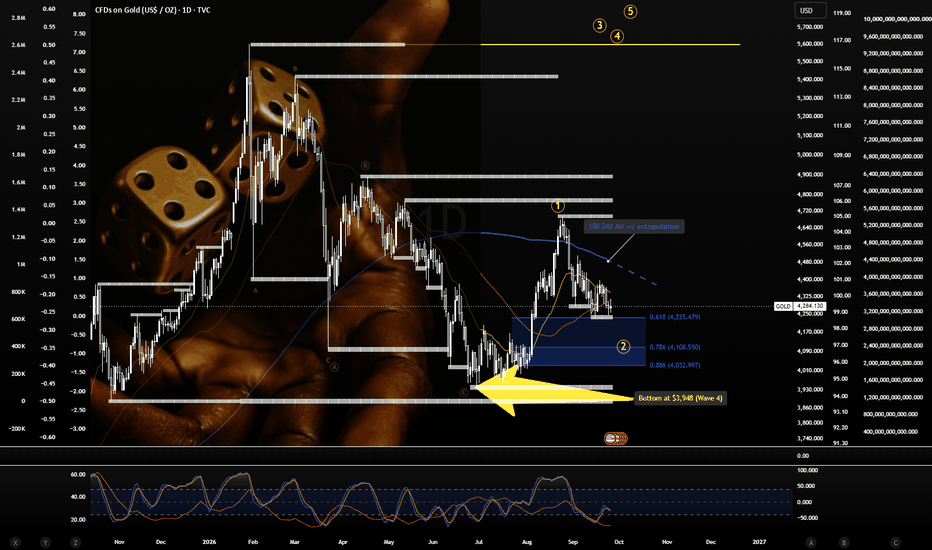
Gold has fallen 30% from its ATH. From the chart and the SMI, I believe there is still some downside left. My view on the Macro Elliott Wave trend is a 4th wave in a larger Wave 3.
The BUY ZONE is between $3800 and $3300 with an upside price of $7000. This is a 110% price increase and with a 2X leveraged gold ETF, a potential 3X return.
Timeframe: from buy zone to target price of $7000: 1-2 years.
*Not Financial Advice*
The BUY ZONE is between $3800 and $3300 with an upside price of $7000. This is a 110% price increase and with a 2X leveraged gold ETF, a potential 3X return.
Timeframe: from buy zone to target price of $7000: 1-2 years.
*Not Financial Advice*
トレード稼働中
Connecting the Dots To The Next Financial SystemToday, a hamburger in the US is $2.19 - $3.00. In 1948, that same hamburger was 15 cents. The US debt was the equivalent to $5 trillion in todays valuation.
They never paid a single cent back.
At a $40 trillion debt today, they will not be able to pay it back… and neither are they going to even try. But it will still disappear. HOW? Keep reading.
For decades, the global financial system has operated on one simple premise: debt creates growth. Governments issue debt. Central banks keep borrowing costs low. Banks create credit. Investors search for higher returns. Liquidity flows around the world.
The United States sits at the center because the dollar is the world's reserve currency.
Japan plays a different but equally important role.
For more than 30 years, Japan has kept interest rates close to zero, effectively becoming the world's piggy bank. Hedge funds, pension funds, and institutions borrowed trillions of yen at almost no cost and invested that money into higher-yielding assets like U.S. stocks, Treasuries, and private equity. This became known as the yen carry trade.
Japan's debt has reached levels where defending the currency, supporting economic growth, and financing government spending can no longer all be achieved simultaneously. As the Bank of Japan slowly raises interest rates, the cost of borrowing yen increases. Investors unwind carry trades, sell overseas assets, buy back yen, and global liquidity contracts. The August 2024 Nasdaq selloff was a reminder that a policy decision in Tokyo can erase hundreds of billions of dollars in U.S. market value within days.
At the same time, the United States faces its own challenge.
Federal debt has reached levels not seen since World War II. Historically, countries have dealt with excessive debt through some combination of economic growth, inflation, and keeping interest rates below inflation. In other words, they reduce the real value of debt rather than paying it off dollar for dollar.
This is one reason central banks have quietly become major buyers of gold.
Gold is not someone else's liability. It cannot be printed. As confidence in sovereign debt weakens, demand for a neutral reserve asset naturally increases. This is where forecasts of $30,000 gold originate—not because gold suddenly becomes more valuable on its own, but because currencies may become worth less relative to scarce assets under certain extreme monetary-reset scenarios.
While some capital seeks safety through gold, another transformation is happening on the opposite side of the financial system.
The United States is modernizing the infrastructure itself.
Legislation such as the CLARITY Act, the rise of regulated stablecoins, and the tokenization of stocks, bonds, and Treasuries are all pieces of the same evolution. The objective isn't simply to put assets on a blockchain, like ETHEREUM. It's to create a faster, programmable, globally accessible financial system where U.S. assets remain the preferred destination for global capital.
Instead of waiting days for settlement, transactions can occur almost instantly.
Instead of markets operating only during business hours, tokenized assets can trade continuously.
Instead of capital flowing through layers of intermediaries, it can move directly on digital rails.
In that sense, gold and tokenization are not opposites.
They solve different problems.
Gold addresses the trust problem.
Tokenization addresses the efficiency problem.
Japan represents the strain on the old monetary system.
Tokenization represents the architecture of the next one.
The connective tissue is debt.
Excessive debt forces governments to manage currencies, inflation, and interest rates differently than they otherwise would. Those pressures influence capital flows, drive demand for hard assets such as gold, expose weaknesses in legacy financial plumbing, and accelerate investment in new infrastructure.
Whether this transition unfolds gradually or through periods of market stress remains uncertain.
But if you zoom out, Japan, gold, tokenization, digital asset legislation, and the evolution of capital markets don't appear as isolated headlines.
They begin to look like chapters of the same story:
The financial system isn't collapsing. It's being rebuilt under the pressure of debt, technology, and changing global capital flows.
This is not financial advice. Do your own homework.
トレード終了: 利益確定目標に到達
Gold has bottomed at $3,949.See new gold analysis below.

免責事項
これらの情報および投稿は、TradingViewが提供または承認する金融、投資、取引、またはその他の種類の助言もしくは推奨であることを意図したものではなく、またこれらに該当するものでもありません。詳細は利用規約をご覧ください。
免責事項
これらの情報および投稿は、TradingViewが提供または承認する金融、投資、取引、またはその他の種類の助言もしくは推奨であることを意図したものではなく、またこれらに該当するものでもありません。詳細は利用規約をご覧ください。