
The 1% Risk Rule
The Rule That Keeps Beginners Safe in the Market
Most new traders focus only on one thing:
“How much profit can I make?”
But experienced traders ask a better question:
“How much can I lose if this trade goes wrong?”
That mindset is where real trading discipline begins.
___________________________________
✅What is the 1% Risk Rule?
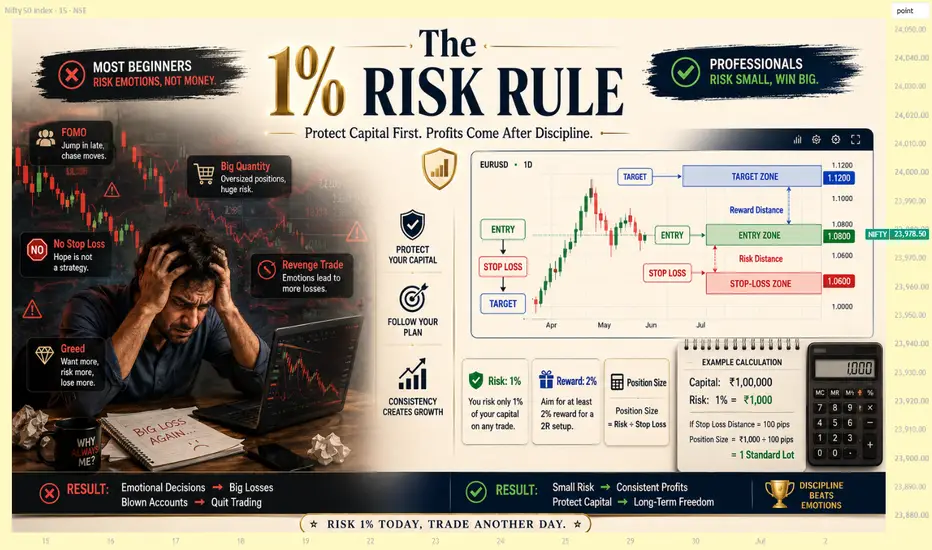
The 1% Risk Rule means you should never risk more than 1% of your total trading capital on a single trade.
It does not mean you invest only 1% of your capital.
It means your maximum loss on one trade should be limited to 1%.
📊Example:
If your capital is ₹1,00,000, then 1% risk is ₹1,000.
So, if your stop-loss hits, your loss should not be more than ₹1,000.
___________________________________
✅Why This Rule Matters
Trading is not about winning every trade.
Even good traders face losing streaks.
The difference is this:
A beginner loses big when wrong.
A professional loses small when wrong.
If you risk too much on one trade, one bad setup can damage your confidence and capital.
But if you risk only 1%, even 5 losses in a row will not destroy your account.
You still stay in the game.
And in trading, survival comes before profits.
___________________________________
✅The Simple Formula
Before entering any trade, calculate your quantity like this:
Position Size = Risk Amount ÷ Stop-Loss Difference
📊Example:
Capital = ₹1,00,000
Risk = 1% = ₹1,000
Entry = ₹500
Stop-loss = ₹480
Risk per share = ₹20
Position size:
₹1,000 ÷ ₹20 = 50 shares
So your correct quantity is 50 shares.
Not 100.
Not 200.
Not based on confidence.
Only based on risk.
___________________________________
✅Most Beginners Do This Wrong
Many traders decide quantity first and stop-loss later.
That is dangerous.
They think:
“I will buy 500 quantity, then manage somehow.”
But professional traders think:
“My stop-loss is here. How much quantity can I safely take?”
That is the correct approach.
Your quantity should come from your risk calculation, not from greed or excitement.
___________________________________
✅Risk Small, Think Big
Many beginners feel:
“If I risk only 1%, my profit will be small.”
But that is not true.
You may risk 1% to make 2%, 3%, or more.
📊Example:
Risk = 1%
Target = 2%
This means your risk-to-reward is 1:2.
Even if you win only 5 out of 10 trades, you can still be profitable if your winners are bigger than your losers.
That is why trading is not about being right every time.
It is about managing risk properly when you are wrong.
___________________________________
✅The 1% Rule in Options Trading
Options move fast.
This is why the 1% rule becomes even more important.
Many beginners buy options because the premium looks cheap.
But cheap premium does not mean low risk.
📊Example:
Capital = ₹1,00,000
Risk allowed = ₹1,000
Option entry = ₹100
Stop-loss = ₹80
Risk per quantity = ₹20
Allowed quantity:
₹1,000 ÷ ₹20 = 50 quantity
So before buying options, always ask:
“If my stop-loss hits, how much will I lose?”
___________________________________
✅Stop-Loss Should Be Logical
Do not place stop-loss randomly.
Your stop-loss should be based on chart structure.
Good stop-loss areas:
A stop-loss should be placed where your trade idea becomes invalid.
Not where your emotions feel comfortable.
___________________________________
✅Beginner Rule to Follow
For beginners, even 1% risk can feel heavy.
So you can start with:
0.25% to 0.50% risk per trade
Your first goal is not to make big money.
Your first goal is to build discipline.
Once you become consistent, you can slowly increase risk.
___________________________________
✅What we Learned Here
The 1% Risk Rule protects you from emotional trading.
It helps you avoid revenge trades.
It keeps your losses small.
It gives you more chances to learn.
And most importantly, it protects your capital.
___________________________________
Remember:
A trader with capital can always come back.
A trader without capital only watches the market.
Before every trade, ask yourself:
⚠️What is my entry?
⚠️Where is my stop-loss?
⚠️How much am I risking?
⚠️Is this trade worth the risk?
If you cannot answer these questions, you are not ready to enter.
A professional trader does not enter a trade because it looks exciting.
A professional trader enters only when the risk is clear, controlled, and acceptable.
Protect your capital first. Profits come after discipline.
Disclaimer: This post is for educational purposes only.
The Rule That Keeps Beginners Safe in the Market
Most new traders focus only on one thing:
“How much profit can I make?”
But experienced traders ask a better question:
“How much can I lose if this trade goes wrong?”
That mindset is where real trading discipline begins.
___________________________________
✅What is the 1% Risk Rule?
The 1% Risk Rule means you should never risk more than 1% of your total trading capital on a single trade.
It does not mean you invest only 1% of your capital.
It means your maximum loss on one trade should be limited to 1%.
📊Example:
If your capital is ₹1,00,000, then 1% risk is ₹1,000.
So, if your stop-loss hits, your loss should not be more than ₹1,000.
___________________________________
✅Why This Rule Matters
Trading is not about winning every trade.
Even good traders face losing streaks.
The difference is this:
A beginner loses big when wrong.
A professional loses small when wrong.
If you risk too much on one trade, one bad setup can damage your confidence and capital.
But if you risk only 1%, even 5 losses in a row will not destroy your account.
You still stay in the game.
And in trading, survival comes before profits.
___________________________________
✅The Simple Formula
Before entering any trade, calculate your quantity like this:
Position Size = Risk Amount ÷ Stop-Loss Difference
📊Example:
Capital = ₹1,00,000
Risk = 1% = ₹1,000
Entry = ₹500
Stop-loss = ₹480
Risk per share = ₹20
Position size:
₹1,000 ÷ ₹20 = 50 shares
So your correct quantity is 50 shares.
Not 100.
Not 200.
Not based on confidence.
Only based on risk.
___________________________________
✅Most Beginners Do This Wrong
Many traders decide quantity first and stop-loss later.
That is dangerous.
They think:
“I will buy 500 quantity, then manage somehow.”
But professional traders think:
“My stop-loss is here. How much quantity can I safely take?”
That is the correct approach.
Your quantity should come from your risk calculation, not from greed or excitement.
___________________________________
✅Risk Small, Think Big
Many beginners feel:
“If I risk only 1%, my profit will be small.”
But that is not true.
You may risk 1% to make 2%, 3%, or more.
📊Example:
Risk = 1%
Target = 2%
This means your risk-to-reward is 1:2.
Even if you win only 5 out of 10 trades, you can still be profitable if your winners are bigger than your losers.
That is why trading is not about being right every time.
It is about managing risk properly when you are wrong.
___________________________________
✅The 1% Rule in Options Trading
Options move fast.
This is why the 1% rule becomes even more important.
Many beginners buy options because the premium looks cheap.
But cheap premium does not mean low risk.
📊Example:
Capital = ₹1,00,000
Risk allowed = ₹1,000
Option entry = ₹100
Stop-loss = ₹80
Risk per quantity = ₹20
Allowed quantity:
₹1,000 ÷ ₹20 = 50 quantity
So before buying options, always ask:
“If my stop-loss hits, how much will I lose?”
___________________________________
✅Stop-Loss Should Be Logical
Do not place stop-loss randomly.
Your stop-loss should be based on chart structure.
Good stop-loss areas:
- Below support
- Below swing low
- Below demand zone
- Below breakout candle low
- Above resistance for short trades
- Above swing high for short trades
A stop-loss should be placed where your trade idea becomes invalid.
Not where your emotions feel comfortable.
___________________________________
✅Beginner Rule to Follow
For beginners, even 1% risk can feel heavy.
So you can start with:
0.25% to 0.50% risk per trade
Your first goal is not to make big money.
Your first goal is to build discipline.
Once you become consistent, you can slowly increase risk.
___________________________________
✅What we Learned Here
The 1% Risk Rule protects you from emotional trading.
It helps you avoid revenge trades.
It keeps your losses small.
It gives you more chances to learn.
And most importantly, it protects your capital.
___________________________________
Remember:
A trader with capital can always come back.
A trader without capital only watches the market.
Before every trade, ask yourself:
⚠️What is my entry?
⚠️Where is my stop-loss?
⚠️How much am I risking?
⚠️Is this trade worth the risk?
If you cannot answer these questions, you are not ready to enter.
A professional trader does not enter a trade because it looks exciting.
A professional trader enters only when the risk is clear, controlled, and acceptable.
Protect your capital first. Profits come after discipline.
Disclaimer: This post is for educational purposes only.

⭐For Live Trading Courses And Trading Community 📈
Contact ⬇️
📱wa.me/919322295961
📱t.me/+UgF9lES_XxA0MTk9
⭐Advanced courses
⭐Fully Automated Algo Trading
⭐Daily F&O Trade tips
📱 t.me/+UgF9lES_XxA0MTk9
Contact ⬇️
📱wa.me/919322295961
📱t.me/+UgF9lES_XxA0MTk9
⭐Advanced courses
⭐Fully Automated Algo Trading
⭐Daily F&O Trade tips
📱 t.me/+UgF9lES_XxA0MTk9
関連の投稿
免責事項
これらの情報および投稿は、TradingViewが提供または承認する金融、投資、取引、またはその他の種類の助言もしくは推奨であることを意図したものではなく、またこれらに該当するものでもありません。詳細は利用規約をご覧ください。
⭐For Live Trading Courses And Trading Community 📈
Contact ⬇️
📱wa.me/919322295961
📱t.me/+UgF9lES_XxA0MTk9
⭐Advanced courses
⭐Fully Automated Algo Trading
⭐Daily F&O Trade tips
📱 t.me/+UgF9lES_XxA0MTk9
Contact ⬇️
📱wa.me/919322295961
📱t.me/+UgF9lES_XxA0MTk9
⭐Advanced courses
⭐Fully Automated Algo Trading
⭐Daily F&O Trade tips
📱 t.me/+UgF9lES_XxA0MTk9
関連の投稿
免責事項
これらの情報および投稿は、TradingViewが提供または承認する金融、投資、取引、またはその他の種類の助言もしくは推奨であることを意図したものではなく、またこれらに該当するものでもありません。詳細は利用規約をご覧ください。