
Oracle Corporation (NYSE: ORCL) suffered a sharp selloff after its latest quarterly earnings report, with shares plunging more than 16% as the market reacted negatively to a revenue miss. The decline erased months of gains and dragged the stock back below levels last seen before its major September rally. Despite the market panic, the underlying fundamentals reveal a more nuanced story.
Oracle’s reported revenue once again fell short of analyst expectations—continuing a trend seen in previous quarters. In Q1, the company also missed both earnings per share and revenue estimates, though optimism around its cloud growth overshadowed the weakness at the time. This quarter, without a headline-grabbing cloud announcement, investors reacted more aggressively to the top-line disappointment.
However, Oracle’s Remaining Performance Obligation (RPO)—a key forward-looking metric reflecting future contracted revenue—beat expectations significantly. The company reported $523 billion in RPO, surpassing the Street’s projection of $500 billion. Analysts, including Wedbush’s Dan Ives, argue that the selloff is overstated and does not reflect the long-term growth trajectory of Oracle’s AI-driven cloud strategy. Oracle remains deeply integrated in AI infrastructure through its massive multi-year deals, including the $300 billion computing partnership with OpenAI.
Technical Analysis
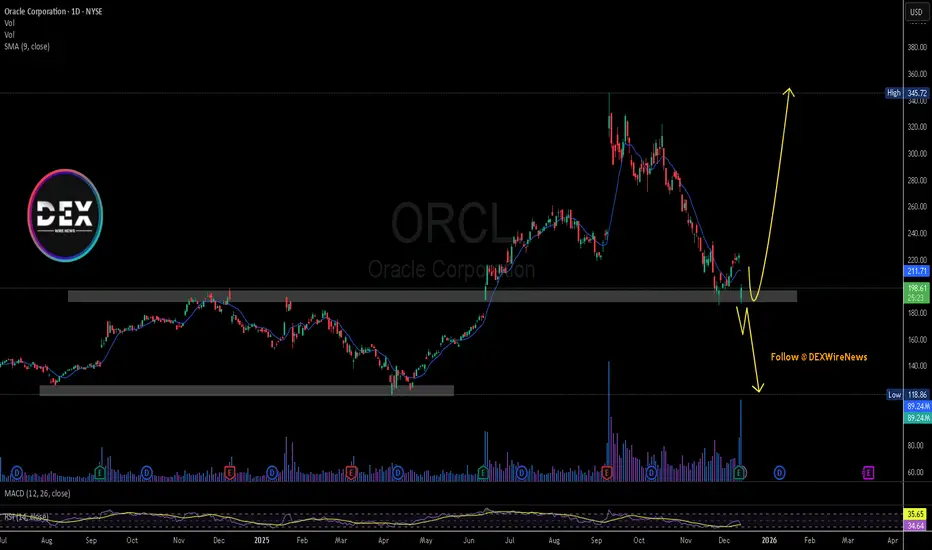
The ORCL chart shows a decisive breakdown from a critical support zone around $210–$215. This level, previously a strong demand area, failed to hold as heavy selling pressure drove the stock into a deeper correction. The breakdown was accompanied by elevated volume, confirming strong bearish participation.
Price is now sitting within a broader weekly support range near $190–$200. A bounce from this zone could trigger a recovery push toward $300 and eventually $345 if sentiment shifts. However, failure to reclaim the demand region leaves the path open for a deeper slide toward $121, where the next major structural support lies.
Oracle’s reported revenue once again fell short of analyst expectations—continuing a trend seen in previous quarters. In Q1, the company also missed both earnings per share and revenue estimates, though optimism around its cloud growth overshadowed the weakness at the time. This quarter, without a headline-grabbing cloud announcement, investors reacted more aggressively to the top-line disappointment.
However, Oracle’s Remaining Performance Obligation (RPO)—a key forward-looking metric reflecting future contracted revenue—beat expectations significantly. The company reported $523 billion in RPO, surpassing the Street’s projection of $500 billion. Analysts, including Wedbush’s Dan Ives, argue that the selloff is overstated and does not reflect the long-term growth trajectory of Oracle’s AI-driven cloud strategy. Oracle remains deeply integrated in AI infrastructure through its massive multi-year deals, including the $300 billion computing partnership with OpenAI.
Technical Analysis
The ORCL chart shows a decisive breakdown from a critical support zone around $210–$215. This level, previously a strong demand area, failed to hold as heavy selling pressure drove the stock into a deeper correction. The breakdown was accompanied by elevated volume, confirming strong bearish participation.
Price is now sitting within a broader weekly support range near $190–$200. A bounce from this zone could trigger a recovery push toward $300 and eventually $345 if sentiment shifts. However, failure to reclaim the demand region leaves the path open for a deeper slide toward $121, where the next major structural support lies.

関連の投稿
免責事項
これらの情報および投稿は、TradingViewが提供または承認する金融、投資、取引、またはその他の種類の助言もしくは推奨であることを意図したものではなく、またこれらに該当するものでもありません。詳細は利用規約をご覧ください。
免責事項
これらの情報および投稿は、TradingViewが提供または承認する金融、投資、取引、またはその他の種類の助言もしくは推奨であることを意図したものではなく、またこれらに該当するものでもありません。詳細は利用規約をご覧ください。