
After the May 4 earnings report, Palantir delivered exceptionally strong results, with revenue reaching approximately $1.63 billion, representing 85% year-over-year growth. The most significant driver of performance was the U.S. business, which grew 104% overall, with U.S. commercial revenue accelerating sharply by 133% and government revenue increasing by 84%, highlighting strong momentum across both segments of the business. Profitability remained at very high levels for a rapidly growing software company, with an adjusted operating margin of around 60% and substantial net income supported by strong operating leverage. The company also reported continued expansion in deal activity and backlog, including growth in large contracts and remaining deal value, which contributed to an upward revision of full-year 2026 guidance to approximately $7.65 billion in expected revenue.
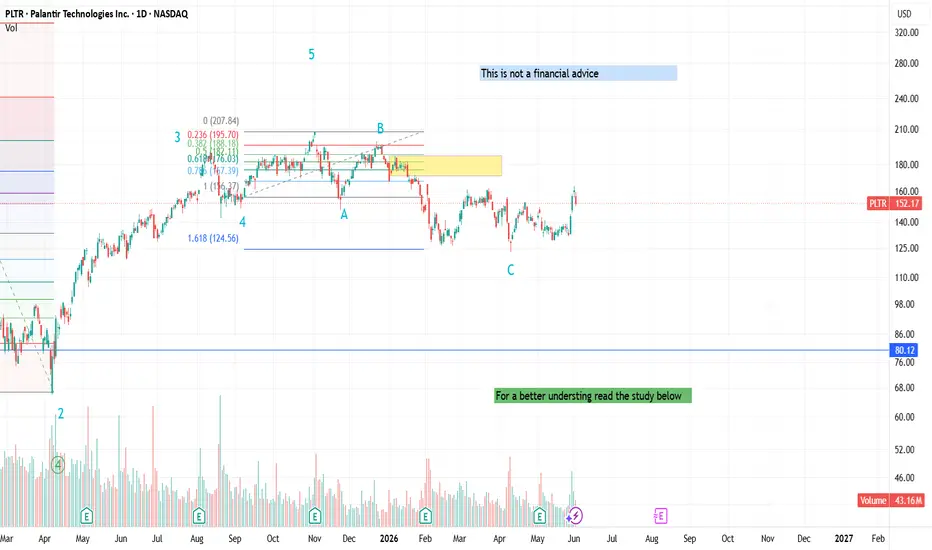
From a technical analysis perspective, the price structure appears to have completed a minor Elliott Wave cycle, although with the usual flexibility required when applying Elliott Wave Theory to single equities rather than indices, for which the framework was originally designed. Within this context, the recent consolidation and subsequent price action could be interpreted as the potential start of a new minor impulsive wave, suggesting that momentum may be entering a fresh phase following the completion of the prior structure.
Heading into the next quarterly release, these figures set an extremely high benchmark. The market is no longer pricing Palantir as a typical growth software company but as a key beneficiary of the artificial intelligence adoption cycle. As a result, even strong performance may be viewed as insufficient unless it is accompanied by further acceleration, particularly in U.S. commercial growth and additional upward revisions to guidance, which remain the primary focus for investors.
This is not a financial advice.
From a technical analysis perspective, the price structure appears to have completed a minor Elliott Wave cycle, although with the usual flexibility required when applying Elliott Wave Theory to single equities rather than indices, for which the framework was originally designed. Within this context, the recent consolidation and subsequent price action could be interpreted as the potential start of a new minor impulsive wave, suggesting that momentum may be entering a fresh phase following the completion of the prior structure.
Heading into the next quarterly release, these figures set an extremely high benchmark. The market is no longer pricing Palantir as a typical growth software company but as a key beneficiary of the artificial intelligence adoption cycle. As a result, even strong performance may be viewed as insufficient unless it is accompanied by further acceleration, particularly in U.S. commercial growth and additional upward revisions to guidance, which remain the primary focus for investors.
This is not a financial advice.
トレード稼働中

免責事項
これらの情報および投稿は、TradingViewが提供または承認する金融、投資、取引、またはその他の種類の助言もしくは推奨であることを意図したものではなく、またこれらに該当するものでもありません。詳細は利用規約をご覧ください。
免責事項
これらの情報および投稿は、TradingViewが提供または承認する金融、投資、取引、またはその他の種類の助言もしくは推奨であることを意図したものではなく、またこれらに該当するものでもありません。詳細は利用規約をご覧ください。