
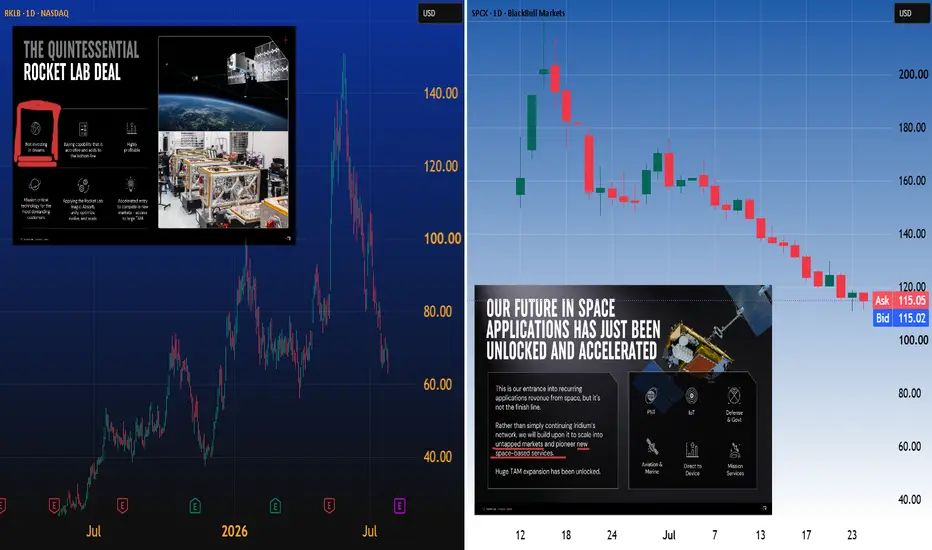
On page 10 of the presentation announcing Rocket Lab’s (NASDAQ: RKLB) acquisition of Iridium Communications (NASDAQ: IRDM), released June 29, 2026, there’s a line that reads like a dig at SpaceX (NASDAQ: SPCX):
“Not investing in dreams.”
I’ve taken this as Rocket Lab highlighting the practicality of the acquisition while also making fun of SpaceX’s mission to “extend the light of consciousness to the stars” and establish a colony on Mars. Has a company ever put out a more pretentious and unrealistic mission, and been rewarded by the market like SpaceX? (SpaceX has since tumbled to below its IPO price, so there is a tiny slither of justice in the world, I guess). Maybe it’s all just marketing, but to me the mission statement suggests an unseriousness with SpaceX. Sure, they can pull off some incredibly practical feats (and even this I’m proly underselling), but this unseriousness is just another red flag with the company (in addition to Musk’s voting rights, Musk’s nazi salutes, and SpaceX acquiring XAI and the social media platform X just weeks before the IPO).
If you cannot tell already, I believe Rocket Lab looks and feels like the better investment just for being more realistic (while still being highly ambitious). But I want to scrutinise this assertion by diving deeper into something found on the last page of that same Iridium presentation, which potentially suggests there are new practical sources of revenue:
“Rather than simply continuing Iridium’s network, we will build upon it to scale into untapped markets and pioneer new space-based services.”
That was as much detail as Rocket Lab provided in the presentation, so we reached out for something a little more specific.
First, I was interested in what they believe to be the “untapped markets,” how they discovered these markets, and why they were more suited to tap them than Iridium was before the acquisition. This was Rocket Lab’s practical-based response:
<<
Initially, we believe they have a few underappreciated growth drivers in the form of;
Next Generation PNT, both as reliable redundancy to GPS for marine and aviation, which is even more valuable in the context of GPS-denied conditions (think of Russian jamming GPS in Ukraine…), as L-Band based PNT is less vulnerable to jamming vs GPS.
Primary and back-up in-cockpit and maritime emergency comms.
Direct-to-Device (think IoT applications given the L-band vs mobile cellular broadband that Starlink and AST and others are going after). Iridium has discussed what they’ve been working on to upgrade the satellites on orbit to support the mobile 3GPP standard.
>>
Secondly, I was interested in the “new space-based services.” The hope was that Rocket Lab was not making fanciful claims about some (ultimately unattainable) sources of revenue, like we might expect from SpaceX. With a quick scan of the below you’ll see that Rocket Lab is scoping out plans for military and non-military services. Nothing too fanciful yet. This is what they had to say about this:
<<
Longer-term, one of the important capabilities this deal brings is our ability to pitch next gen secure gov comms services, not completely unlike what StarShield is offering around the world. It has been a relatively clear-cut pitch with regard to Rocket Lab being an established solutions provider that can make robust satellite hardware, and has the ability to provide prioritized launch for those satellites, but we don’t have the heritage in operating a global high-reliable comms constellation, so that is the missing or “trust us” part of the pitch. With Iridium, we’d be able to compete more convincingly against something like Starshield in bringing all the pieces with decades of heritage. That said, this deal brings some of the likely necessary spectrum, but not all, but definitely checks the box from the network operations credentials and infrastructure perspective, including established ground-stations around the world with regulated landing rights, etc.
Beyond that, we’re holding other longer-term new space-based services closer to our vest. It doesn’t require a lot of squinting to think of space based capabilities suited to support various modes of autonomy, earth observation, and location based services. More to come on this front. It isn’t that Rocket Lab is necessarily better at discovering these new applications, but rather we believe we’re better positioned to efficiently exploit opportunities given our vertically integrated end-to-end capabilities, and the efficiency will manifest itself in the lower cost and shorter timelines to deploy the space infrastructure to enable and deliver these new capabilities.
>>
From the Desk of M.O
Additional research and stock news at blackbullresearch.substack.com/
“Not investing in dreams.”
I’ve taken this as Rocket Lab highlighting the practicality of the acquisition while also making fun of SpaceX’s mission to “extend the light of consciousness to the stars” and establish a colony on Mars. Has a company ever put out a more pretentious and unrealistic mission, and been rewarded by the market like SpaceX? (SpaceX has since tumbled to below its IPO price, so there is a tiny slither of justice in the world, I guess). Maybe it’s all just marketing, but to me the mission statement suggests an unseriousness with SpaceX. Sure, they can pull off some incredibly practical feats (and even this I’m proly underselling), but this unseriousness is just another red flag with the company (in addition to Musk’s voting rights, Musk’s nazi salutes, and SpaceX acquiring XAI and the social media platform X just weeks before the IPO).
If you cannot tell already, I believe Rocket Lab looks and feels like the better investment just for being more realistic (while still being highly ambitious). But I want to scrutinise this assertion by diving deeper into something found on the last page of that same Iridium presentation, which potentially suggests there are new practical sources of revenue:
“Rather than simply continuing Iridium’s network, we will build upon it to scale into untapped markets and pioneer new space-based services.”
That was as much detail as Rocket Lab provided in the presentation, so we reached out for something a little more specific.
First, I was interested in what they believe to be the “untapped markets,” how they discovered these markets, and why they were more suited to tap them than Iridium was before the acquisition. This was Rocket Lab’s practical-based response:
<<
Initially, we believe they have a few underappreciated growth drivers in the form of;
Next Generation PNT, both as reliable redundancy to GPS for marine and aviation, which is even more valuable in the context of GPS-denied conditions (think of Russian jamming GPS in Ukraine…), as L-Band based PNT is less vulnerable to jamming vs GPS.
Primary and back-up in-cockpit and maritime emergency comms.
Direct-to-Device (think IoT applications given the L-band vs mobile cellular broadband that Starlink and AST and others are going after). Iridium has discussed what they’ve been working on to upgrade the satellites on orbit to support the mobile 3GPP standard.
>>
Secondly, I was interested in the “new space-based services.” The hope was that Rocket Lab was not making fanciful claims about some (ultimately unattainable) sources of revenue, like we might expect from SpaceX. With a quick scan of the below you’ll see that Rocket Lab is scoping out plans for military and non-military services. Nothing too fanciful yet. This is what they had to say about this:
<<
Longer-term, one of the important capabilities this deal brings is our ability to pitch next gen secure gov comms services, not completely unlike what StarShield is offering around the world. It has been a relatively clear-cut pitch with regard to Rocket Lab being an established solutions provider that can make robust satellite hardware, and has the ability to provide prioritized launch for those satellites, but we don’t have the heritage in operating a global high-reliable comms constellation, so that is the missing or “trust us” part of the pitch. With Iridium, we’d be able to compete more convincingly against something like Starshield in bringing all the pieces with decades of heritage. That said, this deal brings some of the likely necessary spectrum, but not all, but definitely checks the box from the network operations credentials and infrastructure perspective, including established ground-stations around the world with regulated landing rights, etc.
Beyond that, we’re holding other longer-term new space-based services closer to our vest. It doesn’t require a lot of squinting to think of space based capabilities suited to support various modes of autonomy, earth observation, and location based services. More to come on this front. It isn’t that Rocket Lab is necessarily better at discovering these new applications, but rather we believe we’re better positioned to efficiently exploit opportunities given our vertically integrated end-to-end capabilities, and the efficiency will manifest itself in the lower cost and shorter timelines to deploy the space infrastructure to enable and deliver these new capabilities.
>>
From the Desk of M.O
Additional research and stock news at blackbullresearch.substack.com/

Free TradingView Premium:
blackbull.com/en/platforms/tradingview/?utm_source=tradingview
Investing in complex securities involves risk. You may lose some or all of your invested capital.
blackbull.com/en/platforms/tradingview/?utm_source=tradingview
Investing in complex securities involves risk. You may lose some or all of your invested capital.
免責事項
これらの情報および投稿は、TradingViewが提供または承認する金融、投資、取引、またはその他の種類の助言もしくは推奨であることを意図したものではなく、またこれらに該当するものでもありません。詳細は利用規約をご覧ください。
Free TradingView Premium:
blackbull.com/en/platforms/tradingview/?utm_source=tradingview
Investing in complex securities involves risk. You may lose some or all of your invested capital.
blackbull.com/en/platforms/tradingview/?utm_source=tradingview
Investing in complex securities involves risk. You may lose some or all of your invested capital.
免責事項
これらの情報および投稿は、TradingViewが提供または承認する金融、投資、取引、またはその他の種類の助言もしくは推奨であることを意図したものではなく、またこれらに該当するものでもありません。詳細は利用規約をご覧ください。