
Good Afternoon,
Hope all is well. Here is my TA on RPD!
What I’m Seeing
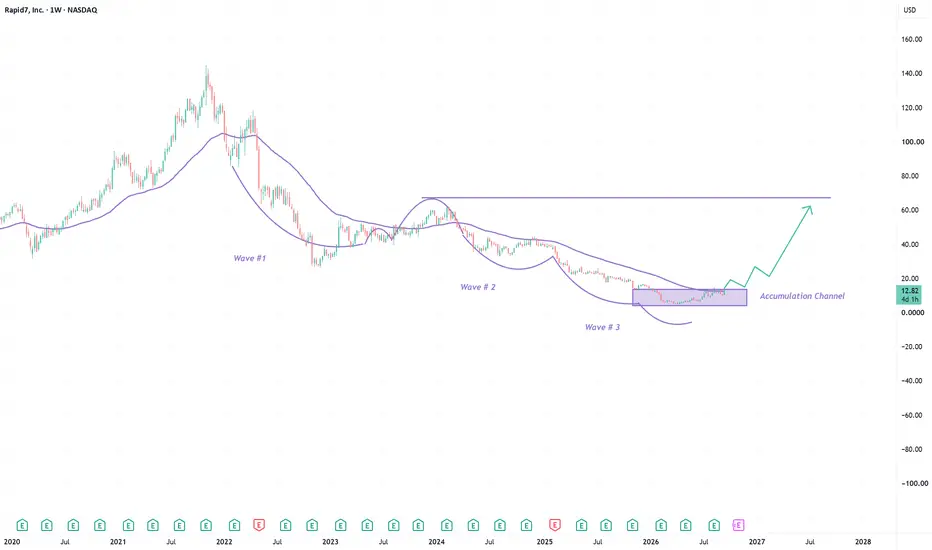
Looking at Rapid7 on the weekly chart, this is one of the cleaner potential bottoming structures you've posted recently.
The long-term trend is still bearish. RPD collapsed from roughly $140 at its 2021 peak to single digits in 2026, so I don't want to mistake one strong week for a completed reversal.
But the character of the decline has changed.
I've essentially got three major waves lower:
Wave #1 → stabilization → Wave #2 → stabilization → Wave #3 → accumulation
Each successive wave has brought price lower, but the third decline appears to have lost much of the momentum seen earlier in the bear market.
Now price has spent months building a base around approximately $5–$13, and this week's move to roughly $12.80 (+24%) is beginning to test the upper boundary.
To me, this could be the transition from:
markdown → capitulation → accumulation → early expansion.
The accumulation thesis is interesting. The reversal itself still needs confirmation.
The Three-Wave Structure
The larger structure is what catches my attention first.
Wave #1 took RPD from the $100+ area toward roughly $30.
Wave #2 eventually pushed the stock from around $60 into the $20s.
Wave #3 then took price into the single digits.
What matters to me isn't whether these are textbook Elliott waves. I'm using them primarily to visualize the progressive exhaustion of the downtrend.
The first decline was violent.
The second produced another major markdown.
The third pushed price to its lowest level, but eventually produced a much tighter and more controlled structure near the lows.
That's usually where I start looking for evidence that sellers are losing control.
The Accumulation Channel
The most important area on this chart is the rectangle you've marked from roughly $5–$13.
Rapid7 spent much of 2026 inside this range.
Instead of continuing immediately toward zero, price began moving sideways.
That's important because after a multi-year downtrend, time itself can become part of the bottoming process.
Weak holders exit.
Selling pressure gets absorbed.
Volatility compresses.
Eventually, price reaches a point where additional bad news struggles to create substantially lower prices.
That's the behavior I'm interested in here.
I wouldn't automatically call this institutional accumulation just from the chart, but it is a credible accumulation candidate.
This Week's +24% Move Matters
The current weekly candle is significant.
RPD opened around $10.62 and has traded as high as approximately $12.85, putting price directly against the top of the accumulation range.
This is exactly where I want to see buyers become aggressive.
But I'm not interested in simply chasing a 24% weekly candle.
The important question is:
Can Rapid7 leave the range and stay out of it?
That's the difference between a temporary squeeze and an actual change in market structure.
The First Breakout Area: $13–$15
Approximately $13–$15 is my first important confirmation zone.
RPD has spent months trading underneath this area, and the declining weekly trend/average is also converging nearby.
That creates confluence.
If price can break through this region with expanding participation, I'd consider that the first legitimate evidence that the accumulation phase is ending.
But the pullback afterward would be even more important.
My ideal sequence is:
$5–$13 accumulation → $13–$15 breakout → pullback → former resistance holds → higher low → expansion.
That's what would make me considerably more bullish.
The Weekly Trend Needs to Flip
The declining weekly trend line/average has controlled RPD throughout essentially this entire bear market.
Price has repeatedly rallied into it and failed.
So I don't want to ignore it simply because the stock has had one strong week.
A sustained move above that declining trend would tell me something fundamental about market structure has changed:
sellers are no longer able to defend the trend.
If RPD breaks above it and then successfully uses it as support, I'd start treating the move as an emerging new trend rather than just another bear-market rally.
What I Would Watch Above the Breakout
If $13–$15 breaks, I wouldn't immediately jump to the $60 target you've drawn.
There's a lot of trapped supply between here and there.
I'd think about it in stages.
My rough technical roadmap would be:
$13–$15 → $18–$20 → $25–$30 → $38–$42 → eventually $55–$65.
That final $60–$65 region is particularly important because it represents the major 2023–24 recovery high and a substantial previous supply area.
So I agree with the direction of your projected path, but I'd treat ~$60 as a long-term recovery objective conditional on an actual trend reversal, rather than an immediate price target.
Why $25–$30 Is Especially Important
If RPD eventually reaches the mid/high-$20s, I think that becomes a major test.
That's approximately where the previous breakdown accelerated and where the stock could encounter a large amount of overhead supply.
Getting there would already represent roughly a doubling from today's price.
If price reaches that region and then creates a higher low instead of collapsing back toward the accumulation range, I'd have much stronger evidence that this is a genuine new cycle.
Fundamentals — The Stock Is Bottoming Before the Business Has Returned to Growth
This is where Rapid7 becomes particularly interesting.
The fundamentals are not strong yet.
Q2 2026 revenue was approximately $210.9 million, down 1.5% year over year, while ARR declined 2% to $824 million. Management expects Q3 ARR of roughly $812 million, another 3% year-over-year decline, and full-year revenue of $837–$841 million, down approximately 2–3%.
So I can't build the bullish argument around current revenue growth.
There isn't any.
The market is potentially beginning to price something else:
stabilization and a future turnaround.
The Fundamental Deterioration Has Been Slowing
There's an interesting progression in the numbers.
Rapid7 ended 2025 with $840 million of ARR. That declined to $832 million in Q1 and then $824 million in Q2.
That's still contraction, so I'm not trying to make it sound bullish.
But this gives me a very clear fundamental indicator to watch alongside your technical accumulation channel.
If ARR starts stabilizing around these levels and eventually turns positive while the stock breaks out, the technical and fundamental theses would begin confirming each other.
That's what I'd want to see.
Profitability and Cash Flow Change the Risk Profile
This is probably the strongest part of the fundamental argument.
Rapid7 isn't an unprofitable cybersecurity company burning through its remaining cash while revenue collapses.
In Q2, it produced $3 million of GAAP operating income, $28.9 million of non-GAAP operating income and approximately $31.9 million of free cash flow.
The company also had approximately $702.6 million in cash, cash equivalents and government securities at quarter-end.
Management expects around $130 million of free cash flow for full-year 2026.
That matters enormously to me.
A company going through a revenue reset has much more time to repair itself when it's generating cash rather than consuming it.
Management Is Restructuring the Business
There's also been a major change in leadership and strategy.
Wael Mohamed became CEO in June, while longtime CEO Corey Thomas moved into the Executive Chairman role. Mohamed previously held senior leadership positions at Forescout and Trend Micro and was brought in with an explicit focus on operational execution.
Then in Q2, Rapid7 announced a restructuring affecting approximately 12% of its workforce.
Management is concentrating investment around two primary areas:
Detection & Response + Exposure Management, connected through its AI platform.
Fundamentally, that's important.
Rapid7 is essentially acknowledging that trying to do everything wasn't producing adequate growth.
The new strategy is about focus.
Now I need to see whether that focus actually improves execution.
AI Could Be a Catalyst — But I Want Revenue Proof
Rapid7 has also been aggressively repositioning itself around AI-powered security operations.
The company acquired Kenzo Security in March, bringing agentic AI technology into its security platform. Kenzo's technology is designed to automate security investigations and increase the percentage of alerts security teams can actually investigate.
Rapid7 has also expanded its Command Platform and launched Cyber GRC, connecting governance, risk and compliance workflows with live security-operations data.
The opportunity is real.
Cyber threats aren't disappearing. Rapid7's own recent research found a sharp increase in newly exploited vulnerabilities and much faster weaponization of vulnerabilities.
But I don't want to buy the stock simply because management says "AI."
I want to see:
product improvement → customer wins → ARR stabilization → ARR growth → operating leverage.
That's the fundamental sequence that would validate the story.
Customer Retention Is Important
Rapid7 still serves more than 11,500 customers, with approximately $70,000 of ARR per customer.
That existing customer base gives management something valuable to work with.
They don't need to rebuild the company from zero.
If the new leadership team can increase adoption across Detection & Response, Exposure Management, GRC and AI-driven security operations within that installed base, the revenue trajectory could improve without requiring an entirely new customer ecosystem.
That's why I see this more as a turnaround than a distressed-company survival trade.
Why This Setup Interests Me
The technical and fundamental pictures are beginning to line up in an interesting way.
Fundamentally:
Revenue contracting → ARR declining → restructuring → new CEO → strategic focus → strong cash position → positive free cash flow.
Technically:
Wave #1 down → Wave #2 down → Wave #3 down → selling exhaustion → prolonged base → breakout attempt.
That combination is exactly what I look for in a turnaround setup.
The business doesn't have to be perfect at the bottom.
In fact, it usually isn't.
The question is whether the rate of deterioration is beginning to improve before the market recognizes it.
My Bullish Scenario
My preferred sequence from here would be:
$5–$13 accumulation → $13–$15 breakout → controlled retest → higher low → $18–$20 → $25–$30.
If RPD can establish itself above $25–$30, then I think the larger recovery thesis becomes substantially more credible.
From there, $38–$42 would be another important supply zone.
Only after clearing those areas would I start taking the chart's larger $55–$65 objective seriously.
The important thing is that each rally creates a higher floor.
My Bearish Scenario
My invalidation is straightforward.
If this breakout attempt fails and RPD falls back into the accumulation range, I become more cautious.
If it subsequently loses roughly $7–$8, I'd assume the base needs more time.
A decisive breakdown beneath approximately $5–$6, especially with expanding volume and worsening fundamentals, would largely invalidate my current accumulation thesis.
That would tell me the market hasn't finished repricing the company.
My Bias
I'm cautiously bullish on Rapid7 here, but I view it as an early-stage turnaround setup rather than a confirmed long-term uptrend.
What I like is the combination of:
A three-wave multi-year decline
A prolonged base at depressed prices
Price beginning to challenge the top of that base
A declining weekly trend that's now within reach
Positive free cash flow despite declining revenue
More than $700 million of cash and government securities
New leadership and a more focused operating strategy
A large existing cybersecurity customer base
What I don't have yet is the most important confirmation: growth.
So for me, $5–$10 represents the established base, $13–$15 is the breakout test, $18–$20 is the first meaningful expansion zone, and $25–$30 is where I'd start believing the larger reversal has real strength.
If the chart breaks out while ARR simultaneously begins stabilizing, that's where this setup becomes much more compelling.
Until then, I'm treating the current +24% weekly move as the beginning of a possible change in character—not proof that the entire bear market is over.
Trade Safely
Enjoy
Hope all is well. Here is my TA on RPD!
What I’m Seeing
Looking at Rapid7 on the weekly chart, this is one of the cleaner potential bottoming structures you've posted recently.
The long-term trend is still bearish. RPD collapsed from roughly $140 at its 2021 peak to single digits in 2026, so I don't want to mistake one strong week for a completed reversal.
But the character of the decline has changed.
I've essentially got three major waves lower:
Wave #1 → stabilization → Wave #2 → stabilization → Wave #3 → accumulation
Each successive wave has brought price lower, but the third decline appears to have lost much of the momentum seen earlier in the bear market.
Now price has spent months building a base around approximately $5–$13, and this week's move to roughly $12.80 (+24%) is beginning to test the upper boundary.
To me, this could be the transition from:
markdown → capitulation → accumulation → early expansion.
The accumulation thesis is interesting. The reversal itself still needs confirmation.
The Three-Wave Structure
The larger structure is what catches my attention first.
Wave #1 took RPD from the $100+ area toward roughly $30.
Wave #2 eventually pushed the stock from around $60 into the $20s.
Wave #3 then took price into the single digits.
What matters to me isn't whether these are textbook Elliott waves. I'm using them primarily to visualize the progressive exhaustion of the downtrend.
The first decline was violent.
The second produced another major markdown.
The third pushed price to its lowest level, but eventually produced a much tighter and more controlled structure near the lows.
That's usually where I start looking for evidence that sellers are losing control.
The Accumulation Channel
The most important area on this chart is the rectangle you've marked from roughly $5–$13.
Rapid7 spent much of 2026 inside this range.
Instead of continuing immediately toward zero, price began moving sideways.
That's important because after a multi-year downtrend, time itself can become part of the bottoming process.
Weak holders exit.
Selling pressure gets absorbed.
Volatility compresses.
Eventually, price reaches a point where additional bad news struggles to create substantially lower prices.
That's the behavior I'm interested in here.
I wouldn't automatically call this institutional accumulation just from the chart, but it is a credible accumulation candidate.
This Week's +24% Move Matters
The current weekly candle is significant.
RPD opened around $10.62 and has traded as high as approximately $12.85, putting price directly against the top of the accumulation range.
This is exactly where I want to see buyers become aggressive.
But I'm not interested in simply chasing a 24% weekly candle.
The important question is:
Can Rapid7 leave the range and stay out of it?
That's the difference between a temporary squeeze and an actual change in market structure.
The First Breakout Area: $13–$15
Approximately $13–$15 is my first important confirmation zone.
RPD has spent months trading underneath this area, and the declining weekly trend/average is also converging nearby.
That creates confluence.
If price can break through this region with expanding participation, I'd consider that the first legitimate evidence that the accumulation phase is ending.
But the pullback afterward would be even more important.
My ideal sequence is:
$5–$13 accumulation → $13–$15 breakout → pullback → former resistance holds → higher low → expansion.
That's what would make me considerably more bullish.
The Weekly Trend Needs to Flip
The declining weekly trend line/average has controlled RPD throughout essentially this entire bear market.
Price has repeatedly rallied into it and failed.
So I don't want to ignore it simply because the stock has had one strong week.
A sustained move above that declining trend would tell me something fundamental about market structure has changed:
sellers are no longer able to defend the trend.
If RPD breaks above it and then successfully uses it as support, I'd start treating the move as an emerging new trend rather than just another bear-market rally.
What I Would Watch Above the Breakout
If $13–$15 breaks, I wouldn't immediately jump to the $60 target you've drawn.
There's a lot of trapped supply between here and there.
I'd think about it in stages.
My rough technical roadmap would be:
$13–$15 → $18–$20 → $25–$30 → $38–$42 → eventually $55–$65.
That final $60–$65 region is particularly important because it represents the major 2023–24 recovery high and a substantial previous supply area.
So I agree with the direction of your projected path, but I'd treat ~$60 as a long-term recovery objective conditional on an actual trend reversal, rather than an immediate price target.
Why $25–$30 Is Especially Important
If RPD eventually reaches the mid/high-$20s, I think that becomes a major test.
That's approximately where the previous breakdown accelerated and where the stock could encounter a large amount of overhead supply.
Getting there would already represent roughly a doubling from today's price.
If price reaches that region and then creates a higher low instead of collapsing back toward the accumulation range, I'd have much stronger evidence that this is a genuine new cycle.
Fundamentals — The Stock Is Bottoming Before the Business Has Returned to Growth
This is where Rapid7 becomes particularly interesting.
The fundamentals are not strong yet.
Q2 2026 revenue was approximately $210.9 million, down 1.5% year over year, while ARR declined 2% to $824 million. Management expects Q3 ARR of roughly $812 million, another 3% year-over-year decline, and full-year revenue of $837–$841 million, down approximately 2–3%.
So I can't build the bullish argument around current revenue growth.
There isn't any.
The market is potentially beginning to price something else:
stabilization and a future turnaround.
The Fundamental Deterioration Has Been Slowing
There's an interesting progression in the numbers.
Rapid7 ended 2025 with $840 million of ARR. That declined to $832 million in Q1 and then $824 million in Q2.
That's still contraction, so I'm not trying to make it sound bullish.
But this gives me a very clear fundamental indicator to watch alongside your technical accumulation channel.
If ARR starts stabilizing around these levels and eventually turns positive while the stock breaks out, the technical and fundamental theses would begin confirming each other.
That's what I'd want to see.
Profitability and Cash Flow Change the Risk Profile
This is probably the strongest part of the fundamental argument.
Rapid7 isn't an unprofitable cybersecurity company burning through its remaining cash while revenue collapses.
In Q2, it produced $3 million of GAAP operating income, $28.9 million of non-GAAP operating income and approximately $31.9 million of free cash flow.
The company also had approximately $702.6 million in cash, cash equivalents and government securities at quarter-end.
Management expects around $130 million of free cash flow for full-year 2026.
That matters enormously to me.
A company going through a revenue reset has much more time to repair itself when it's generating cash rather than consuming it.
Management Is Restructuring the Business
There's also been a major change in leadership and strategy.
Wael Mohamed became CEO in June, while longtime CEO Corey Thomas moved into the Executive Chairman role. Mohamed previously held senior leadership positions at Forescout and Trend Micro and was brought in with an explicit focus on operational execution.
Then in Q2, Rapid7 announced a restructuring affecting approximately 12% of its workforce.
Management is concentrating investment around two primary areas:
Detection & Response + Exposure Management, connected through its AI platform.
Fundamentally, that's important.
Rapid7 is essentially acknowledging that trying to do everything wasn't producing adequate growth.
The new strategy is about focus.
Now I need to see whether that focus actually improves execution.
AI Could Be a Catalyst — But I Want Revenue Proof
Rapid7 has also been aggressively repositioning itself around AI-powered security operations.
The company acquired Kenzo Security in March, bringing agentic AI technology into its security platform. Kenzo's technology is designed to automate security investigations and increase the percentage of alerts security teams can actually investigate.
Rapid7 has also expanded its Command Platform and launched Cyber GRC, connecting governance, risk and compliance workflows with live security-operations data.
The opportunity is real.
Cyber threats aren't disappearing. Rapid7's own recent research found a sharp increase in newly exploited vulnerabilities and much faster weaponization of vulnerabilities.
But I don't want to buy the stock simply because management says "AI."
I want to see:
product improvement → customer wins → ARR stabilization → ARR growth → operating leverage.
That's the fundamental sequence that would validate the story.
Customer Retention Is Important
Rapid7 still serves more than 11,500 customers, with approximately $70,000 of ARR per customer.
That existing customer base gives management something valuable to work with.
They don't need to rebuild the company from zero.
If the new leadership team can increase adoption across Detection & Response, Exposure Management, GRC and AI-driven security operations within that installed base, the revenue trajectory could improve without requiring an entirely new customer ecosystem.
That's why I see this more as a turnaround than a distressed-company survival trade.
Why This Setup Interests Me
The technical and fundamental pictures are beginning to line up in an interesting way.
Fundamentally:
Revenue contracting → ARR declining → restructuring → new CEO → strategic focus → strong cash position → positive free cash flow.
Technically:
Wave #1 down → Wave #2 down → Wave #3 down → selling exhaustion → prolonged base → breakout attempt.
That combination is exactly what I look for in a turnaround setup.
The business doesn't have to be perfect at the bottom.
In fact, it usually isn't.
The question is whether the rate of deterioration is beginning to improve before the market recognizes it.
My Bullish Scenario
My preferred sequence from here would be:
$5–$13 accumulation → $13–$15 breakout → controlled retest → higher low → $18–$20 → $25–$30.
If RPD can establish itself above $25–$30, then I think the larger recovery thesis becomes substantially more credible.
From there, $38–$42 would be another important supply zone.
Only after clearing those areas would I start taking the chart's larger $55–$65 objective seriously.
The important thing is that each rally creates a higher floor.
My Bearish Scenario
My invalidation is straightforward.
If this breakout attempt fails and RPD falls back into the accumulation range, I become more cautious.
If it subsequently loses roughly $7–$8, I'd assume the base needs more time.
A decisive breakdown beneath approximately $5–$6, especially with expanding volume and worsening fundamentals, would largely invalidate my current accumulation thesis.
That would tell me the market hasn't finished repricing the company.
My Bias
I'm cautiously bullish on Rapid7 here, but I view it as an early-stage turnaround setup rather than a confirmed long-term uptrend.
What I like is the combination of:
A three-wave multi-year decline
A prolonged base at depressed prices
Price beginning to challenge the top of that base
A declining weekly trend that's now within reach
Positive free cash flow despite declining revenue
More than $700 million of cash and government securities
New leadership and a more focused operating strategy
A large existing cybersecurity customer base
What I don't have yet is the most important confirmation: growth.
So for me, $5–$10 represents the established base, $13–$15 is the breakout test, $18–$20 is the first meaningful expansion zone, and $25–$30 is where I'd start believing the larger reversal has real strength.
If the chart breaks out while ARR simultaneously begins stabilizing, that's where this setup becomes much more compelling.
Until then, I'm treating the current +24% weekly move as the beginning of a possible change in character—not proof that the entire bear market is over.
Trade Safely
Enjoy

免責事項
これらの情報および投稿は、TradingViewが提供または承認する金融、投資、取引、またはその他の種類の助言もしくは推奨であることを意図したものではなく、またこれらに該当するものでもありません。詳細は利用規約をご覧ください。
免責事項
これらの情報および投稿は、TradingViewが提供または承認する金融、投資、取引、またはその他の種類の助言もしくは推奨であることを意図したものではなく、またこれらに該当するものでもありません。詳細は利用規約をご覧ください。