

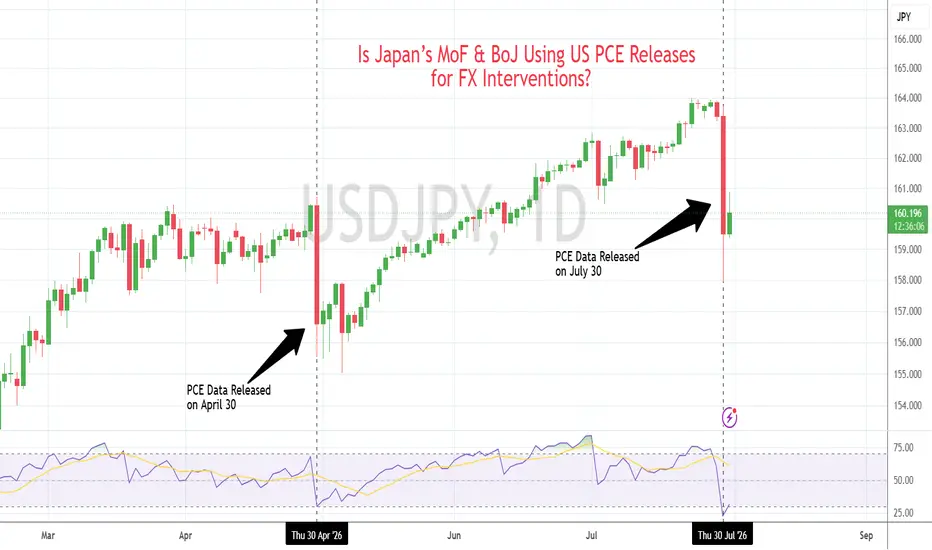
Take a close look at the daily chart of USDJPY.
The massive red candles on April 30 and July 30 highlights a clear, tactical correlation.
The Bottom Line:
It could not be just a coincidence. Japanese authorities seem to actively weaponize the heavy trading volume and volatility that occurs during U.S. PCE releases to hide or compound their market intervention footprint.
Keep a very close eye on the calendar for upcoming U.S. inflation data drops—they have officially become prime territory for major Yen reversals.
The massive red candles on April 30 and July 30 highlights a clear, tactical correlation.
- The Action: Sharp Japanese Yen-buying interventions to suppress a runaway USDJPY exchange rate.
- The Funding: Tokyo funding the operation by bulk-purchasing JPY and dumping U.S. Treasuries.
- The Timing: Both instances landed exactly on days when the U.S. Bureau of Economic Analysis (BEA) dropped its PCE inflation data.
The Bottom Line:
It could not be just a coincidence. Japanese authorities seem to actively weaponize the heavy trading volume and volatility that occurs during U.S. PCE releases to hide or compound their market intervention footprint.
Keep a very close eye on the calendar for upcoming U.S. inflation data drops—they have officially become prime territory for major Yen reversals.

免責事項
これらの情報および投稿は、TradingViewが提供または承認する金融、投資、取引、またはその他の種類の助言もしくは推奨であることを意図したものではなく、またこれらに該当するものでもありません。詳細は利用規約をご覧ください。
免責事項
これらの情報および投稿は、TradingViewが提供または承認する金融、投資、取引、またはその他の種類の助言もしくは推奨であることを意図したものではなく、またこれらに該当するものでもありません。詳細は利用規約をご覧ください。