
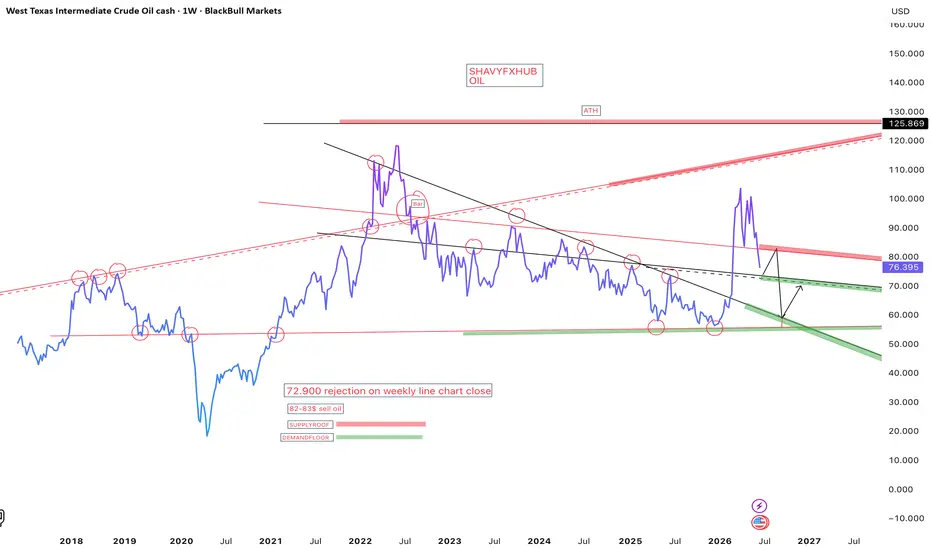
Oil is retesting a weekly sell zone 82-80$ per barrel,sell oil on retest.
The weekly TF structure is broken,peace deal reached between United States and Iran,global tension reduced and maritime security assured and soon insurance companies will return to providing services at normal rate.
Oil rally is struggling to print a higher high,the best high will be 82$-80$ zone and if price does get to this zone sell target will be 68-62$ zone.
Further escalation will be watched,the energy price is dependent on demand and supply,supply rely on logistics routes,any disruption will course increase in price,
Oil maritime security plays a vital role in the price of crude oil,insurance companies and risk premiums.
Key Oil Chokepoints
According to the U.S. Energy Information Administration (EIA) and other sources, the most critical ones by volume include:
• Strait of Hormuz (Persian Gulf to Gulf of Oman/Arabian Sea): The single most important. It carries ~20-21 million barrels per day (b/d) in recent years, equivalent to about 20% of global petroleum liquids consumption and ~25% of seaborne oil trade. Primarily exports from Saudi Arabia, Iraq, UAE, Iran, Kuwait, etc., heading to Asia (China takes a huge share), Europe, and beyond. No easy alternatives for much of this volume; pipelines help only partially. 
• Strait of Malacca (between Indian Ocean and South China Sea, via Indonesia/Malaysia/Singapore): ~22-24 million b/d. Links Middle East/African oil to major East Asian importers (China, Japan, South Korea). Very high volume but has some alternative routes (though longer/costlier). 
• Suez Canal and SUMED Pipeline (Egypt): Connects Red Sea/Mediterranean. Around 5-9 million b/d depending on the year. Important for Gulf oil to Europe/North America. 
• Bab el-Mandeb Strait (between Red Sea and Gulf of Aden, near Yemen): ~4-9 million b/d. Links to Suez route; vulnerable to attacks (e.g., Houthi incidents). 
• Others: Turkish Straits (Black Sea exports, e.g., Russian oil), Danish Straits, Panama Canal (smaller volumes for oil).
These routes together handle a massive share of global seaborne oil (~60%+ of traded oil moves by sea). Even temporary threats can reroute tankers (adding thousands of miles, fuel, and time) or halt flows. 
Why Risk Premiums Go High During Conflicts
Risk premiums in oil markets refer to the extra compensation (higher prices) that buyers and traders demand to account for potential future supply disruptions, uncertainty, and volatility. Conflicts elevate this premium through several mechanisms: 
1. Perceived Supply Risk: Conflicts in oil-producing regions (e.g., Middle East) or near chokepoints raise fears of direct attacks on infrastructure, blockades (like threats to Hormuz), sanctions, or production halts. Even if current supply is intact, the probability of future shortages spikes. Traders price this in via futures markets, increasing the “convenience yield” (value of holding physical oil now). 
2. Higher Costs and Disruptions: Insurance premiums for tankers skyrocket in risky areas. Shipping companies avoid routes, causing delays, rerouting, and effective supply reductions. This happened with recent Hormuz/Bab el-Mandeb tensions. 
3. Speculation and Market Sentiment: Geopolitical events drive speculative buying (hoarding for potential shortages), which amplifies price moves. Media coverage and uncertainty boost volatility. Studies show GPR (geopolitical risk) indices correlate with higher oil price volatility and premiums, especially when involving major producers or chokepoints. 
4. Demand/Supply Channel Imbalance: While broad geopolitical shocks can sometimes dampen global demand (via economic uncertainty), oil-specific conflicts (e.g., in OPEC+ areas or key routes) make the risk/supply channel dominate, pushing prices up. Effects are often short-lived unless prolonged, but can persist with ongoing tensions. 
Examples: Tensions or attacks near Hormuz historically cause immediate spikes (e.g., premiums added during Iran-related incidents). The premium reflects not just actual barrels lost but fear of worse scenarios. 
In summary, these chokepoints act as bottlenecks in a just-in-time global supply chain. Conflicts heighten risk premiums because markets are forward-looking and hate uncertainty—better to pay more now than risk shortages later. Prices can decouple from fundamentals temporarily due to this psychology and hedging behavior. #usoil
The weekly TF structure is broken,peace deal reached between United States and Iran,global tension reduced and maritime security assured and soon insurance companies will return to providing services at normal rate.
Oil rally is struggling to print a higher high,the best high will be 82$-80$ zone and if price does get to this zone sell target will be 68-62$ zone.
Further escalation will be watched,the energy price is dependent on demand and supply,supply rely on logistics routes,any disruption will course increase in price,
Oil maritime security plays a vital role in the price of crude oil,insurance companies and risk premiums.
Key Oil Chokepoints
According to the U.S. Energy Information Administration (EIA) and other sources, the most critical ones by volume include:
• Strait of Hormuz (Persian Gulf to Gulf of Oman/Arabian Sea): The single most important. It carries ~20-21 million barrels per day (b/d) in recent years, equivalent to about 20% of global petroleum liquids consumption and ~25% of seaborne oil trade. Primarily exports from Saudi Arabia, Iraq, UAE, Iran, Kuwait, etc., heading to Asia (China takes a huge share), Europe, and beyond. No easy alternatives for much of this volume; pipelines help only partially. 
• Strait of Malacca (between Indian Ocean and South China Sea, via Indonesia/Malaysia/Singapore): ~22-24 million b/d. Links Middle East/African oil to major East Asian importers (China, Japan, South Korea). Very high volume but has some alternative routes (though longer/costlier). 
• Suez Canal and SUMED Pipeline (Egypt): Connects Red Sea/Mediterranean. Around 5-9 million b/d depending on the year. Important for Gulf oil to Europe/North America. 
• Bab el-Mandeb Strait (between Red Sea and Gulf of Aden, near Yemen): ~4-9 million b/d. Links to Suez route; vulnerable to attacks (e.g., Houthi incidents). 
• Others: Turkish Straits (Black Sea exports, e.g., Russian oil), Danish Straits, Panama Canal (smaller volumes for oil).
These routes together handle a massive share of global seaborne oil (~60%+ of traded oil moves by sea). Even temporary threats can reroute tankers (adding thousands of miles, fuel, and time) or halt flows. 
Why Risk Premiums Go High During Conflicts
Risk premiums in oil markets refer to the extra compensation (higher prices) that buyers and traders demand to account for potential future supply disruptions, uncertainty, and volatility. Conflicts elevate this premium through several mechanisms: 
1. Perceived Supply Risk: Conflicts in oil-producing regions (e.g., Middle East) or near chokepoints raise fears of direct attacks on infrastructure, blockades (like threats to Hormuz), sanctions, or production halts. Even if current supply is intact, the probability of future shortages spikes. Traders price this in via futures markets, increasing the “convenience yield” (value of holding physical oil now). 
2. Higher Costs and Disruptions: Insurance premiums for tankers skyrocket in risky areas. Shipping companies avoid routes, causing delays, rerouting, and effective supply reductions. This happened with recent Hormuz/Bab el-Mandeb tensions. 
3. Speculation and Market Sentiment: Geopolitical events drive speculative buying (hoarding for potential shortages), which amplifies price moves. Media coverage and uncertainty boost volatility. Studies show GPR (geopolitical risk) indices correlate with higher oil price volatility and premiums, especially when involving major producers or chokepoints. 
4. Demand/Supply Channel Imbalance: While broad geopolitical shocks can sometimes dampen global demand (via economic uncertainty), oil-specific conflicts (e.g., in OPEC+ areas or key routes) make the risk/supply channel dominate, pushing prices up. Effects are often short-lived unless prolonged, but can persist with ongoing tensions. 
Examples: Tensions or attacks near Hormuz historically cause immediate spikes (e.g., premiums added during Iran-related incidents). The premium reflects not just actual barrels lost but fear of worse scenarios. 
In summary, these chokepoints act as bottlenecks in a just-in-time global supply chain. Conflicts heighten risk premiums because markets are forward-looking and hate uncertainty—better to pay more now than risk shortages later. Prices can decouple from fundamentals temporarily due to this psychology and hedging behavior. #usoil

免責事項
これらの情報および投稿は、TradingViewが提供または承認する金融、投資、取引、またはその他の種類の助言もしくは推奨であることを意図したものではなく、またこれらに該当するものでもありません。詳細は利用規約をご覧ください。
免責事項
これらの情報および投稿は、TradingViewが提供または承認する金融、投資、取引、またはその他の種類の助言もしくは推奨であることを意図したものではなく、またこれらに該当するものでもありません。詳細は利用規約をご覧ください。