
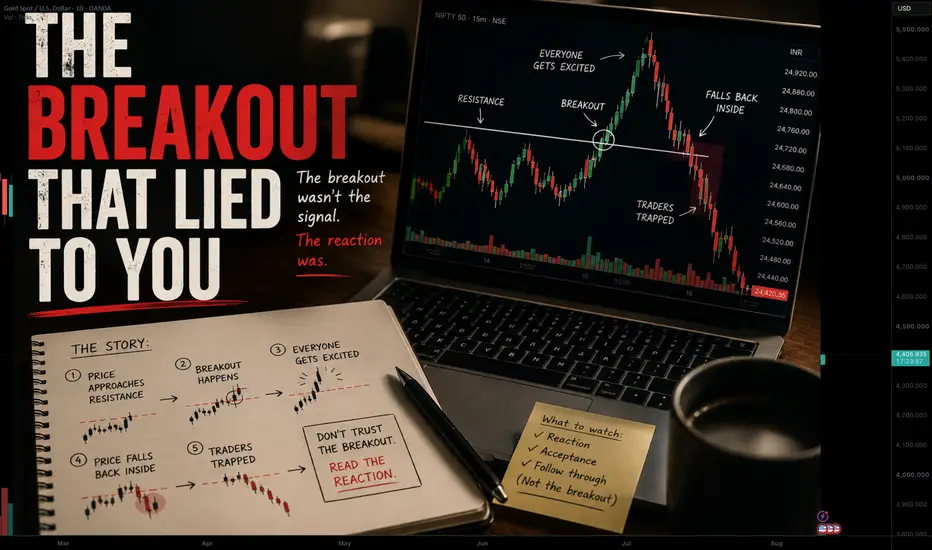
A breakout is one of the most attractive moments on a chart.
Price moves through resistance, momentum suddenly increases, candles become stronger, and it feels like the market has finally confirmed the direction. This is where many traders enter, expecting the move to continue.
But sometimes the breakout isn't the real signal.
The reaction that follows is.
Why Breakouts Attract Traders :
A resistance level becomes important because traders can see it. After several attempts to break above the same area, another push through that level can look like confirmation.
Traders see the breakout and start thinking about continuation.
But a price moving above resistance doesn't automatically mean the market has accepted higher prices.
The important question is what happens next.
Does price remain above the level?
Does it continue building higher?
Or does it quickly fall back inside the previous range?
When the Breakout Fails :
Imagine price has been moving sideways below resistance for some time.
Eventually, it breaks above the level.
Buyers enter.
Momentum increases.
The breakout looks convincing.
Then price starts falling.
It returns to the previous resistance zone and eventually moves back below it.
Now the situation has completely changed.
Traders who bought the breakout are no longer sitting in a position of strength. Some may begin closing their trades, while others may be forced out as their stops are triggered.
What looked like the beginning of a new trend can quickly become a move in the opposite direction.
The Reaction Tells the Story :
This is why the candle that breaks resistance shouldn't always receive all the attention.
Watch what happens afterward.
If price breaks above resistance and holds there, the market is showing acceptance.
If price breaks above resistance and immediately returns below it, the market is showing rejection.
The difference can be small on the chart, but significant for the trader.
A breakout is an event.
The reaction tells you whether that event actually mattered.
Where Traders Get Trapped :
Failed breakouts are interesting because they can create one sided positioning.
Traders who entered after the breakout are expecting higher prices. When price suddenly moves back below the level, their original idea is no longer behaving as expected.
That can create additional selling as positions are closed.
This doesn't mean the market is deliberately targeting individual traders.
It simply means that when many participants respond to the same price level, their decisions can influence what happens next.
What Should You Watch? :
Instead of treating every breakout as an automatic entry, pay attention to the behavior around the level.
These questions can provide much more information than the breakout candle alone.
Conclusion :
A breakout can look convincing and still fail.
That doesn't make breakouts useless. It simply means that crossing a level is not the entire story.
The market has to prove that it can accept the new price area.
So the next time you see a breakout, don't rush to decide what it means.
Watch what happens after it.
The breakout wasn't the signal. The reaction was.
Price moves through resistance, momentum suddenly increases, candles become stronger, and it feels like the market has finally confirmed the direction. This is where many traders enter, expecting the move to continue.
But sometimes the breakout isn't the real signal.
The reaction that follows is.
Why Breakouts Attract Traders :
A resistance level becomes important because traders can see it. After several attempts to break above the same area, another push through that level can look like confirmation.
Traders see the breakout and start thinking about continuation.
But a price moving above resistance doesn't automatically mean the market has accepted higher prices.
The important question is what happens next.
Does price remain above the level?
Does it continue building higher?
Or does it quickly fall back inside the previous range?
When the Breakout Fails :
Imagine price has been moving sideways below resistance for some time.
Eventually, it breaks above the level.
Buyers enter.
Momentum increases.
The breakout looks convincing.
Then price starts falling.
It returns to the previous resistance zone and eventually moves back below it.
Now the situation has completely changed.
Traders who bought the breakout are no longer sitting in a position of strength. Some may begin closing their trades, while others may be forced out as their stops are triggered.
What looked like the beginning of a new trend can quickly become a move in the opposite direction.
The Reaction Tells the Story :
This is why the candle that breaks resistance shouldn't always receive all the attention.
Watch what happens afterward.
If price breaks above resistance and holds there, the market is showing acceptance.
If price breaks above resistance and immediately returns below it, the market is showing rejection.
The difference can be small on the chart, but significant for the trader.
A breakout is an event.
The reaction tells you whether that event actually mattered.
Where Traders Get Trapped :
Failed breakouts are interesting because they can create one sided positioning.
Traders who entered after the breakout are expecting higher prices. When price suddenly moves back below the level, their original idea is no longer behaving as expected.
That can create additional selling as positions are closed.
This doesn't mean the market is deliberately targeting individual traders.
It simply means that when many participants respond to the same price level, their decisions can influence what happens next.
What Should You Watch? :
Instead of treating every breakout as an automatic entry, pay attention to the behavior around the level.
- Does price hold above resistance?
- Does the breakout have follow through?
- Does price quickly return inside the range?
- Does volume support the move?
- How does price behave after the first rejection?
These questions can provide much more information than the breakout candle alone.
Conclusion :
A breakout can look convincing and still fail.
That doesn't make breakouts useless. It simply means that crossing a level is not the entire story.
The market has to prove that it can accept the new price area.
So the next time you see a breakout, don't rush to decide what it means.
Watch what happens after it.
The breakout wasn't the signal. The reaction was.

関連の投稿
免責事項
これらの情報および投稿は、TradingViewが提供または承認する金融、投資、取引、またはその他の種類の助言もしくは推奨であることを意図したものではなく、またこれらに該当するものでもありません。詳細は利用規約をご覧ください。
関連の投稿
免責事項
これらの情報および投稿は、TradingViewが提供または承認する金融、投資、取引、またはその他の種類の助言もしくは推奨であることを意図したものではなく、またこれらに該当するものでもありません。詳細は利用規約をご覧ください。