OPEN-SOURCE SCRIPT
POC Sweep Reclaim [LuxAlgo]
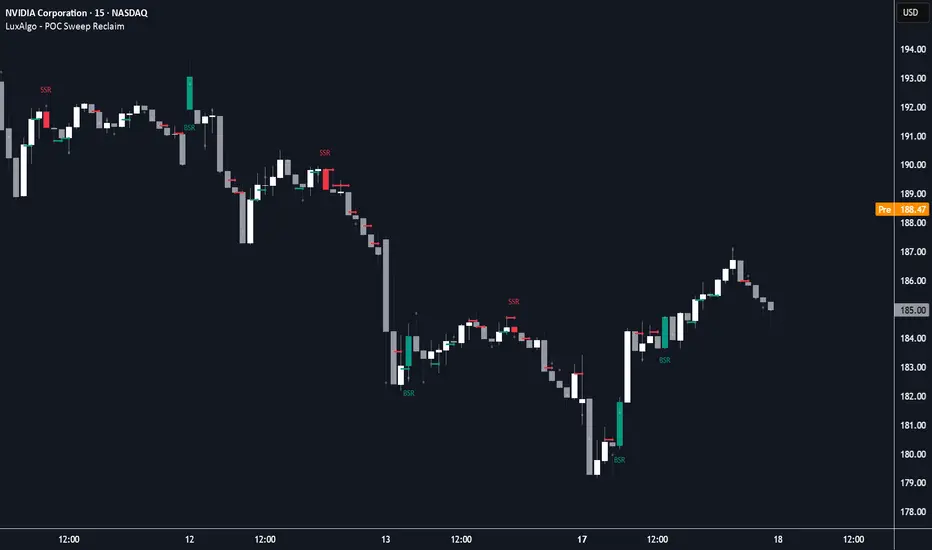
The POC Sweep Reclaim (PSR) model identifies a two-step "rejection then acceptance" price action pattern centered around the Point of Control (POC) of previous candles. By approximating volume-at-price data using lower timeframe (LTF) granularity, the tool highlights specific liquidity traps where price first fails to sustain a move beyond a high-volume level and subsequently reclaims it.
The PSR framework is built on the logic that a "Sweep" represents a failed probe of value, while the "Reclaim" represents a successful breach, signaling a potential shift in market dominance as price moves away from trapped participants.
🔶 USAGE
The indicator visualizes market microstructure dynamics through a sequence of two distinct events:
🔹 The Sweep (The Rejection)
A sweep occurs when a candle's wick trades through the previous bar's POC, but the candle body fails to close beyond it. This identifies a "Liquidity Grab" where price interacts with a high-volume node but fails to find acceptance, often trapping breakout traders.
🔹 The Reclaim (The Acceptance)
A reclaim occurs when the candle immediately following a sweep successfully closes beyond the same POC level that was just rejected.
🔶 DETAILS
The script aims to bridge the gap between standard OHLCV analysis and order-flow dynamics. While a true footprint engine (available on higher TradingView tiers) is more accurate, this script uses a proxy by aggregating volume from a lower timeframe (e.g., 1-minute) to estimate the POC of higher-timeframe bars.
🔹 Academic Intuition
🔹 Practical Limitations
🔶 SETTINGS
The PSR framework is built on the logic that a "Sweep" represents a failed probe of value, while the "Reclaim" represents a successful breach, signaling a potential shift in market dominance as price moves away from trapped participants.
🔶 USAGE
The indicator visualizes market microstructure dynamics through a sequence of two distinct events:
🔹 The Sweep (The Rejection)
A sweep occurs when a candle's wick trades through the previous bar's POC, but the candle body fails to close beyond it. This identifies a "Liquidity Grab" where price interacts with a high-volume node but fails to find acceptance, often trapping breakout traders.
- Buyside Sweep: Price wicks above the previous POC but closes below it (Bearish Rejection).
- Sellside Sweep: Price wicks below the previous POC but closes above it (Bullish Rejection).
🔹 The Reclaim (The Acceptance)
A reclaim occurs when the candle immediately following a sweep successfully closes beyond the same POC level that was just rejected.
- BSR (Buyside Reclaim): A bullish signal where price closes above a previously swept upper POC, suggesting the trap is resolved to the upside.
- SSR (Sellside Reclaim): A bearish signal where price closes below a previously swept lower POC, suggesting follow-through to the downside.
🔶 DETAILS
The script aims to bridge the gap between standard OHLCV analysis and order-flow dynamics. While a true footprint engine (available on higher TradingView tiers) is more accurate, this script uses a proxy by aggregating volume from a lower timeframe (e.g., 1-minute) to estimate the POC of higher-timeframe bars.
🔹 Academic Intuition
- Order-Flow Imbalance (OFI): Short-term price changes are strongly linked to the inability of one side to provide enough depth. A "reclaim" reflects a shift where the dominant side successfully absorbs the liquidity that caused the initial rejection.
- Salient Prices: High-volume nodes like the POC act as psychological and mechanical barriers. Research indicates that liquidity clusters around these prominent prices, making them significant areas for support/resistance.
- Stop-Loss Cascades: Sweeps often interact with clustered stop-loss orders. If price reclaims the level after clearing these stops, it can trigger a directional move as the market "clears" the liquidity hurdle.
🔹 Practical Limitations
- Footprint Proxy: The POC is calculated by aggregating volume at the close of LTF bars. This is a noisy proxy compared to a true footprint, which tracks every tick.
- Data Snooping: Like all pattern-based indicators, the "Reclaim" logic should be verified with robust backtesting to ensure signals are not the result of random price noise.
- Repainting: Because the POC depends on LTF data, the values for the current developing bar may fluctuate until the candle closes.
🔶 SETTINGS
- Lower Timeframe for POC: Sets the granularity for volume aggregation. A lower value (like 1m) provides a more precise POC proxy.
- Show POC: Toggles the visibility of the calculated Point of Control dots for every bar.
- Show Sweep Dots: Displays markers at the POC level when a wick interaction occurs without a body close.
- Show BSR (Buyside Reclaim): Highlights candles that successfully close above a swept buyside POC.
- Show SSR (Sellside Reclaim): Highlights candles that successfully close below a swept sellside POC.
オープンソーススクリプト
TradingViewの精神に則り、このスクリプトの作者はコードをオープンソースとして公開してくれました。トレーダーが内容を確認・検証できるようにという配慮です。作者に拍手を送りましょう!無料で利用できますが、コードの再公開はハウスルールに従う必要があります。

All content & scripts provided by LuxAlgo are for educational purposes only and are not financial advice.
免責事項
これらの情報および投稿は、TradingViewが提供または承認する金融、投資、取引、またはその他の種類の助言もしくは推奨であることを意図したものではなく、またこれらに該当するものでもありません。詳細は利用規約をご覧ください。
オープンソーススクリプト
TradingViewの精神に則り、このスクリプトの作者はコードをオープンソースとして公開してくれました。トレーダーが内容を確認・検証できるようにという配慮です。作者に拍手を送りましょう!無料で利用できますが、コードの再公開はハウスルールに従う必要があります。
免責事項
これらの情報および投稿は、TradingViewが提供または承認する金融、投資、取引、またはその他の種類の助言もしくは推奨であることを意図したものではなく、またこれらに該当するものでもありません。詳細は利用規約をご覧ください。