OPEN-SOURCE SCRIPT
Strong Pressure Zones | ProjectSyndicate
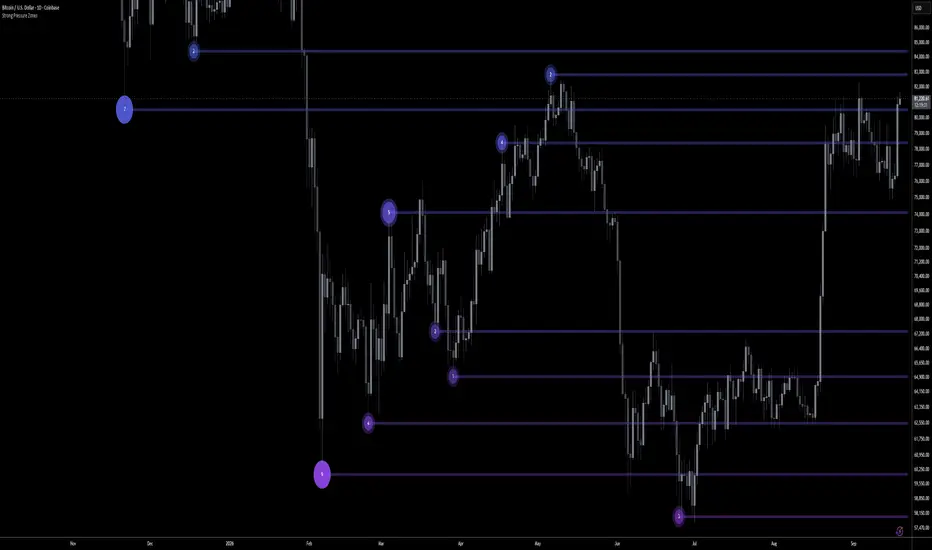
Strong Pressure Zones
Strong Pressure Zones maps where market pressure is concentrated — then waits for the trap. Every swing pivot becomes a volume-weighted pressure pool, drawn as a round heat bubble sized by how much pressure sits there and stamped with a live 0–10 strength rank inside it. Then the engine watches for the one event that flips an ordinary level into a high-conviction reversal: a sweep of the zone (the liquidity grab) followed by a reclaim back through it (the failed break). A pressure pool swept below and reclaimed is a bear trap. A pool swept above and reclaimed is a bull trap. Your chart stays clean — bubbles, level bands and a number, nothing else — while the engine tracks every grab-and-reclaim underneath.
Most level tools trade the bounce or trade the break. This one grades the pressure behind the level, and trades the trap.
GBPUSD

🫧 Pressure Bubbles — the visual that carries the read
Each pressure pool is a filled circular bubble sitting on its level. Bubble size = pressure magnitude (volume × range concentrated there), so the heaviest pools are unmistakable at a glance. The number inside = live 0–10 strength. A soft glow halo gives every pool its heat. One look tells you where pressure is stacked, how heavy it is, and how strong the level rates — without reading a single line of text off to the side.
🌐 Pressure Fuel — native on every market, aggregated on BTC
On any symbol — Gold, Silver, Forex, Indices, Futures, stocks or crypto — pressure is measured from that market's own volume, so the read is correct everywhere out of the box. On Bitcoin pairs it goes a step further and aggregates Binance + Coinbase + Bitstamp into one deeper book, so BTC magnitude reflects the broader crypto tape instead of a single venue's slice. The switch is automatic: chart a BTC pair and the multi-exchange aggregation kicks in; chart anything else and it uses that instrument's native volume — nothing to toggle.
📊 Volume × Range Magnitude — real weight, not just a wick
A pool's magnitude is volume multiplied by the bar's range at formation — the classic footprint of a level where size actually traded and leveraged positions rest. Big participation on a wide bar builds a heavy pool; a thin, quiet pivot builds a light one. Magnitude is then ranked relative to the other live pools on your chart, so the heaviest pressure always reads at the top of the scale and the map re-ranks itself as new pools form.
🎯 The Reclaim Engine — the core
Each zone is treated as a pool of resting liquidity where the crowd parks its stops. A wick that pierces a zone border by your Min Sweep Depth is a sweep — a liquidity grab, not a normal touch. If price then closes back through the zone within the Reclaim Window, the breakout has failed: that's the reclaim, the contrarian event the whole tool is built around. Grab the stops, fail the break, reverse.
🟩🟥 Multi-Zone Pool — both sides, always live
Swing-low pivots build long-pressure pools below price (support); swing-high pivots build short-pressure pools above (resistance) — a full pool of levels tracked at once, not one per side. Overlap suppression keeps the read clean, a max-bubbles cap keeps it fast, and the oldest pools recycle automatically.
XTIUSD

🧲 Sweep vs. Hold — the separation that matters
A wick that dips into a zone and closes back inside is a hold — it strengthens the level (its retest count). A wick that pierces clean through it by the sweep depth is a grab. The engine never confuses the two, so a genuine liquidity raid is flagged the moment it happens.
♻️ Reclaim Confirmation — border, midline, or far side
Choose how far back through the zone price must close to confirm a reclaim: the near border (loose), the midline, or the far border (strict). Deeper confirmation means fewer, higher-quality reclaims. An optional RSI momentum-extreme filter only accepts a bullish reclaim while oversold and a bearish reclaim while overbought — strictly contrarian.
💥 Genuine Break & Flip — when it isn't a trap
If price accepts beyond the border — a decisive close through, or no reclaim inside the window — the level genuinely broke. The zone doesn't just vanish: it flips its side in place and becomes a breaker, ready for break-and-retest continuation.
⚡ Sweep-Defense Memory — defended levels get stronger
Every time a zone is swept, reclaims and holds, it logs a defended sweep and its strength rises. A pool that has trapped traders and survived is exactly the pool that matters — and the ranking reflects it. Defended counts persist; they never un-count to flatter the chart.
XAUUSD

🔢 0–10 Strength Ranking — printed inside every bubble
Each pool carries a live grade inside the bubble, blending its pressure magnitude (ranked against the other live pools) with defense quality — held retests, volume, rejection-wick depth and defended sweeps — with idle decay so stale, ignored levels fade back down. Magnitude is what makes a level matter even before it's tested; defense is what earns it the top of the scale. Set a strength floor and weak pools simply dim out, leaving only the levels that earned attention.
📏 Recent-Only Discipline — no stale rails from 90 bars ago
Pools older than your Max Level Age are removed, so the chart shows the pressure that's actually in play right now — not a graveyard of levels dragged forward as if they were still active. Widen it when you want deeper history; keep it tight for a pure recent read.
🎨 Fully Themed & Configurable
Vertical spectrum coloring by price height (the heat look) or clean by-side coloring (teal longs / magenta shorts); adjustable bubble size boost, score text size and number format; magnitude weight, contrast and lookback; strongest/weakest transparency and glow; thick level bands (width up to 10 so lines read as zones) with their own transparency, style and projection; plus the full detection, sweep/reclaim, strength-weight and decay controls.
🔒 Honest, Non-Repainting Core
Pools anchor to confirmed swing pivots — which, like all pivots, confirm a few bars after the fact; that is inherent, not a defect. A reclaim is evaluated on the reclaim bar's close and is fixed once that bar closes; on the live forming bar it can still flicker until close, as any close-based read does. Defended-sweep counts persist and never un-count. The 0–10 strength is a descriptive ranking framework for directing attention, not a backtested edge. Multi-exchange aggregation applies on BTC pairs; every other market ranks on its own native volume automatically.
NQ

🔔 Native Alerts
Proximity to a long/short pressure pool and to a strong pool, zone touch/retest, zone sweep (liquidity grab), zone break (accepted), and the headline events: Bullish Reclaim, Bearish Reclaim, and Any Reclaim.
🎯 Why this is different
Bounce tools fade every touch and get run over on the break. Breakout tools buy the break and get trapped on the reclaim. Strong Pressure Zones measures the pressure behind each level first, ranks the heaviest pools, then waits for the market to show its hand — the stop-raid and the failed break — and only then frames the reversal. You react to the trap, at the level that had the weight to matter.
🎯 How To Trade It — Two Approaches
Everything hinges on one read: did a heavy, high-strength pool just get swept and reclaimed?
◾ 1) Fade the trap — trade the reclaim (the core thesis)
Use when a large, high-strength pool is swept and price closes back through it.
▪️ Mark the strong pools (7+) — big bubble, high number. These are the levels with the weight worth defending.
▪️ Wait for the sweep: price wicks clean through the pool, grabbing the liquidity resting beyond it (Zone Sweep alert).
▪️ Trigger: price closes back through the pool within the reclaim window (Bullish / Bearish Reclaim alert). The breakout failed.
▪️ Entry: on the reclaim, in the reclaim's direction — long when a long-pressure pool is swept low and reclaims, short when a short-pressure pool is swept high and reclaims.
▪️ Stop: beyond the sweep extreme; if price re-breaks and accepts there, it was real acceptance, not a trap — stand aside.
▪️ Target: the opposite side of the pool first, then the next pool / unswept level in your direction.
⚖️ The cleanest version: a heavy long-pressure pool (big bubble, 8/10, already carrying a defended sweep) gets raided — price spears below it and stops out the longs — then snaps back and closes above it within a couple of bars on a volume surge, RSI stretched oversold. Grab, fail, reverse. That is the exact event this tool is built to frame.
◾ 2) Stand down — the map says wait
▪️ Clean acceptance, not a reclaim — price closed and held beyond the border (Zone Break alert). The level genuinely broke; don't fade it.
▪️ Light, weak pools only — small bubbles and low numbers everywhere means nothing heavy worth defending. Let structure develop.
▪️ No sweep yet — a pool being approached is not a pool being reclaimed. Wait for the grab and the close back through.
Rule of thumb: heavy pool + strong number + sweep + reclaim in the same direction → fade the trap toward the pool's far side. Genuine break/acceptance, light/weak pools, or no reclaim yet → stand down until the map agrees.
🚀 Markets & Timeframes
Works on every market, on any timeframe — Gold (XAUUSD), Silver, Forex, Indices, Futures, stocks and Crypto. The pressure-and-reclaim logic is symbol-agnostic: each instrument is ranked on its own volume, so you get the same clean read on gold, the DAX, EURUSD or an equity that you get on BTC. Bitcoin pairs additionally benefit from multi-exchange (Binance + Coinbase + Bitstamp) aggregation for a deeper pressure picture — applied automatically, nothing to switch. Where a symbol carries little or no volume, magnitude leans on range and the sweep-and-reclaim engine still works in full.
💡 Cleanest Setup
Raise Min Sweep Depth and set Reclaim Confirmation to Midline or Far Border for fewer, cleaner traps; keep Max Level Age tight so only live pressure shows; nudge Magnitude Weight toward 0.8 if you want size to dominate the ranking, or down toward 0.5 to reward defended levels more; and keep the RSI filter on when you want strictly contrarian reclaims.
Strong Pressure Zones maps where market pressure is concentrated — then waits for the trap. Every swing pivot becomes a volume-weighted pressure pool, drawn as a round heat bubble sized by how much pressure sits there and stamped with a live 0–10 strength rank inside it. Then the engine watches for the one event that flips an ordinary level into a high-conviction reversal: a sweep of the zone (the liquidity grab) followed by a reclaim back through it (the failed break). A pressure pool swept below and reclaimed is a bear trap. A pool swept above and reclaimed is a bull trap. Your chart stays clean — bubbles, level bands and a number, nothing else — while the engine tracks every grab-and-reclaim underneath.
Most level tools trade the bounce or trade the break. This one grades the pressure behind the level, and trades the trap.
GBPUSD
🫧 Pressure Bubbles — the visual that carries the read
Each pressure pool is a filled circular bubble sitting on its level. Bubble size = pressure magnitude (volume × range concentrated there), so the heaviest pools are unmistakable at a glance. The number inside = live 0–10 strength. A soft glow halo gives every pool its heat. One look tells you where pressure is stacked, how heavy it is, and how strong the level rates — without reading a single line of text off to the side.
🌐 Pressure Fuel — native on every market, aggregated on BTC
On any symbol — Gold, Silver, Forex, Indices, Futures, stocks or crypto — pressure is measured from that market's own volume, so the read is correct everywhere out of the box. On Bitcoin pairs it goes a step further and aggregates Binance + Coinbase + Bitstamp into one deeper book, so BTC magnitude reflects the broader crypto tape instead of a single venue's slice. The switch is automatic: chart a BTC pair and the multi-exchange aggregation kicks in; chart anything else and it uses that instrument's native volume — nothing to toggle.
📊 Volume × Range Magnitude — real weight, not just a wick
A pool's magnitude is volume multiplied by the bar's range at formation — the classic footprint of a level where size actually traded and leveraged positions rest. Big participation on a wide bar builds a heavy pool; a thin, quiet pivot builds a light one. Magnitude is then ranked relative to the other live pools on your chart, so the heaviest pressure always reads at the top of the scale and the map re-ranks itself as new pools form.
🎯 The Reclaim Engine — the core
Each zone is treated as a pool of resting liquidity where the crowd parks its stops. A wick that pierces a zone border by your Min Sweep Depth is a sweep — a liquidity grab, not a normal touch. If price then closes back through the zone within the Reclaim Window, the breakout has failed: that's the reclaim, the contrarian event the whole tool is built around. Grab the stops, fail the break, reverse.
🟩🟥 Multi-Zone Pool — both sides, always live
Swing-low pivots build long-pressure pools below price (support); swing-high pivots build short-pressure pools above (resistance) — a full pool of levels tracked at once, not one per side. Overlap suppression keeps the read clean, a max-bubbles cap keeps it fast, and the oldest pools recycle automatically.
XTIUSD
🧲 Sweep vs. Hold — the separation that matters
A wick that dips into a zone and closes back inside is a hold — it strengthens the level (its retest count). A wick that pierces clean through it by the sweep depth is a grab. The engine never confuses the two, so a genuine liquidity raid is flagged the moment it happens.
♻️ Reclaim Confirmation — border, midline, or far side
Choose how far back through the zone price must close to confirm a reclaim: the near border (loose), the midline, or the far border (strict). Deeper confirmation means fewer, higher-quality reclaims. An optional RSI momentum-extreme filter only accepts a bullish reclaim while oversold and a bearish reclaim while overbought — strictly contrarian.
💥 Genuine Break & Flip — when it isn't a trap
If price accepts beyond the border — a decisive close through, or no reclaim inside the window — the level genuinely broke. The zone doesn't just vanish: it flips its side in place and becomes a breaker, ready for break-and-retest continuation.
⚡ Sweep-Defense Memory — defended levels get stronger
Every time a zone is swept, reclaims and holds, it logs a defended sweep and its strength rises. A pool that has trapped traders and survived is exactly the pool that matters — and the ranking reflects it. Defended counts persist; they never un-count to flatter the chart.
XAUUSD
🔢 0–10 Strength Ranking — printed inside every bubble
Each pool carries a live grade inside the bubble, blending its pressure magnitude (ranked against the other live pools) with defense quality — held retests, volume, rejection-wick depth and defended sweeps — with idle decay so stale, ignored levels fade back down. Magnitude is what makes a level matter even before it's tested; defense is what earns it the top of the scale. Set a strength floor and weak pools simply dim out, leaving only the levels that earned attention.
📏 Recent-Only Discipline — no stale rails from 90 bars ago
Pools older than your Max Level Age are removed, so the chart shows the pressure that's actually in play right now — not a graveyard of levels dragged forward as if they were still active. Widen it when you want deeper history; keep it tight for a pure recent read.
🎨 Fully Themed & Configurable
Vertical spectrum coloring by price height (the heat look) or clean by-side coloring (teal longs / magenta shorts); adjustable bubble size boost, score text size and number format; magnitude weight, contrast and lookback; strongest/weakest transparency and glow; thick level bands (width up to 10 so lines read as zones) with their own transparency, style and projection; plus the full detection, sweep/reclaim, strength-weight and decay controls.
🔒 Honest, Non-Repainting Core
Pools anchor to confirmed swing pivots — which, like all pivots, confirm a few bars after the fact; that is inherent, not a defect. A reclaim is evaluated on the reclaim bar's close and is fixed once that bar closes; on the live forming bar it can still flicker until close, as any close-based read does. Defended-sweep counts persist and never un-count. The 0–10 strength is a descriptive ranking framework for directing attention, not a backtested edge. Multi-exchange aggregation applies on BTC pairs; every other market ranks on its own native volume automatically.
NQ
🔔 Native Alerts
Proximity to a long/short pressure pool and to a strong pool, zone touch/retest, zone sweep (liquidity grab), zone break (accepted), and the headline events: Bullish Reclaim, Bearish Reclaim, and Any Reclaim.
🎯 Why this is different
Bounce tools fade every touch and get run over on the break. Breakout tools buy the break and get trapped on the reclaim. Strong Pressure Zones measures the pressure behind each level first, ranks the heaviest pools, then waits for the market to show its hand — the stop-raid and the failed break — and only then frames the reversal. You react to the trap, at the level that had the weight to matter.
🎯 How To Trade It — Two Approaches
Everything hinges on one read: did a heavy, high-strength pool just get swept and reclaimed?
◾ 1) Fade the trap — trade the reclaim (the core thesis)
Use when a large, high-strength pool is swept and price closes back through it.
▪️ Mark the strong pools (7+) — big bubble, high number. These are the levels with the weight worth defending.
▪️ Wait for the sweep: price wicks clean through the pool, grabbing the liquidity resting beyond it (Zone Sweep alert).
▪️ Trigger: price closes back through the pool within the reclaim window (Bullish / Bearish Reclaim alert). The breakout failed.
▪️ Entry: on the reclaim, in the reclaim's direction — long when a long-pressure pool is swept low and reclaims, short when a short-pressure pool is swept high and reclaims.
▪️ Stop: beyond the sweep extreme; if price re-breaks and accepts there, it was real acceptance, not a trap — stand aside.
▪️ Target: the opposite side of the pool first, then the next pool / unswept level in your direction.
⚖️ The cleanest version: a heavy long-pressure pool (big bubble, 8/10, already carrying a defended sweep) gets raided — price spears below it and stops out the longs — then snaps back and closes above it within a couple of bars on a volume surge, RSI stretched oversold. Grab, fail, reverse. That is the exact event this tool is built to frame.
◾ 2) Stand down — the map says wait
▪️ Clean acceptance, not a reclaim — price closed and held beyond the border (Zone Break alert). The level genuinely broke; don't fade it.
▪️ Light, weak pools only — small bubbles and low numbers everywhere means nothing heavy worth defending. Let structure develop.
▪️ No sweep yet — a pool being approached is not a pool being reclaimed. Wait for the grab and the close back through.
Rule of thumb: heavy pool + strong number + sweep + reclaim in the same direction → fade the trap toward the pool's far side. Genuine break/acceptance, light/weak pools, or no reclaim yet → stand down until the map agrees.
🚀 Markets & Timeframes
Works on every market, on any timeframe — Gold (XAUUSD), Silver, Forex, Indices, Futures, stocks and Crypto. The pressure-and-reclaim logic is symbol-agnostic: each instrument is ranked on its own volume, so you get the same clean read on gold, the DAX, EURUSD or an equity that you get on BTC. Bitcoin pairs additionally benefit from multi-exchange (Binance + Coinbase + Bitstamp) aggregation for a deeper pressure picture — applied automatically, nothing to switch. Where a symbol carries little or no volume, magnitude leans on range and the sweep-and-reclaim engine still works in full.
💡 Cleanest Setup
Raise Min Sweep Depth and set Reclaim Confirmation to Midline or Far Border for fewer, cleaner traps; keep Max Level Age tight so only live pressure shows; nudge Magnitude Weight toward 0.8 if you want size to dominate the ranking, or down toward 0.5 to reward defended levels more; and keep the RSI filter on when you want strictly contrarian reclaims.
オープンソーススクリプト
TradingViewの精神に則り、このスクリプトの作者はコードをオープンソースとして公開してくれました。トレーダーが内容を確認・検証できるようにという配慮です。作者に拍手を送りましょう!無料で利用できますが、コードの再公開はハウスルールに従う必要があります。

Institutional-desk · 10+ yrs building trading algos
Syndicate Ultimate · 4 systems · 1 bundle
· 1 payment · lifetime access
Gold · FX · NQ/ES · private systems
syndicate001.com
TG channel
t.me/aisyndicate001
Syndicate Ultimate · 4 systems · 1 bundle
· 1 payment · lifetime access
Gold · FX · NQ/ES · private systems
syndicate001.com
TG channel
t.me/aisyndicate001
免責事項
これらの情報および投稿は、TradingViewが提供または承認する金融、投資、取引、またはその他の種類の助言もしくは推奨であることを意図したものではなく、またこれらに該当するものでもありません。詳細は利用規約をご覧ください。
オープンソーススクリプト
TradingViewの精神に則り、このスクリプトの作者はコードをオープンソースとして公開してくれました。トレーダーが内容を確認・検証できるようにという配慮です。作者に拍手を送りましょう!無料で利用できますが、コードの再公開はハウスルールに従う必要があります。
Institutional-desk · 10+ yrs building trading algos
Syndicate Ultimate · 4 systems · 1 bundle
· 1 payment · lifetime access
Gold · FX · NQ/ES · private systems
syndicate001.com
TG channel
t.me/aisyndicate001
Syndicate Ultimate · 4 systems · 1 bundle
· 1 payment · lifetime access
Gold · FX · NQ/ES · private systems
syndicate001.com
TG channel
t.me/aisyndicate001
免責事項
これらの情報および投稿は、TradingViewが提供または承認する金融、投資、取引、またはその他の種類の助言もしくは推奨であることを意図したものではなく、またこれらに該当するものでもありません。詳細は利用規約をご覧ください。