ICT Session Scalper Toolkit
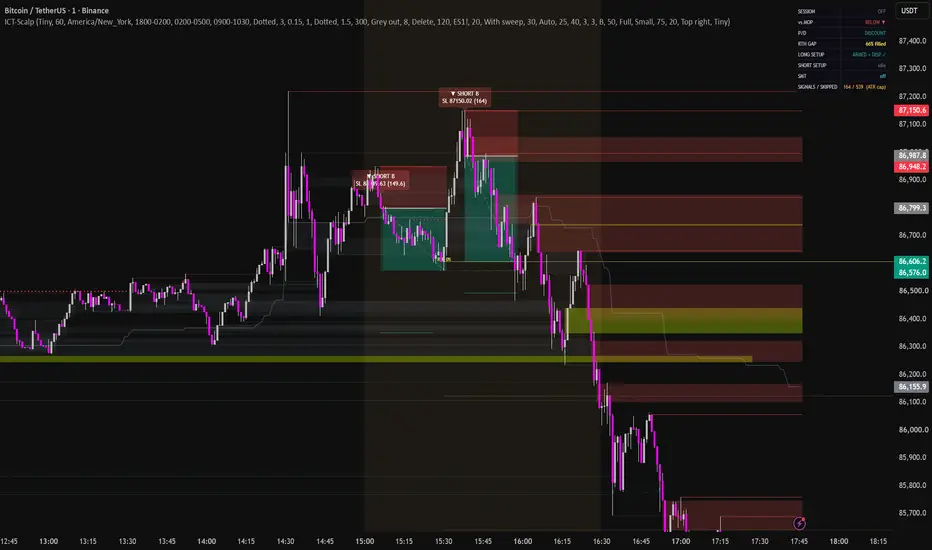
ICT Session Scalper Toolkit
OVERVIEW
A session-scalping framework built on ICT (Inner Circle Trader) concepts. It maps the full workflow of a liquidity-based scalping model onto one chart: the session structure (Asia accumulation → London / New York manipulation → distribution), the liquidity pools that get targeted, the sweep that marks the manipulation, the displacement that confirms it, and the fair-value-gap entry that follows. Each completed sequence is graded A+ / B / C from higher-timeframe confluence.
The model follows the session-scalping process described by funded trader Candice BL in a public interview: wait for the killzone, wait for liquidity to be swept, require displacement and speed, enter on a valid inverted FVG or FVG retrace, cap the stop, target the nearest liquidity with at least 1:2.
Every visual element can be switched on/off and recolored, including all text, so the chart can be as minimal or as detailed as you want.
HOW IT WORKS
Sessions & killzones (New York time). Asia range (18:00-02:00), London killzone (02:00-05:00) and New York killzone (09:00-10:30) are tracked and optionally shaded. By default signals only fire inside a killzone, so no setup is taken before the session's real manipulation window.
Liquidity pools. Swing highs and lows (pivot length configurable) become buyside / sellside pools. Pools within a small ATR-based tolerance merge into equal highs / equal lows, which are drawn thicker. The Asia high/low and previous day high/low are added as named pools. When price trades through a pool it is marked as swept: that is the manipulation leg.
Displacement. A candle whose body exceeds a multiple of the 20-bar average body (default 1.5×) counts as displacement: the "displacement + speed" requirement of the model.
FVG / IFVG engine. Three-candle fair value gaps are tracked (optionally only those created by displacement). A gap becomes a valid inverted FVG only when a candle body closes through it: a wick or partial close is not enough. Retraces into valid IFVGs or displacement FVGs are entry events. Invalidated zones are greyed out, deleted or kept (your choice).
Signal sequence. A long requires, in order: a sellside sweep → bullish displacement within the window (default 30 bars) → a bullish IFVG validation or a retrace into a bullish zone. Shorts mirror this. The stop sits beyond the sweep extreme. If that stop exceeds the cap, the setup is skipped — "if I need a larger stop, it is not the entry". Targets: TP1 = nearest unswept pool, final target = at least the minimum R:R (default 2R).
Stop cap. Auto mode uses fixed point caps on NQ / MNQ (25 London, 40 New York, as in the source model) and an ATR multiple (default 3 × ATR14) on every other symbol, so the logic works on crypto, metals and forex without manual tuning.
Grading (A+ / B / C). Points are added for: entry or stop inside a 1H or daily FVG, proximity to the midnight open / NDOG / NWOG, a recent SMT divergence, a sweep of equal highs/lows, a low-resistance run of pools toward the target, and buying in discount / selling in premium. A point is deducted when obvious liquidity remains behind the entry (the model's C-setup rule). 4+ = A+, 2-3 = B, below = C.
Context levels. Midnight opening price, new day / new week opening gaps (18:00 ET futures reopen), the RTH gap (16:00 close → 9:30 open) with 25 / 50 / 75 % levels, 1H and daily FVGs, and the equilibrium of the recent dealing range.
SMT divergence. Compares new swing extremes on the chart symbol against a correlated symbol (default ES for NQ). Labels can be shown with sweeps only, for all SMTs, or off, and are removed when their level breaks.
Dashboard. Active session, position vs midnight open, premium/discount, RTH gap fill %, long/short setup state (armed / displacement confirmed), active SMT, and a signals / skipped counter that shows when the stop cap is filtering setups.
HOW TO USE IT
Use the 1H / daily FVGs and named pools for bias and targets; use the chart timeframe (1-5 min) for execution.
Treat signals as a checklist: the sweep, displacement and IFVG are marked; the discretionary read of speed on lower timeframes (seconds charts) remains yours.
Grades help size: the source model sizes up on A+ and takes B / C setups with reduced size.
If the dashboard shows many skipped signals, the stop cap is too tight for the instrument: switch the stop cap mode or raise the cap.
SETTINGS
All elements have their own toggle, color and text option: session shading, MOP, NDOG/NWOG, RTH gap and quartiles, liquidity lines and pool text, sweep marks, displacement markers, FVG boxes, FVG text, IFVG text, volume imbalances, HTF FVGs and text, equilibrium, SMT labels, signal labels (full / compact / off), trade lines and the dashboard. A global text size and a per-element label limit keep the chart clean.
NOTES & LIMITATIONS
Signals are evaluated on bar close by default (no repaint). Disabling "Signals on bar close only" shows them intrabar, where they can still change before the bar closes.
HTF FVGs use completed 1H / daily candles; previous day high/low uses the completed prior day only.
Session times assume futures/forex trading hours in New York time; adjust them for other markets.
SMT needs a correlated symbol your data plan can load; if it cannot be loaded SMT switches itself off.
This is a visualization and execution aid for a discretionary model. It is not a trading system, produces no performance statistics and makes no claims about profitability. Past setups shown on the chart do not imply future results.

Free live order book heatmap, footprint and CVD for BTC, gold and 7 more markets: swiftedge.uk/bitcoin-order-book-heatmap
免責事項
これらの情報および投稿は、TradingViewが提供または承認する金融、投資、取引、またはその他の種類の助言もしくは推奨であることを意図したものではなく、またこれらに該当するものでもありません。詳細は利用規約をご覧ください。
Free live order book heatmap, footprint and CVD for BTC, gold and 7 more markets: swiftedge.uk/bitcoin-order-book-heatmap
免責事項
これらの情報および投稿は、TradingViewが提供または承認する金融、投資、取引、またはその他の種類の助言もしくは推奨であることを意図したものではなく、またこれらに該当するものでもありません。詳細は利用規約をご覧ください。