OPEN-SOURCE SCRIPT
Currency Strength Meter [ForexCracked]
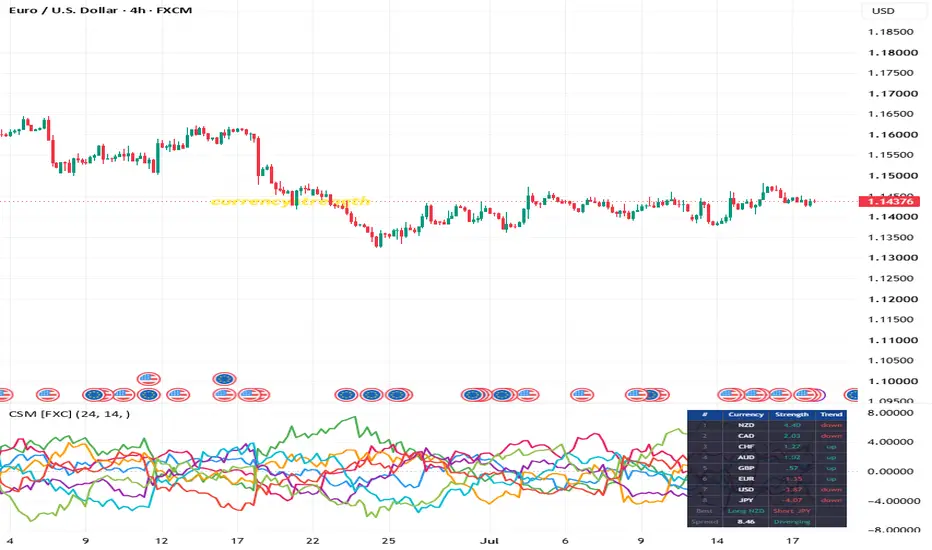
🔵 OVERVIEW
A currency strength meter that ranks the eight major currencies against each other in real time, and then tells you the one thing you actually opened it for: which pair to trade right now.
It reads all 28 major crosses, so every currency is measured across all seven of its pairs, not just against the dollar.
🔵 WHAT MAKES THIS ONE DIFFERENT
Almost every strength meter measures each pair's percent change and averages it. That has a flaw nobody talks about: a 40 pip move in a quiet pair and a 40 pip move in a violent one are treated as the same event, when they are not remotely the same event.
This meter measures every move in ATR units instead. A currency only scores highly if it has moved far relative to how far that pair normally moves. Quiet pairs stop being drowned out by naturally volatile ones, and the ranking stops flattering whichever currency happens to be paired with the wildest counterpart that week.
🔵 WHAT IT SHOWS
• A live ranking of USD, EUR, GBP, JPY, CHF, AUD, NZD and CAD, strongest to weakest
• Each currency's strength in ATR units, so the numbers mean something rather than being an index
• Whether each currency is strengthening or weakening against its own recent reading, not just where it sits
• The Best Pair line: long the strongest currency, short the weakest
• The Spread: the distance between strongest and weakest
🔵 THE SPREAD (read this one first)
The spread is the gap between the strongest and the weakest currency. It answers a question most traders skip: is anything actually happening?
A wide spread means currencies are genuinely diverging and a strength-based trade has something to work with. A narrow spread means everything is drifting together, the ranking is mostly noise, and the best trade is usually no trade. Check the spread before you trust the ranking.
🔵 HOW TO USE
• Read the spread. If it is small, the ranking is not telling you much, so wait.
• Take the Best Pair as a starting point, not an entry. It tells you where the divergence is, not when to get in.
• Prefer a currency that is both highly ranked and still strengthening over one that is highly ranked and already fading, since the second one has usually made its move.
• Confirm the pair on the chart with your own entry method. A strength meter frames the trade. It does not time it.
• Lengthen the Lookback for swing trading and shorten it for intraday.
🔵 SETTINGS
• Strength Lookback: how many bars back the move is measured over (default 24)
• ATR Length: the volatility yardstick every move is divided by (default 14)
• Symbol Prefix: leave blank on most charts. If the pairs do not load, set it to your data provider, for example OANDA: or FX:
• Show Ranking Table: toggles the strongest-to-weakest table in the top right (default on)
• Plot Strength Lines: toggles the eight strength curves in the pane (default on)
⚠️ DISCLAIMER
Relative strength tells you which currencies are moving and which are not. It does not tell you when to enter, and strong currencies reverse. Results depend on market conditions, settings, and your own execution and risk management. Shared for educational and research purposes. Not financial advice.
A currency strength meter that ranks the eight major currencies against each other in real time, and then tells you the one thing you actually opened it for: which pair to trade right now.
It reads all 28 major crosses, so every currency is measured across all seven of its pairs, not just against the dollar.
🔵 WHAT MAKES THIS ONE DIFFERENT
Almost every strength meter measures each pair's percent change and averages it. That has a flaw nobody talks about: a 40 pip move in a quiet pair and a 40 pip move in a violent one are treated as the same event, when they are not remotely the same event.
This meter measures every move in ATR units instead. A currency only scores highly if it has moved far relative to how far that pair normally moves. Quiet pairs stop being drowned out by naturally volatile ones, and the ranking stops flattering whichever currency happens to be paired with the wildest counterpart that week.
🔵 WHAT IT SHOWS
• A live ranking of USD, EUR, GBP, JPY, CHF, AUD, NZD and CAD, strongest to weakest
• Each currency's strength in ATR units, so the numbers mean something rather than being an index
• Whether each currency is strengthening or weakening against its own recent reading, not just where it sits
• The Best Pair line: long the strongest currency, short the weakest
• The Spread: the distance between strongest and weakest
🔵 THE SPREAD (read this one first)
The spread is the gap between the strongest and the weakest currency. It answers a question most traders skip: is anything actually happening?
A wide spread means currencies are genuinely diverging and a strength-based trade has something to work with. A narrow spread means everything is drifting together, the ranking is mostly noise, and the best trade is usually no trade. Check the spread before you trust the ranking.
🔵 HOW TO USE
• Read the spread. If it is small, the ranking is not telling you much, so wait.
• Take the Best Pair as a starting point, not an entry. It tells you where the divergence is, not when to get in.
• Prefer a currency that is both highly ranked and still strengthening over one that is highly ranked and already fading, since the second one has usually made its move.
• Confirm the pair on the chart with your own entry method. A strength meter frames the trade. It does not time it.
• Lengthen the Lookback for swing trading and shorten it for intraday.
🔵 SETTINGS
• Strength Lookback: how many bars back the move is measured over (default 24)
• ATR Length: the volatility yardstick every move is divided by (default 14)
• Symbol Prefix: leave blank on most charts. If the pairs do not load, set it to your data provider, for example OANDA: or FX:
• Show Ranking Table: toggles the strongest-to-weakest table in the top right (default on)
• Plot Strength Lines: toggles the eight strength curves in the pane (default on)
⚠️ DISCLAIMER
Relative strength tells you which currencies are moving and which are not. It does not tell you when to enter, and strong currencies reverse. Results depend on market conditions, settings, and your own execution and risk management. Shared for educational and research purposes. Not financial advice.
オープンソーススクリプト
TradingViewの精神に則り、このスクリプトの作者はコードをオープンソースとして公開してくれました。トレーダーが内容を確認・検証できるようにという配慮です。作者に拍手を送りましょう!無料で利用できますが、コードの再公開はハウスルールに従う必要があります。

⚜️ Free TG Channel : t.me/fxcracked_backup
⚜️ Free Forex EAs, MT4 indicators, and Forex strategies to automate trades and boost profits. Perfect tools for traders of all levels! - forexcracked.com/
⚜️ Free Forex EAs, MT4 indicators, and Forex strategies to automate trades and boost profits. Perfect tools for traders of all levels! - forexcracked.com/
免責事項
これらの情報および投稿は、TradingViewが提供または承認する金融、投資、取引、またはその他の種類の助言もしくは推奨であることを意図したものではなく、またこれらに該当するものでもありません。詳細は利用規約をご覧ください。
オープンソーススクリプト
TradingViewの精神に則り、このスクリプトの作者はコードをオープンソースとして公開してくれました。トレーダーが内容を確認・検証できるようにという配慮です。作者に拍手を送りましょう!無料で利用できますが、コードの再公開はハウスルールに従う必要があります。
⚜️ Free TG Channel : t.me/fxcracked_backup
⚜️ Free Forex EAs, MT4 indicators, and Forex strategies to automate trades and boost profits. Perfect tools for traders of all levels! - forexcracked.com/
⚜️ Free Forex EAs, MT4 indicators, and Forex strategies to automate trades and boost profits. Perfect tools for traders of all levels! - forexcracked.com/
免責事項
これらの情報および投稿は、TradingViewが提供または承認する金融、投資、取引、またはその他の種類の助言もしくは推奨であることを意図したものではなく、またこれらに該当するものでもありません。詳細は利用規約をご覧ください。