OPEN-SOURCE SCRIPT
更新済 Reclaim Breakout Planner [AGPro Series]
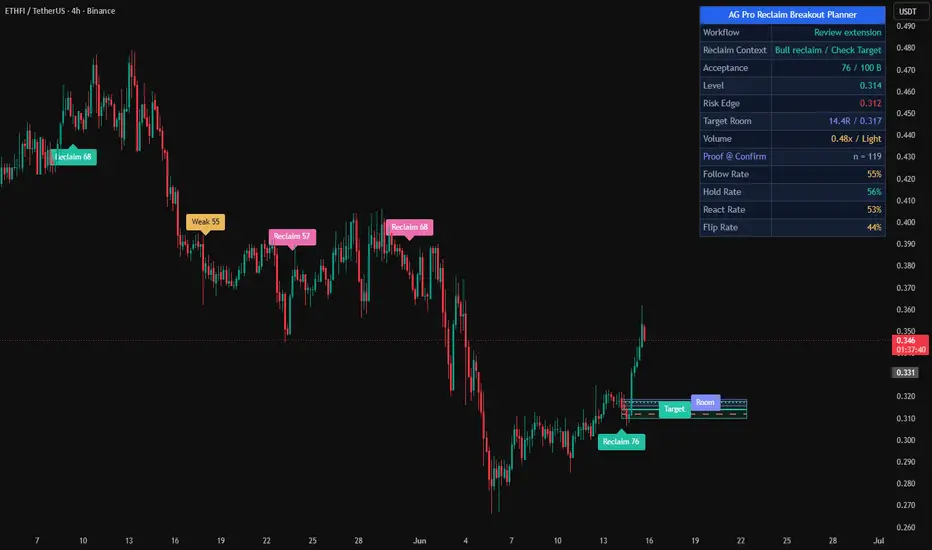
Reclaim Breakout Planner [AGPro Series]
🧠 Core Idea
Is a recently broken structural level being lost and reclaimed in a way that creates a valid breakout planning area?
📌 Overview / What it does
Reclaim Breakout Planner [AGPro Series] is a chart-first breakout planning tool built around structural pivot reclaim behavior. It detects when price breaks beyond a confirmed pivot level, temporarily moves back through that broken level, and then closes back on the breakout side with measurable acceptance quality.
The script produces a 0-100 Acceptance Score, an active Reclaim State, an Acceptance Pocket, a Risk Edge, a Target Corridor, controlled chart labels, and a compact AG Pro panel. The goal is to help traders organize reclaim context after a structural breakout attempt.
This script does not predict price direction, automate trades, or mark every pivot as important. It filters for a specific sequence: structural level break -> temporary level loss -> reclaim close -> planning state.
🎯 Purpose & Design Philosophy
Many breakout tools stop after price crosses a level. Many retest tools treat any return to the level as meaningful. This script was built for the narrower question that often matters after a breakout: did price briefly lose the broken level and then reclaim it with enough quality to deserve attention?
It is designed for traders who want a cleaner decision-support layer around breakout acceptance, not another crowded support/resistance map. The mindset is planning first: evaluate validity, score quality, locate risk, estimate target room, and decide whether the context deserves monitoring.
⚡ Why This Script Is Different
Most tools focus on the breakout candle or the retest touch.
This script does NOT clone VWAP Reclaim Quality, Previous Day Sweep & Reclaim, EMA reclaim maps, session VWAP reaction tools, or a simple breakout retest readiness model.
Instead, it focuses on structural pivot reclaim after a level is briefly lost. The reclaim must come from a confirmed pivot break, a temporary move back through the broken level, and a close back on the breakout side. That creates a distinct reclaim-planning workflow rather than a generic level scanner.
⚙️ Methodology
1. Context Detection
The script identifies confirmed pivot highs and pivot lows as structural levels. These levels are not VWAP, previous-day highs/lows, session anchors, order blocks, or fixed support/resistance zones.
2. Breakout Arming
When price closes beyond a pivot level by an ATR-normalized amount, the planner arms a reclaim watch. A bullish watch begins after a close above resistance. A bearish watch begins after a close below support.
3. Reclaim Evaluation
The script waits for price to temporarily lose the broken level and then close back through it. It scores the event using reclaim close distance, retest depth, volume support, trend alignment, and wick rejection.
4. Visual Output
Accepted reclaims create an Acceptance Pocket, Risk Edge, Target Corridor, event labels, sparse context labels, and panel state. The visuals are designed to stay readable without leaving the chart empty.
🗺️ How to Read the Chart
Acceptance Pocket = the reclaimed structural level area where the breakout side is being tested.
Risk Edge = the failed-side reference beyond the pocket. It is a planning boundary, not a trading instruction.
Target Corridor = a projected review area based on the reclaim risk distance and the selected R multiple.
Labels = compact event and context markers such as Bull Reclaim, Bear Reclaim, Retest Watch, and Failed Reclaim. Target Review labels are optional because the target corridor already marks the review area.
Colors = bullish reclaim context uses teal, bearish reclaim context uses pink, caution/watch states use gold or indigo, and risk/failure context uses red.
Panel = shows Reclaim State, Acceptance Score, Risk Edge, Target Room, and Action.
🚦 Signals & States
• Scan Structure → no active reclaim plan exists yet.
• Bull Retest Watch → price broke above a structural pivot and is waiting for a valid reclaim sequence.
• Bear Retest Watch → price broke below a structural pivot and is waiting for a valid reclaim sequence.
• Acceptance Watch → reclaim exists, but the score is not strong enough for the highest planning state.
• Plan Review → reclaim quality is strong enough to monitor as structured planning context.
• Risk Edge Test → price is testing the failed-side boundary.
• Failed Reclaim → the active reclaim plan closed beyond the risk edge.
• Target Review → price reached the projected target corridor area.
🔔 Alerts Logic
Bullish Reclaim Breakout Plan triggers when a bullish structural reclaim is accepted and the score is above the alert threshold.
Bearish Reclaim Breakout Plan triggers when a bearish structural reclaim is accepted and the score is above the alert threshold.
Reclaim Risk Edge Failed triggers when an active reclaim plan closes beyond the risk edge.
Reclaim Target Corridor Reached triggers when price reaches the projected target corridor.
Alerts are attention markers. They are not trade instructions.
🧩 Confluence Logic
The context becomes stronger when a confirmed pivot breakout, temporary level loss, reclaim close, supportive volume, trend alignment, and wick rejection appear together. The score compresses those components into one readable 0-100 Acceptance Score.
📊 When to Use
• After structural breakouts where price returns to the broken level
• During trending or transitioning markets where reclaim behavior matters
• When evaluating whether a breakout level is being accepted after a brief failure
• When a trader needs risk edge and target-room context around a reclaim sequence
⚠️ When NOT to Use
• Very low-liquidity symbols with unreliable volume and erratic candles
• Extremely noisy ranges where pivots form too frequently
• News-driven candles where ATR-normalized structure can be distorted
• Markets where price is far from any meaningful structural pivot
🎛️ Key Inputs
• Reclaim Side → selects Auto, Bullish Only, or Bearish Only.
• Pivot Strength → controls how selective structural levels are.
• Minimum Break Close ATR → defines how far beyond the pivot price must close before a reclaim watch is armed.
• Minimum Level Loss ATR → requires price to temporarily move back through the broken level before reclaim evaluation.
• Acceptance Pocket ATR → controls the visual and logical reclaim pocket size.
• Retest Window Bars → controls how long the reclaim watch remains valid.
• Risk Edge Buffer ATR → adjusts the failed-side planning boundary.
• Target Corridor R Multiple → controls the projected target review area.
• Label and Panel Settings → control chart label density, optional target review labels, font size, panel location, and panel theme.
🖥️ Interface & Visual Design
The interface is intentionally compact. The chart carries the main decision layer through acceptance pockets, risk edges, target corridors, and event labels. The panel acts as a quick readout for state, score, risk, target room, and next action.
The first panel row follows the AGPro style with a merged blue title row. Label density is controlled by cooldown and maximum visible label settings so the chart remains premium and readable.
🧪 Practical Usage Workflow
1. Read the panel state.
2. Check whether the planner is scanning, watching a retest, or showing an accepted reclaim.
3. Inspect the Acceptance Pocket and Risk Edge.
4. Compare the Acceptance Score with the active state.
5. Use the Target Corridor as a review area, not as a guaranteed objective.
🔍 Interpretation Guidelines
A high score means the reclaim sequence is cleaner under the script's rules. It does not mean the market must continue.
A weak score means the reclaim lacks enough acceptance quality, volume support, trend alignment, or wick rejection.
A failed reclaim means the planning structure has weakened and should be re-evaluated in broader market context.
🚫 What This Script Is NOT
• Not a prediction engine
• Not financial advice
• Not auto trading
• Not guaranteed signals
• Not a VWAP reclaim tool
• Not a previous-day sweep reclaim script
• Not a generic support/resistance map
• Not an order block or FVG scanner
⚠️ Limitations & Transparency
Timeframe selection affects pivot behavior. Lower timeframes may create more reclaim sequences, while higher timeframes may produce fewer but more important structural levels.
Volatility can widen pockets and risk edges. During extreme volatility, reclaim signals can appear later or fail faster.
Volume quality may be less reliable on markets where reported volume is synthetic, incomplete, or inconsistent.
🧠 Market Context Notes
Reclaim behavior often matters when a market tests whether a broken level is becoming accepted. A clean reclaim can show that a breakout area is still being defended. A failed reclaim can show that the attempted breakout lost structure.
The script treats that behavior as planning context, not certainty.
🧾 Use Case Examples
When price closes above a pivot high, dips back below the broken level, then closes back above it with rejection wick and supportive volume, the planner may create a bullish reclaim plan.
When price closes below a pivot low, trades back above the broken level, then closes back below it with rejection behavior, the planner may create a bearish reclaim plan.
🧱 System Philosophy
AGPro tools are designed to help traders organize context, not chase isolated signals. This script follows that principle by turning reclaim behavior into a structured planning workflow with score, state, risk edge, target room, and action text.
🔐 Non-Promise Statement
No script can guarantee continuation, reversal, or future price behavior. Reclaim structure can fail, especially in fast, illiquid, or news-driven markets.
📉 Risk Disclosure
Trading involves risk. This script is for educational and analytical use only. It does not provide financial advice, investment advice, or guaranteed trading outcomes. Users remain responsible for their own decisions.
📚 Educational Note
Use the script to study how reclaimed structural levels behave across symbols, timeframes, and volatility environments. The best use is disciplined observation, comparison, and context building.
🧠 Core Idea
Is a recently broken structural level being lost and reclaimed in a way that creates a valid breakout planning area?
📌 Overview / What it does
Reclaim Breakout Planner [AGPro Series] is a chart-first breakout planning tool built around structural pivot reclaim behavior. It detects when price breaks beyond a confirmed pivot level, temporarily moves back through that broken level, and then closes back on the breakout side with measurable acceptance quality.
The script produces a 0-100 Acceptance Score, an active Reclaim State, an Acceptance Pocket, a Risk Edge, a Target Corridor, controlled chart labels, and a compact AG Pro panel. The goal is to help traders organize reclaim context after a structural breakout attempt.
This script does not predict price direction, automate trades, or mark every pivot as important. It filters for a specific sequence: structural level break -> temporary level loss -> reclaim close -> planning state.
🎯 Purpose & Design Philosophy
Many breakout tools stop after price crosses a level. Many retest tools treat any return to the level as meaningful. This script was built for the narrower question that often matters after a breakout: did price briefly lose the broken level and then reclaim it with enough quality to deserve attention?
It is designed for traders who want a cleaner decision-support layer around breakout acceptance, not another crowded support/resistance map. The mindset is planning first: evaluate validity, score quality, locate risk, estimate target room, and decide whether the context deserves monitoring.
⚡ Why This Script Is Different
Most tools focus on the breakout candle or the retest touch.
This script does NOT clone VWAP Reclaim Quality, Previous Day Sweep & Reclaim, EMA reclaim maps, session VWAP reaction tools, or a simple breakout retest readiness model.
Instead, it focuses on structural pivot reclaim after a level is briefly lost. The reclaim must come from a confirmed pivot break, a temporary move back through the broken level, and a close back on the breakout side. That creates a distinct reclaim-planning workflow rather than a generic level scanner.
⚙️ Methodology
1. Context Detection
The script identifies confirmed pivot highs and pivot lows as structural levels. These levels are not VWAP, previous-day highs/lows, session anchors, order blocks, or fixed support/resistance zones.
2. Breakout Arming
When price closes beyond a pivot level by an ATR-normalized amount, the planner arms a reclaim watch. A bullish watch begins after a close above resistance. A bearish watch begins after a close below support.
3. Reclaim Evaluation
The script waits for price to temporarily lose the broken level and then close back through it. It scores the event using reclaim close distance, retest depth, volume support, trend alignment, and wick rejection.
4. Visual Output
Accepted reclaims create an Acceptance Pocket, Risk Edge, Target Corridor, event labels, sparse context labels, and panel state. The visuals are designed to stay readable without leaving the chart empty.
🗺️ How to Read the Chart
Acceptance Pocket = the reclaimed structural level area where the breakout side is being tested.
Risk Edge = the failed-side reference beyond the pocket. It is a planning boundary, not a trading instruction.
Target Corridor = a projected review area based on the reclaim risk distance and the selected R multiple.
Labels = compact event and context markers such as Bull Reclaim, Bear Reclaim, Retest Watch, and Failed Reclaim. Target Review labels are optional because the target corridor already marks the review area.
Colors = bullish reclaim context uses teal, bearish reclaim context uses pink, caution/watch states use gold or indigo, and risk/failure context uses red.
Panel = shows Reclaim State, Acceptance Score, Risk Edge, Target Room, and Action.
🚦 Signals & States
• Scan Structure → no active reclaim plan exists yet.
• Bull Retest Watch → price broke above a structural pivot and is waiting for a valid reclaim sequence.
• Bear Retest Watch → price broke below a structural pivot and is waiting for a valid reclaim sequence.
• Acceptance Watch → reclaim exists, but the score is not strong enough for the highest planning state.
• Plan Review → reclaim quality is strong enough to monitor as structured planning context.
• Risk Edge Test → price is testing the failed-side boundary.
• Failed Reclaim → the active reclaim plan closed beyond the risk edge.
• Target Review → price reached the projected target corridor area.
🔔 Alerts Logic
Bullish Reclaim Breakout Plan triggers when a bullish structural reclaim is accepted and the score is above the alert threshold.
Bearish Reclaim Breakout Plan triggers when a bearish structural reclaim is accepted and the score is above the alert threshold.
Reclaim Risk Edge Failed triggers when an active reclaim plan closes beyond the risk edge.
Reclaim Target Corridor Reached triggers when price reaches the projected target corridor.
Alerts are attention markers. They are not trade instructions.
🧩 Confluence Logic
The context becomes stronger when a confirmed pivot breakout, temporary level loss, reclaim close, supportive volume, trend alignment, and wick rejection appear together. The score compresses those components into one readable 0-100 Acceptance Score.
📊 When to Use
• After structural breakouts where price returns to the broken level
• During trending or transitioning markets where reclaim behavior matters
• When evaluating whether a breakout level is being accepted after a brief failure
• When a trader needs risk edge and target-room context around a reclaim sequence
⚠️ When NOT to Use
• Very low-liquidity symbols with unreliable volume and erratic candles
• Extremely noisy ranges where pivots form too frequently
• News-driven candles where ATR-normalized structure can be distorted
• Markets where price is far from any meaningful structural pivot
🎛️ Key Inputs
• Reclaim Side → selects Auto, Bullish Only, or Bearish Only.
• Pivot Strength → controls how selective structural levels are.
• Minimum Break Close ATR → defines how far beyond the pivot price must close before a reclaim watch is armed.
• Minimum Level Loss ATR → requires price to temporarily move back through the broken level before reclaim evaluation.
• Acceptance Pocket ATR → controls the visual and logical reclaim pocket size.
• Retest Window Bars → controls how long the reclaim watch remains valid.
• Risk Edge Buffer ATR → adjusts the failed-side planning boundary.
• Target Corridor R Multiple → controls the projected target review area.
• Label and Panel Settings → control chart label density, optional target review labels, font size, panel location, and panel theme.
🖥️ Interface & Visual Design
The interface is intentionally compact. The chart carries the main decision layer through acceptance pockets, risk edges, target corridors, and event labels. The panel acts as a quick readout for state, score, risk, target room, and next action.
The first panel row follows the AGPro style with a merged blue title row. Label density is controlled by cooldown and maximum visible label settings so the chart remains premium and readable.
🧪 Practical Usage Workflow
1. Read the panel state.
2. Check whether the planner is scanning, watching a retest, or showing an accepted reclaim.
3. Inspect the Acceptance Pocket and Risk Edge.
4. Compare the Acceptance Score with the active state.
5. Use the Target Corridor as a review area, not as a guaranteed objective.
🔍 Interpretation Guidelines
A high score means the reclaim sequence is cleaner under the script's rules. It does not mean the market must continue.
A weak score means the reclaim lacks enough acceptance quality, volume support, trend alignment, or wick rejection.
A failed reclaim means the planning structure has weakened and should be re-evaluated in broader market context.
🚫 What This Script Is NOT
• Not a prediction engine
• Not financial advice
• Not auto trading
• Not guaranteed signals
• Not a VWAP reclaim tool
• Not a previous-day sweep reclaim script
• Not a generic support/resistance map
• Not an order block or FVG scanner
⚠️ Limitations & Transparency
Timeframe selection affects pivot behavior. Lower timeframes may create more reclaim sequences, while higher timeframes may produce fewer but more important structural levels.
Volatility can widen pockets and risk edges. During extreme volatility, reclaim signals can appear later or fail faster.
Volume quality may be less reliable on markets where reported volume is synthetic, incomplete, or inconsistent.
🧠 Market Context Notes
Reclaim behavior often matters when a market tests whether a broken level is becoming accepted. A clean reclaim can show that a breakout area is still being defended. A failed reclaim can show that the attempted breakout lost structure.
The script treats that behavior as planning context, not certainty.
🧾 Use Case Examples
When price closes above a pivot high, dips back below the broken level, then closes back above it with rejection wick and supportive volume, the planner may create a bullish reclaim plan.
When price closes below a pivot low, trades back above the broken level, then closes back below it with rejection behavior, the planner may create a bearish reclaim plan.
🧱 System Philosophy
AGPro tools are designed to help traders organize context, not chase isolated signals. This script follows that principle by turning reclaim behavior into a structured planning workflow with score, state, risk edge, target room, and action text.
🔐 Non-Promise Statement
No script can guarantee continuation, reversal, or future price behavior. Reclaim structure can fail, especially in fast, illiquid, or news-driven markets.
📉 Risk Disclosure
Trading involves risk. This script is for educational and analytical use only. It does not provide financial advice, investment advice, or guaranteed trading outcomes. Users remain responsible for their own decisions.
📚 Educational Note
Use the script to study how reclaimed structural levels behave across symbols, timeframes, and volatility environments. The best use is disciplined observation, comparison, and context building.
リリースノート
UPDATE NOTES - V1.2This update focuses on close-zone label readability, overlap prevention, visual clarity, and cleaner publication screenshots.
The core purpose of the script remains unchanged.
This release improves how acceptance pocket and target corridor text is displayed when both visual zones are very close to each other.
This script continues to function as an analytical and visualization tool.
It does not attempt to predict price direction or provide guaranteed outcomes.
------------------------
What Changed
------------------------
* Fixed close-zone text overlap
Acceptance pocket and target corridor text no longer print on top of each other when both zones occupy the same visual price area.
* Added combined zone text behavior
When the reclaim pocket and target corridor are too close, the script now uses one centered text message instead of two competing labels.
* Improved failed and target-review readability
Close-zone text now adapts to FAILED RECLAIM, TARGET REVIEW, or RECLAIM PLAN context depending on the active state.
* Preserved core reclaim logic
The reclaim detection, scoring model, risk edge, target corridor, and alert logic remain unchanged.
------------------------
Visual Improvements
------------------------
* Reduced visual clutter inside overlapping reclaim and target zones
* Kept the active zone message centered inside the visible planning area
* Removed competing box text when target and reclaim zones are too close
* Improved screenshot readability for compact target-corridor situations
------------------------
Interface & Usability
------------------------
* No input workflow changes were required
* Existing panel controls, visual controls, label controls, and alert controls remain available
* The chart is easier to read when reclaim and target references compress into the same area
------------------------
Behavior Notes
------------------------
This update does not change the core analytical logic of the script.
The goal is to improve clarity and usability, not to introduce predictive behavior.
Users should interpret outputs the same way as before, but with cleaner zone text and reduced overlap risk.
------------------------
Limitations Reminder
------------------------
The script remains a rule-based analytical tool.
Very compressed price structures can still place planning objects close together, but the text handling is now designed to avoid competing messages.
Outputs should always be interpreted within broader market context.
------------------------
Risk Reminder
------------------------
This script is for educational and analytical purposes only.
It does not provide financial advice or guaranteed trading outcomes.
Users remain responsible for their own decisions.
リリースノート
🔧 UPDATE NOTES - VERSION 1.3This update focuses on readability, panel structure, zone interpretation, and visual balance.
The core purpose of the script remains unchanged.
This release improves how the existing reclaim breakout logic is presented, organized, and interpreted on the chart.
This script continues to function as an analytical and visualization tool.
It does not attempt to predict price direction or provide guaranteed outcomes.
------------------------
What Changed
------------------------
• Reworked reclaim workflow language
The planning states now use clearer action-oriented language such as Review Reclaim, Watch Hold, Test Risk, Check Target, and Rebuild Plan.
• Improved zone label handling
Acceptance and target corridor text now uses centered premium badges instead of native box text, improving readability when zones sit close together.
• Refined panel hierarchy
The panel now prioritizes workflow, reclaim context, acceptance score, risk edge, target room, and review context.
• Reduced chart clutter
Labels were shortened to compact review markers such as RECLAIM, WEAK, FAIL, and TARGET.
• Improved panel controls
Panel show, location, theme, and font-size controls are preserved, with expanded location options including center placements.
------------------------
Visual Improvements
------------------------
• Improved chart readability by separating zone fill from zone text
• Reduced visual clutter to enhance first-glance interpretation
• Refined visual hierarchy so reclaim pocket, risk edge, and target corridor stand out more clearly
• Adjusted label wording and spacing to reduce candle overlap
------------------------
Interface & Usability
------------------------
• Optimized panel layout for a clearer planning workflow
• Improved label readability for better chart interaction
• Adjusted default visual language for a more balanced publication screenshot
• Enhanced overall user experience without changing core logic
------------------------
Behavior Notes
------------------------
This update does not change the core analytical logic of the script.
The goal is to improve clarity and usability, not to introduce new predictive behavior.
Users should interpret outputs the same way as before, but with improved visual structure.
------------------------
Limitations Reminder
------------------------
The script remains a rule-based analytical tool.
Market conditions such as volatility, liquidity, timeframe differences, and structural pivot behavior may affect how reclaim states appear.
Outputs should always be interpreted within broader market context.
------------------------
Risk Reminder
------------------------
This script is for educational and analytical purposes only.
It does not provide financial advice, trade instructions, or guaranteed trading outcomes.
Users remain responsible for their own decisions.
リリースノート
🔧 UPDATE NOTES - V1.7This update focuses on a Pine coordinate safety fix for the active reclaim plan badges.
The core purpose of the script remains unchanged.
This release corrects how centered active-plan badges are positioned between the plan start bar and the forward projection edge.
------------------------
What Changed
------------------------
• Fixed active badge X-positioning
The pocket and room badge positions now use a bounded interpolation between the active plan start and the projected right edge.
• Prevented 500-bar future placement errors
The previous V1.6 badge-lane calculation could push labels beyond TradingView's xloc.bar_index future drawing limit on some charts.
• Preserved the cleaner V1.6 layout
Right-side level tags remain disabled by default, while the active pocket and room badges stay visually separated.
------------------------
Behavior Notes
------------------------
This update does not change the reclaim logic, scoring model, alert logic, or panel interpretation.
The change is a chart-rendering safety fix only.
------------------------
Risk Reminder
------------------------
This script is for educational and analytical purposes only.
It does not provide financial advice or guaranteed trading outcomes.
リリースノート
UPDATE NOTES - Version 1.8This update focuses on adding a confirmation-anchored proof layer to the panel.
The core purpose of the script remains unchanged.
This release adds a proof layer that measures how often an accepted reclaim reached its target
corridor before its risk edge, and cleans up a redundant panel readout.
This script continues to function as an analytical and visualization tool.
It does not attempt to predict price direction or provide guaranteed outcomes.
------------------------
What Changed
------------------------
* Added a Proof Layer (Follow / Hold / React / Flip)
The panel now reports how accepted reclaims resolved on the current symbol and timeframe. Each time
a reclaim is accepted, the script tracks it forward using the plan's own levels: the entry is the
acceptance close, the favorable reference is the projected target corridor, and the adverse
reference is the risk edge.
- Follow Rate : share of reclaims that reached the target corridor before the risk edge
- Hold Rate : share whose risk edge was not broken by resolution
- React Rate : share that produced an early favorable reaction toward the target corridor
- Flip Rate : share that broke the risk edge, meaning the plan failed
A sample size (n) is shown so the rates are read in context, and they display as "building" only
until the first plan resolves. Plans that neither reach the corridor nor break the risk edge resolve
at the plan expiry horizon.
* Simplified the volume row
The volume row previously repeated the same next-action already shown by the workflow row. It now
shows volume participation only (the relative volume and a strong / normal / light read), so the
panel carries the proof layer without duplicating the workflow.
* Added hidden proof outputs
The Follow, Hold, React, and Flip rates are exported as hidden plots so they can be used in alerts
and screeners without adding chart clutter.
------------------------
Visual Improvements
------------------------
* Kept the acceptance pocket, target corridor, reclaim / risk / target lines, centered badges,
optional right-side tags, and event labels exactly as before.
* Preserved the existing event-label cooldown, context-label spacing, and max-visible-label limits
so the chart stays readable.
------------------------
Behavior Notes
------------------------
This update does not change the core breakout, reclaim, scoring, risk-edge, or target logic.
The proof rates are descriptive statistics of accepted reclaims on the current symbol and timeframe.
They measure how often a reclaim reached its target corridor before its risk edge, mirroring the
script's own target and risk-edge resolution, and they do not change how breakouts, reclaims, scores,
levels, or corridors are produced.
Users should interpret outputs the same way as before, now with added reliability context.
------------------------
Limitations Reminder
------------------------
The script remains a rule-based analytical tool.
Proof rates depend on the available history and on how many reclaims were accepted on the current
symbol and timeframe; a small sample (low n) should be treated with caution. Each accepted reclaim
is counted once, with the entry, risk edge, and target corridor frozen at the acceptance bar. Market
conditions such as volatility, liquidity, and timeframe differences may affect how reclaims and rates
appear.
Outputs should always be interpreted within broader market context.
------------------------
Risk Reminder
------------------------
This script is for educational and analytical purposes only.
It does not provide financial advice or guaranteed trading outcomes.
Users remain responsible for their own decisions.
オープンソーススクリプト
TradingViewの精神に則り、このスクリプトの作者はコードをオープンソースとして公開してくれました。トレーダーが内容を確認・検証できるようにという配慮です。作者に拍手を送りましょう!無料で利用できますが、コードの再公開はハウスルールに従う必要があります。

Public-free scripts + invite-only AGPro workflows for market analysis, liquidity context, risk planning and execution review.
Rules-based. No hype. No guesswork.
Library & access: agprolabs.com/
Telegram: t.me/agprolabs
Rules-based. No hype. No guesswork.
Library & access: agprolabs.com/
Telegram: t.me/agprolabs
免責事項
これらの情報および投稿は、TradingViewが提供または承認する金融、投資、取引、またはその他の種類の助言もしくは推奨であることを意図したものではなく、またこれらに該当するものでもありません。詳細は利用規約をご覧ください。
オープンソーススクリプト
TradingViewの精神に則り、このスクリプトの作者はコードをオープンソースとして公開してくれました。トレーダーが内容を確認・検証できるようにという配慮です。作者に拍手を送りましょう!無料で利用できますが、コードの再公開はハウスルールに従う必要があります。
Public-free scripts + invite-only AGPro workflows for market analysis, liquidity context, risk planning and execution review.
Rules-based. No hype. No guesswork.
Library & access: agprolabs.com/
Telegram: t.me/agprolabs
Rules-based. No hype. No guesswork.
Library & access: agprolabs.com/
Telegram: t.me/agprolabs
免責事項
これらの情報および投稿は、TradingViewが提供または承認する金融、投資、取引、またはその他の種類の助言もしくは推奨であることを意図したものではなく、またこれらに該当するものでもありません。詳細は利用規約をご覧ください。