PINE LIBRARY
更新済 Public_Library_ChessBook

This library holds the opening book for the Chess script. It lives apart from the brain (ChessAI) so the openings can grow without republishing the logic. It imports nothing and contains no logic of its own beyond building the map.
Each entry pairs the moves played so far (both sides' moves, lowercase, one space between) with our reply, written the same way - so the key "e2e4 e7e5" answers with "g1f3". Some entries offer several replies separated by "|", and the consumer picks between them with its game seed, so back-to-back games can open differently. The empty-string key holds White's very first move.
We use a map because the book question is exactly a lookup: given the moves played so far, what do we reply? Simply query the canonical move string as the map key and if we get a reply that's our move in response.
Pine maps can't hold arrays as values, which is why several replies pack into one "|"-separated string. Of course we could define a UDT that contains an array, but it's overhead. The trade-off of keying by move sequence rather than by position is that an unusual move order into a known position misses the book - the cost is an early exit to the ladder, never a wrong move, and in exchange every entry in the source reads as a real game you can play through.
The book holds enough entries for every common defence and sideline on both sides, deeper main lines, and wider choices in some of them.
This split of data from calculation is worth using for non-chess scripts: when a big lookup table and the logic that reads it live in separate libraries, the table can grow on its own release schedule.
See the Chess script to play the book in a real game: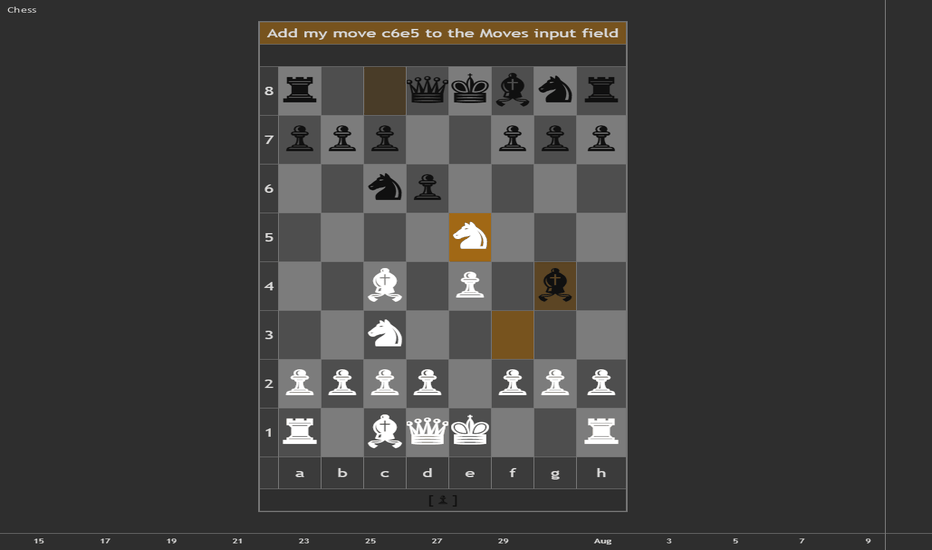
Each entry pairs the moves played so far (both sides' moves, lowercase, one space between) with our reply, written the same way - so the key "e2e4 e7e5" answers with "g1f3". Some entries offer several replies separated by "|", and the consumer picks between them with its game seed, so back-to-back games can open differently. The empty-string key holds White's very first move.
We use a map because the book question is exactly a lookup: given the moves played so far, what do we reply? Simply query the canonical move string as the map key and if we get a reply that's our move in response.
Pine maps can't hold arrays as values, which is why several replies pack into one "|"-separated string. Of course we could define a UDT that contains an array, but it's overhead. The trade-off of keying by move sequence rather than by position is that an unusual move order into a known position misses the book - the cost is an early exit to the ladder, never a wrong move, and in exchange every entry in the source reads as a real game you can play through.
The book holds enough entries for every common defence and sideline on both sides, deeper main lines, and wider choices in some of them.
This split of data from calculation is worth using for non-chess scripts: when a big lookup table and the logic that reads it live in separate libraries, the table can grow on its own release schedule.
See the Chess script to play the book in a real game:
リリースノート
v2Minor display changes.
Pineライブラリ
TradingViewの精神に則り、作者はこのPineコードをオープンソースライブラリとして公開してくれました。コミュニティの他のPineプログラマーが再利用できるようにという配慮です。作者に拍手を!このライブラリは個人利用や他のオープンソースの公開コンテンツで使用できますが、公開物でのコードの再利用はハウスルールに準じる必要があります。

🔥 Beyond Market Structure Paid Space is now live! is.gd/beyondMS
🆓 All my free scripts: is.gd/simplefree
🆓 All my free scripts: is.gd/simplefree
免責事項
これらの情報および投稿は、TradingViewが提供または承認する金融、投資、取引、またはその他の種類の助言もしくは推奨であることを意図したものではなく、またこれらに該当するものでもありません。詳細は利用規約をご覧ください。
Pineライブラリ
TradingViewの精神に則り、作者はこのPineコードをオープンソースライブラリとして公開してくれました。コミュニティの他のPineプログラマーが再利用できるようにという配慮です。作者に拍手を!このライブラリは個人利用や他のオープンソースの公開コンテンツで使用できますが、公開物でのコードの再利用はハウスルールに準じる必要があります。
🔥 Beyond Market Structure Paid Space is now live! is.gd/beyondMS
🆓 All my free scripts: is.gd/simplefree
🆓 All my free scripts: is.gd/simplefree
免責事項
これらの情報および投稿は、TradingViewが提供または承認する金融、投資、取引、またはその他の種類の助言もしくは推奨であることを意図したものではなく、またこれらに該当するものでもありません。詳細は利用規約をご覧ください。