Enhanced Volume
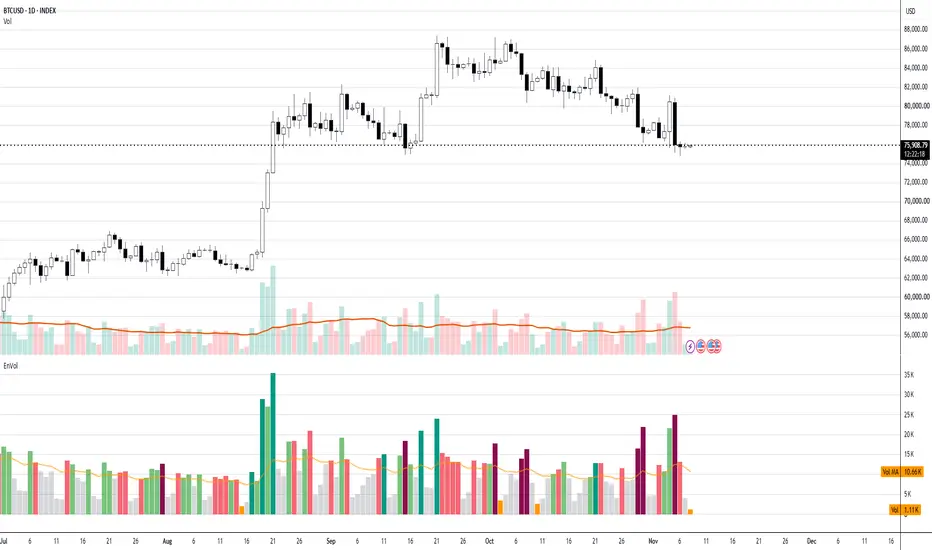
**Enhanced Volume (EnVol)**
A volume histogram that classifies every bar into one of eight tiers, so you can see at a glance whether volume is dry, normal, elevated, a spike, or a pocket pivot. Columns are colored by tier, and a volume moving average is drawn as a reference line.
**Key features**
- **Eight-tier classification:** Each bar gets exactly one color. The highest-priority matching signal wins.
- **Pocket Pivot Volume (PPV):** The strongest signals.
- **PPV Up:** The bar closes up and its volume exceeds the highest down-day volume in the lookback window.
- **PPV Down:** The bar closes down and its volume exceeds the highest up-day volume in the lookback window.
- **Volume spikes:** Volume above a chosen percentage of its moving average, split into spike up and spike down by the close direction.
- **Dry volume:** Flags bars with volume far below average, a sign of low participation or a pause.
- **Hi-Vol Up / Down:** Above-average volume that hasn't reached spike level.
- **Neutral:** Below-average volume with no other signal, shown in muted gray.
- **Volume MA line:** Optional reference line over the histogram.
- **Warm-up protection:** No signals fire until the baseline has valid data.
- **Real-time updates:** Signals recalculate on every tick of the live bar.
**Signal priority (highest first)**
1. PPV Up
2. PPV Down
3. Spike Up
4. Spike Down
5. Dry Volume
6. Hi-Vol Up
7. Hi-Vol Down
8. Neutral
**Settings**
- **Volume Baseline:** MA length (default 20) and a toggle for the MA line.
- **PPV:** Lookback in bars (default 10) used to find the highest opposing-day volume.
- **Spike:** Threshold as a percentage of the MA. Example: 200 means 2× average.
- **Dry Volume:** Threshold as a multiple of the MA (default 0.3, meaning below 30% of average).
- **Bar Colors:** Every tier's color is configurable, plus the MA line color.
**How to use it**
- Look for PPV Up bars during basing or pullback phases, since they show buyers absorbing more than the heaviest recent selling.
- Treat PPV Down and spike-down bars near highs as potential distribution warnings.
- Use dry-volume bars as a sign of low interest, often seen as a base tightens before a move.
- Tune the spike threshold and MA length to the instrument and timeframe. Shorter MAs suit intraday charts, longer ones suit daily and weekly.
- Combine with price structure, trend and support/resistance rather than trading the colors alone.
**Notes**
Direction is based on the close versus the previous close, not the candle's own open. Because this is a separate pane indicator, it uses the chart symbol's own volume, so it works best on instruments with reliable volume data. Forex volume is usually tick volume and is less dependable.
**Disclaimer**
This script is for educational and analytical purposes only. It is not financial advice and does not guarantee outcomes. Always test on your own markets and use proper risk management.

免責事項
これらの情報および投稿は、TradingViewが提供または承認する金融、投資、取引、またはその他の種類の助言もしくは推奨であることを意図したものではなく、またこれらに該当するものでもありません。詳細は利用規約をご覧ください。
免責事項
これらの情報および投稿は、TradingViewが提供または承認する金融、投資、取引、またはその他の種類の助言もしくは推奨であることを意図したものではなく、またこれらに該当するものでもありません。詳細は利用規約をご覧ください。