Signed Excursion Recovery Oscillator [Pineify]
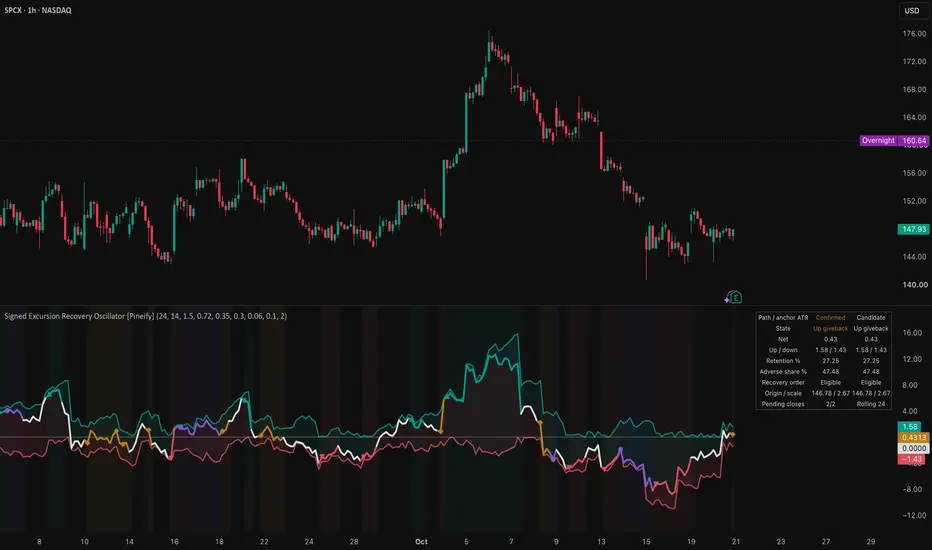
Signed Excursion Recovery Oscillator [Pineify]
Overview
This excursion recovery oscillator compares a rolling endpoint with the highest and lowest prices reached from its starting close. A bipolar field shows retained and surrendered movement in the ATR units known at that start.
Problem Definition
One path rises steadily; another falls, surges and gives back much of its surge. Both can end at the same gain. ROC sees the endpoint; an extreme sees travel but ignores what survived. The problem is to separate retention, giveback and recovery without reading order into every two-sided wick. Direction means the endpoint's side of the starting close.
Design Rationale
A common origin makes travel and endpoint comparable. ATR from that origin prevents current volatility from changing the denominator during the active bar. Retention measures how much of the favorable excursion remains; adverse share measures the competing path. Distinct-bar extreme order adds evidence for recovery. A ratio-only recovery label was rejected because the same extrema can occur in reverse order. Hysteresis and consecutive closes reduce rapid label changes at the cost of delay. Defaults are starting points.
Key Features
How It Works
For an N-bar path, the origin is the close N bars ago and the scale is ATR on that origin bar. The next N bars supply extrema, excluding the origin bar's wicks. Upper/lower excursions are nonnegative highest-minus-origin and origin-minus-lowest distances divided by scale. Net is close minus origin, divided by scale.
Beyond the larger of the dead zone and one tick, the endpoint selects direction. Favorable/adverse excursions swap with direction. Retention is absolute net divided by favorable excursion; adverse share is adverse divided by total excursion. A large favorable excursion with high retention and low adverse share proposes advance. High retention and sufficient adverse share propose recovery only if the latest adverse extreme preceded the latest favorable extreme on distinct bars. Low retention proposes giveback; other valid cases propose noise.
Equal extremes use their latest occurrence; same-bar order is unknown. Same-side states use weaker hold gates. Candidates must repeat for the selected number of closes, including a return to noise. Warm-up needs a complete path and positive origin ATR. Missing OHLC or invalid scale hides readings and clears state at close without a noise transition.
How Multiple Indicators Work Together
These components describe one path. ATR provides units; extremes expose travel but cannot say what survived. Retention separates surrendered travel from retained movement, while adverse share and order distinguish low-opposition advance from recovery. Removing order would label reverse-order paths alike; confirmation controls when the interpretation becomes a displayed state.
Trading Ideas and Insights
Advance supports examining retained displacement; gold giveback asks whether a large excursion has lost endpoint support. Purple recovery identifies an opposite excursion followed by a favorable extreme. Compare candidate and confirmed columns before interpreting changes. Use independent execution and risk rules; these observations are not buy/sell instructions.
Unique Aspects
The contribution relative to ROC is a direction-symmetric state model joining origin-normalized two-sided travel, endpoint retention and a distinct-bar order gate. It separates identical endpoints without inferring intrabar chronology. Its origin rolls every bar; labels describe the latest window rather than one trade or impulse.
How to Use
Use standard OHLC charts and allow warm-up. The upper/lower rails are signed excursion distances; the thick line is the confirmed endpoint. Teal/red indicate advance direction; gold marks giveback and purple recovery. The halo widens with retained fraction, not statistical confidence. Six close-confirmed alerts cover advance, giveback, recovery, noise, coverage loss and restoration; use once per bar close.
Customization
Path length changes both the origin and which extremes survive; ATR length changes starting units. Minimum excursion gates path size, high/low retention gates separate retained and surrendered movement, and adverse share sets recovery opposition. Dead zone filters small endpoints. Hysteresis relaxes hold gates and consecutive closes add delay. Keep the rails when hiding secondary layers.
Assumptions and Limitations
Current candidates can change intrabar; primary plots and labels update at close. Labels can persist while candidates differ. Rolling origin and scale can change readings through expiry without a new event. Wicks, gaps and latest-tie selection affect classification; extreme order is a coarse bar-level proxy, not proof of a continuous recovery. Sparse, synthetic or revised data can mislead. ATR and thresholds are sensitive to timeframe. There is no volume, external data, future access, backfill, trade simulation or performance forecast.
Conclusion
Read the endpoint with the space it traversed and surrendered. Retention and ordered recovery add context to net momentum; rolling-origin and confirmation limits bind interpretation to the observed window.
Overview
This excursion recovery oscillator compares a rolling endpoint with the highest and lowest prices reached from its starting close. A bipolar field shows retained and surrendered movement in the ATR units known at that start.
Problem Definition
One path rises steadily; another falls, surges and gives back much of its surge. Both can end at the same gain. ROC sees the endpoint; an extreme sees travel but ignores what survived. The problem is to separate retention, giveback and recovery without reading order into every two-sided wick. Direction means the endpoint's side of the starting close.
Design Rationale
A common origin makes travel and endpoint comparable. ATR from that origin prevents current volatility from changing the denominator during the active bar. Retention measures how much of the favorable excursion remains; adverse share measures the competing path. Distinct-bar extreme order adds evidence for recovery. A ratio-only recovery label was rejected because the same extrema can occur in reverse order. Hysteresis and consecutive closes reduce rapid label changes at the cost of delay. Defaults are starting points.
Key Features
- Upper and lower excursion rails enclosing a signed endpoint.
- Direction-symmetric advance, giveback, recovery and noise states.
- A retention halo and separate confirmed/candidate summary.
- Optional background, transition markers and live endpoint preview.
How It Works
For an N-bar path, the origin is the close N bars ago and the scale is ATR on that origin bar. The next N bars supply extrema, excluding the origin bar's wicks. Upper/lower excursions are nonnegative highest-minus-origin and origin-minus-lowest distances divided by scale. Net is close minus origin, divided by scale.
Beyond the larger of the dead zone and one tick, the endpoint selects direction. Favorable/adverse excursions swap with direction. Retention is absolute net divided by favorable excursion; adverse share is adverse divided by total excursion. A large favorable excursion with high retention and low adverse share proposes advance. High retention and sufficient adverse share propose recovery only if the latest adverse extreme preceded the latest favorable extreme on distinct bars. Low retention proposes giveback; other valid cases propose noise.
Equal extremes use their latest occurrence; same-bar order is unknown. Same-side states use weaker hold gates. Candidates must repeat for the selected number of closes, including a return to noise. Warm-up needs a complete path and positive origin ATR. Missing OHLC or invalid scale hides readings and clears state at close without a noise transition.
How Multiple Indicators Work Together
These components describe one path. ATR provides units; extremes expose travel but cannot say what survived. Retention separates surrendered travel from retained movement, while adverse share and order distinguish low-opposition advance from recovery. Removing order would label reverse-order paths alike; confirmation controls when the interpretation becomes a displayed state.
Trading Ideas and Insights
Advance supports examining retained displacement; gold giveback asks whether a large excursion has lost endpoint support. Purple recovery identifies an opposite excursion followed by a favorable extreme. Compare candidate and confirmed columns before interpreting changes. Use independent execution and risk rules; these observations are not buy/sell instructions.
Unique Aspects
The contribution relative to ROC is a direction-symmetric state model joining origin-normalized two-sided travel, endpoint retention and a distinct-bar order gate. It separates identical endpoints without inferring intrabar chronology. Its origin rolls every bar; labels describe the latest window rather than one trade or impulse.
How to Use
Use standard OHLC charts and allow warm-up. The upper/lower rails are signed excursion distances; the thick line is the confirmed endpoint. Teal/red indicate advance direction; gold marks giveback and purple recovery. The halo widens with retained fraction, not statistical confidence. Six close-confirmed alerts cover advance, giveback, recovery, noise, coverage loss and restoration; use once per bar close.
Customization
Path length changes both the origin and which extremes survive; ATR length changes starting units. Minimum excursion gates path size, high/low retention gates separate retained and surrendered movement, and adverse share sets recovery opposition. Dead zone filters small endpoints. Hysteresis relaxes hold gates and consecutive closes add delay. Keep the rails when hiding secondary layers.
Assumptions and Limitations
Current candidates can change intrabar; primary plots and labels update at close. Labels can persist while candidates differ. Rolling origin and scale can change readings through expiry without a new event. Wicks, gaps and latest-tie selection affect classification; extreme order is a coarse bar-level proxy, not proof of a continuous recovery. Sparse, synthetic or revised data can mislead. ATR and thresholds are sensitive to timeframe. There is no volume, external data, future access, backfill, trade simulation or performance forecast.
Conclusion
Read the endpoint with the space it traversed and surrendered. Retention and ordered recovery add context to net momentum; rolling-origin and confirmation limits bind interpretation to the observed window.

🚀🚀🚀 Pineify - pineify.app
Essential Toolkit for Every Trader
- AI Pine Script Generator
- Finance AI Agent
- AI Stock Picker
- Pine Script Visual Editor
- Invited indicators
- Strategy Optimizer
- Trading Journal
- Backtest Report
Essential Toolkit for Every Trader
- AI Pine Script Generator
- Finance AI Agent
- AI Stock Picker
- Pine Script Visual Editor
- Invited indicators
- Strategy Optimizer
- Trading Journal
- Backtest Report
免責事項
これらの情報および投稿は、TradingViewが提供または承認する金融、投資、取引、またはその他の種類の助言もしくは推奨であることを意図したものではなく、またこれらに該当するものでもありません。詳細は利用規約をご覧ください。