8am Sniper
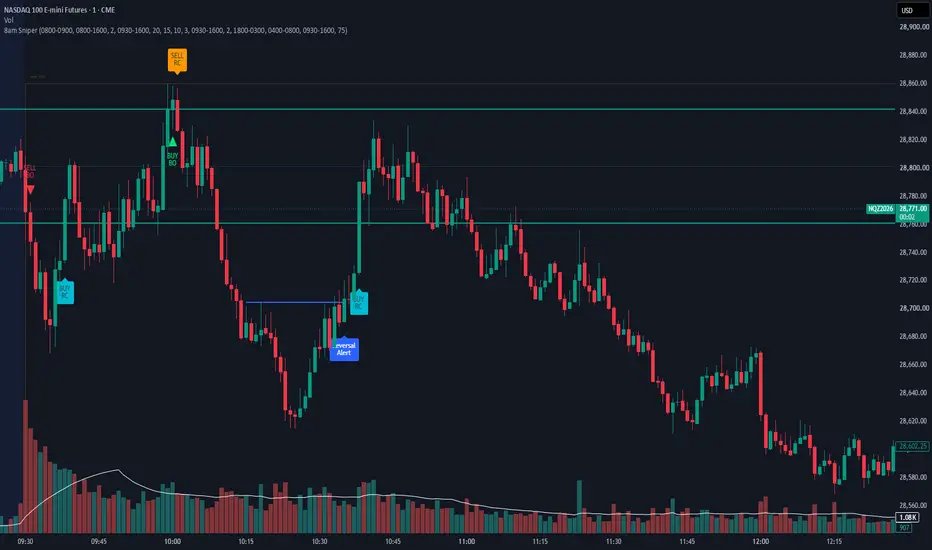
How 8am Sniper works
Signal 1: Breakout (BUY BO / SELL BO), 9:30–16:00 ET
Signal 2: Reclaim (BUY RC / SELL RC), 9:30–16:00 ET
Signal 3: Reversal (Reversal Buy / Reversal Sell), all sessions
All signals fire on a closed candle. When you set alerts, choose “Once Per Bar Close” so you don’t get alerts that disappear mid-candle.
--------------------------------------------------------------------------------------------------------------
The strongest setups
These follow your approach of trading sweeps and reversals with a 40-point max target.
1. Sweep and reclaim (your highest-conviction setup)
2. Reversal plus reclaim stacking (double confirmation)
3. Clean breakout with room
4. Midline reaction
----------------------------------------------------------------------------------------------
Setups to skip
- The indicator marks the high, low, and dotted midline of the 8:00–9:00 ET candle.
- The lines lock in at 9:00 and extend to 16:00 ET.
- Everything else is measured against these three lines.
Signal 1: Breakout (BUY BO / SELL BO), 9:30–16:00 ET
- Fires when a 1-minute candle closes outside the range, coming from inside.
- That candle’s volume must be above its 20-bar average.
- It tells you price has accepted outside the range with real participation.
Signal 2: Reclaim (BUY RC / SELL RC), 9:30–16:00 ET
- Fires when price had closed outside the range and a candle closes back inside on above-average volume.
- It tells you the breakout failed and trapped traders are now on the wrong side.
Signal 3: Reversal (Reversal Buy / Reversal Sell), all sessions
- On the 15-minute chart, it looks for a doji (body 10% or less of the candle’s range) that forms after a trend.
- Once the doji closes, a line is drawn at its high (for a buy) or low (for a sell).
- The signal fires when a 1-minute candle closes through that line within the next two 15-minute candles.
- If price closes through the other side of the doji first, the setup is cancelled.
All signals fire on a closed candle. When you set alerts, choose “Once Per Bar Close” so you don’t get alerts that disappear mid-candle.
--------------------------------------------------------------------------------------------------------------
The strongest setups
These follow your approach of trading sweeps and reversals with a 40-point max target.
1. Sweep and reclaim (your highest-conviction setup)
- Setup: Price breaks the 8AM high or low, runs a key level beyond it (prior-day high or low, overnight high or low, or an obvious swing), then prints RC back inside.
- Entry: On the RC candle close.
- Stop: Just beyond the sweep wick.
- Target: The midline first, then the opposite side of the range if it’s within 40 points.
- Why it works: Breakout traders are trapped, and their stops fuel the move back through the range.
2. Reversal plus reclaim stacking (double confirmation)
- Setup: A Reversal Buy fires near or below the 8AM low and is followed by a BUY RC, or the mirror for sells. Your 10:30 screenshot shows exactly this.
- Why it’s strong: When two independent signals agree, the 15-minute doji shows the trend exhausted and the RC shows price was accepted back into the range.
- Entry: On the first signal, adding on the second, or simply on the second for confirmation.
- Stop: Below the doji low (for buys).
3. Clean breakout with room
- Setup: A BO fires with no key level within 40 points in the direction of the trade.
- Entry: On the BO close, or on a retest of the broken 8AM line that holds.
- Stop: Back inside the range, past the breakout candle.
- Best when: The 8AM range is relatively tight, meaning price compressed before the open.
4. Midline reaction
- After an RC, the midline is the first decision point.
- A clean push through the midline on strong candles often runs to the far side of the range.
- A rejection at the midline is a good spot to take profit.
----------------------------------------------------------------------------------------------
Setups to skip
- Chop: a BO followed quickly by an opposite RC, like your 10:00 BUY BO and SELL RC. If both sides have already been triggered, the range is being chopped. Stand aside or only take the cleanest reclaim.
- Breaking into a wall: a BO where a key level sits less than 40 points away. Your target is blocked before it starts.
- Midday lull: signals roughly 11:30–13:30 ET, when volume typically dries up and above-average volume is easier to hit on small moves.
- Overnight Reversal signals: they’re valid, but liquidity is thinner, so consider smaller size.
- Fighting a fresh signal: taking a trade against a signal that just fired the other way within the last few candles.

免責事項
これらの情報および投稿は、TradingViewが提供または承認する金融、投資、取引、またはその他の種類の助言もしくは推奨であることを意図したものではなく、またこれらに該当するものでもありません。詳細は利用規約をご覧ください。
免責事項
これらの情報および投稿は、TradingViewが提供または承認する金融、投資、取引、またはその他の種類の助言もしくは推奨であることを意図したものではなく、またこれらに該当するものでもありません。詳細は利用規約をご覧ください。