
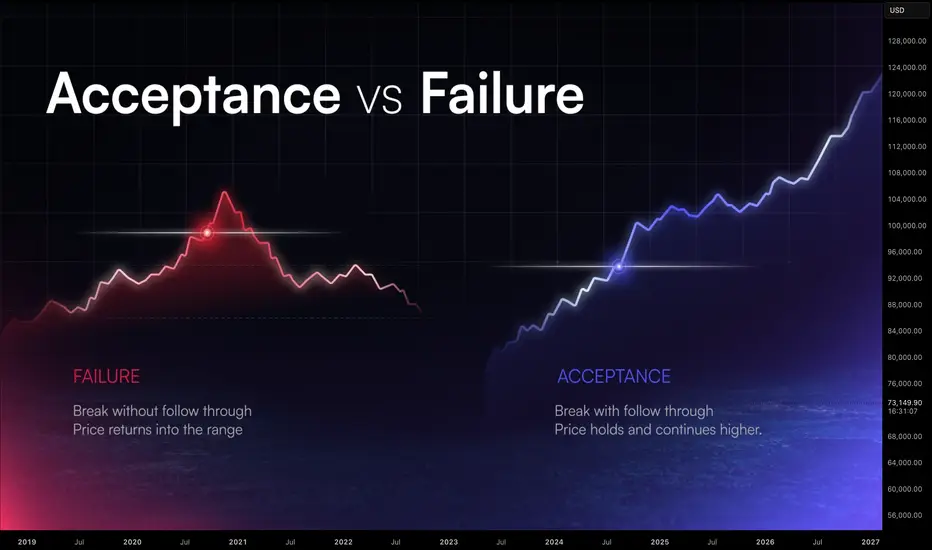
Failed breakouts are often described as traps, but they are rarely random. They occur because the sequence required for continuation is incomplete.
A breakout is not defined by price moving beyond a level. It is defined by the market’s ability to remain beyond that level and build from it.
Most traders focus only on the first part.
When price breaks a resistance level, they interpret it as confirmation of strength and enter immediately. What is often missing is the underlying participation required to sustain that move.
Before a successful breakout, liquidity must be built.
This usually occurs through consolidation. Price rotates within a range, attracting breakout traders and placing stop losses on both sides. This process creates the order flow necessary for a larger move.
When price breaks without this preparation, the move lacks fuel.
The breakout may trigger entries and stops, but without sufficient opposing orders, larger participants cannot sustain direction. Instead, the move is absorbed, and price returns back into the range.
This is the failure.
The breakout itself was not the problem. The conditions leading into it were.
Another key factor is behavior after the break.
In a strong breakout, price moves away from the level and holds above it. Pullbacks remain shallow, and structure begins to form in the new area. In a failed breakout, price hesitates, overlaps, and quickly re-enters the previous range.
This difference is critical.
The first shows acceptance. The second shows rejection.
Traders who understand this do not rush into breakouts. They observe the sequence. They wait to see whether the market can maintain position or whether the move was simply a liquidity event.
Failed breakouts are not anomalies.
They are incomplete moves.
One of the reasons failed breakouts are so common is because traders tend to interpret movement emotionally rather than structurally. The moment price trades beyond a visible level, the breakout appears confirmed visually. Candles expand, momentum increases, and the market suddenly feels directional. This creates urgency. Traders rush to participate because they believe the opportunity exists in the breakout itself rather than in the conditions supporting the breakout.
But strong continuation is rarely created by the break alone.
It is created by the preparation before the break and the acceptance after it.
Without preparation, the market often lacks the liquidity necessary to sustain expansion. A breakout requires participation from both sides. Breakout traders must enter aggressively, while opposing liquidity must exist to absorb those orders and allow larger participants to continue building positions. Consolidation creates this environment naturally. As price rotates within a range, liquidity accumulates above highs and below lows. Stop losses build, breakout traders prepare entries, and positioning gradually becomes concentrated around the boundaries of the range.
This is why consolidation frequently precedes large expansion.
The range itself is not meaningless inactivity. It is the process through which the market prepares liquidity for the next move. Traders who become impatient during consolidation often fail to recognize that the market is building the conditions required for continuation later.
When price breaks a level without sufficient preparation, the breakout often becomes unstable immediately. Momentum appears strong initially because stops and breakout entries create temporary imbalance, but that imbalance quickly fades once the available liquidity is consumed. Without continued participation, the move struggles to progress further. Price begins hesitating, candles overlap, and the breakout loses efficiency almost immediately.
This is where many traders become trapped emotionally.

Because they entered based on visibility, they expect immediate continuation. When the market begins slowing down instead, uncertainty increases rapidly. Some traders tighten stops emotionally. Others continue holding because they remain convinced by the original breakout candle even though the market is no longer behaving constructively.
The important information often appears after the breakout rather than during it.
Strong breakouts tend to behave with stability. Price moves beyond the level and begins accepting the new area. Pullbacks remain controlled, buyers continue defending the breakout zone, and the market gradually builds structure above prior resistance. This acceptance matters because it shows participants are comfortable transacting at higher prices. The breakout is no longer just an emotional expansion. It becomes sustained participation.
Failed breakouts behave very differently.
Instead of building structure, price quickly loses momentum. The market struggles to hold above the level, reactions become unstable, and price rotates back into the previous range. This re-entry is important because it signals that the market rejected the breakout area rather than accepting it. The move may still appear strong visually in hindsight, but structurally it lacked the continuation required for a healthy expansion.
This distinction between acceptance and rejection changes how breakouts should be interpreted entirely.
Inexperienced traders often treat the break itself as the signal. Experienced traders focus more on what happens after the break. Can the market maintain position? Can it absorb pullbacks constructively? Does participation continue supporting expansion, or does momentum disappear immediately after liquidity is taken?
These questions reveal whether the breakout is genuine or incomplete.
This is also why failed breakouts frequently produce strong reversals afterward. Once the breakout fails, trapped participants become liquidity themselves. Traders who entered late into the expansion are forced to exit positions as price returns back into the range. Their exits accelerate movement in the opposite direction, often creating sharp reversals fueled by emotional positioning.
The market understands where emotional traders are likely to act.
Obvious breakout levels attract reactive participation because they appear clear and convincing. When too much positioning becomes concentrated in one direction without proper structural support underneath it, the market often reverses aggressively because the imbalance cannot sustain itself.
Professional traders approach these situations differently because they understand that breakouts are processes, not single moments. They observe the buildup before the move, the liquidity surrounding the level, and the behavior after expansion occurs. They recognize that a breakout without preparation often lacks stability, while a breakout supported by accumulation, structure, and continued acceptance carries much higher probability.
This creates patience.
Instead of reacting immediately to every break of structure, experienced traders wait to see whether the market can actually hold the new territory. They understand that the first expansion often reveals liquidity, but the behavior afterward reveals intent.
That distinction is critical.
Because markets can move beyond a level temporarily without truly accepting those prices. A breakout only becomes meaningful when the market proves it can remain there and continue building structure afterward.
Without that acceptance, the move is often nothing more than a temporary liquidity event.
And temporary liquidity events rarely sustain direction for long.
A breakout is not defined by price moving beyond a level. It is defined by the market’s ability to remain beyond that level and build from it.
Most traders focus only on the first part.
When price breaks a resistance level, they interpret it as confirmation of strength and enter immediately. What is often missing is the underlying participation required to sustain that move.
Before a successful breakout, liquidity must be built.
This usually occurs through consolidation. Price rotates within a range, attracting breakout traders and placing stop losses on both sides. This process creates the order flow necessary for a larger move.
When price breaks without this preparation, the move lacks fuel.
The breakout may trigger entries and stops, but without sufficient opposing orders, larger participants cannot sustain direction. Instead, the move is absorbed, and price returns back into the range.
This is the failure.
The breakout itself was not the problem. The conditions leading into it were.
Another key factor is behavior after the break.
In a strong breakout, price moves away from the level and holds above it. Pullbacks remain shallow, and structure begins to form in the new area. In a failed breakout, price hesitates, overlaps, and quickly re-enters the previous range.
This difference is critical.
The first shows acceptance. The second shows rejection.
Traders who understand this do not rush into breakouts. They observe the sequence. They wait to see whether the market can maintain position or whether the move was simply a liquidity event.
Failed breakouts are not anomalies.
They are incomplete moves.
One of the reasons failed breakouts are so common is because traders tend to interpret movement emotionally rather than structurally. The moment price trades beyond a visible level, the breakout appears confirmed visually. Candles expand, momentum increases, and the market suddenly feels directional. This creates urgency. Traders rush to participate because they believe the opportunity exists in the breakout itself rather than in the conditions supporting the breakout.
But strong continuation is rarely created by the break alone.
It is created by the preparation before the break and the acceptance after it.
Without preparation, the market often lacks the liquidity necessary to sustain expansion. A breakout requires participation from both sides. Breakout traders must enter aggressively, while opposing liquidity must exist to absorb those orders and allow larger participants to continue building positions. Consolidation creates this environment naturally. As price rotates within a range, liquidity accumulates above highs and below lows. Stop losses build, breakout traders prepare entries, and positioning gradually becomes concentrated around the boundaries of the range.
This is why consolidation frequently precedes large expansion.
The range itself is not meaningless inactivity. It is the process through which the market prepares liquidity for the next move. Traders who become impatient during consolidation often fail to recognize that the market is building the conditions required for continuation later.
When price breaks a level without sufficient preparation, the breakout often becomes unstable immediately. Momentum appears strong initially because stops and breakout entries create temporary imbalance, but that imbalance quickly fades once the available liquidity is consumed. Without continued participation, the move struggles to progress further. Price begins hesitating, candles overlap, and the breakout loses efficiency almost immediately.
This is where many traders become trapped emotionally.
Because they entered based on visibility, they expect immediate continuation. When the market begins slowing down instead, uncertainty increases rapidly. Some traders tighten stops emotionally. Others continue holding because they remain convinced by the original breakout candle even though the market is no longer behaving constructively.
The important information often appears after the breakout rather than during it.
Strong breakouts tend to behave with stability. Price moves beyond the level and begins accepting the new area. Pullbacks remain controlled, buyers continue defending the breakout zone, and the market gradually builds structure above prior resistance. This acceptance matters because it shows participants are comfortable transacting at higher prices. The breakout is no longer just an emotional expansion. It becomes sustained participation.
Failed breakouts behave very differently.
Instead of building structure, price quickly loses momentum. The market struggles to hold above the level, reactions become unstable, and price rotates back into the previous range. This re-entry is important because it signals that the market rejected the breakout area rather than accepting it. The move may still appear strong visually in hindsight, but structurally it lacked the continuation required for a healthy expansion.
This distinction between acceptance and rejection changes how breakouts should be interpreted entirely.
Inexperienced traders often treat the break itself as the signal. Experienced traders focus more on what happens after the break. Can the market maintain position? Can it absorb pullbacks constructively? Does participation continue supporting expansion, or does momentum disappear immediately after liquidity is taken?
These questions reveal whether the breakout is genuine or incomplete.
This is also why failed breakouts frequently produce strong reversals afterward. Once the breakout fails, trapped participants become liquidity themselves. Traders who entered late into the expansion are forced to exit positions as price returns back into the range. Their exits accelerate movement in the opposite direction, often creating sharp reversals fueled by emotional positioning.
The market understands where emotional traders are likely to act.
Obvious breakout levels attract reactive participation because they appear clear and convincing. When too much positioning becomes concentrated in one direction without proper structural support underneath it, the market often reverses aggressively because the imbalance cannot sustain itself.
Professional traders approach these situations differently because they understand that breakouts are processes, not single moments. They observe the buildup before the move, the liquidity surrounding the level, and the behavior after expansion occurs. They recognize that a breakout without preparation often lacks stability, while a breakout supported by accumulation, structure, and continued acceptance carries much higher probability.
This creates patience.
Instead of reacting immediately to every break of structure, experienced traders wait to see whether the market can actually hold the new territory. They understand that the first expansion often reveals liquidity, but the behavior afterward reveals intent.
That distinction is critical.
Because markets can move beyond a level temporarily without truly accepting those prices. A breakout only becomes meaningful when the market proves it can remain there and continue building structure afterward.
Without that acceptance, the move is often nothing more than a temporary liquidity event.
And temporary liquidity events rarely sustain direction for long.

🌎 Website
hyrotrader.com/?coupon=hyrosocials
🟣 Discord Community
discord.gg/Pz6N3S4Kmc
🔵 Telegram
t.me/hyrotrading
🔴 YouTube Streams
youtube.com/@HyroTrader/streams
hyrotrader.com/?coupon=hyrosocials
🟣 Discord Community
discord.gg/Pz6N3S4Kmc
🔵 Telegram
t.me/hyrotrading
🔴 YouTube Streams
youtube.com/@HyroTrader/streams
관련 발행물
면책사항
해당 정보와 게시물은 금융, 투자, 트레이딩 또는 기타 유형의 조언이나 권장 사항으로 간주되지 않으며, 트레이딩뷰에서 제공하거나 보증하는 것이 아닙니다. 자세한 내용은 이용 약관을 참조하세요.
🌎 Website
hyrotrader.com/?coupon=hyrosocials
🟣 Discord Community
discord.gg/Pz6N3S4Kmc
🔵 Telegram
t.me/hyrotrading
🔴 YouTube Streams
youtube.com/@HyroTrader/streams
hyrotrader.com/?coupon=hyrosocials
🟣 Discord Community
discord.gg/Pz6N3S4Kmc
🔵 Telegram
t.me/hyrotrading
🔴 YouTube Streams
youtube.com/@HyroTrader/streams
관련 발행물
면책사항
해당 정보와 게시물은 금융, 투자, 트레이딩 또는 기타 유형의 조언이나 권장 사항으로 간주되지 않으며, 트레이딩뷰에서 제공하거나 보증하는 것이 아닙니다. 자세한 내용은 이용 약관을 참조하세요.