
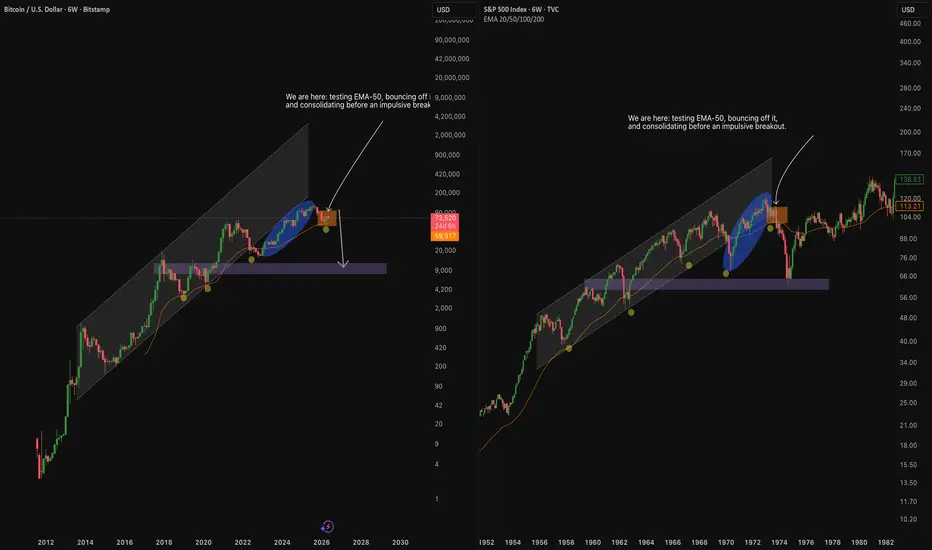
The most dangerous moment in any market is when people stop believing risk exists.
That is exactly what happened before the 1974 crash.
And it’s starting to feel very similar with Bitcoin today.
For three cycles in a row, the market has been pushing the same narrative:
— every BTC cycle will be bigger than the last,
— every bear market low will be higher than the previous one,
— Bitcoin grows in a permanent expansionary trend,
— and if you buy BTC at any price, you will eventually sell it higher.
And now, a huge number of people truly believe it.
Today:
— even people outside crypto talk about $1M Bitcoin,
— every dip is considered a gift,
— fear has almost disappeared,
— and the majority believes the market is simply destined to go higher forever.
But this type of psychology usually appears near the later stages of major cycles.
Back in 1973–1974, investors also believed the strongest assets would keep rising indefinitely.
The market ignored inflation, geopolitical tensions, and systemic risks.
Then came a collapse almost nobody expected.
And the important part:
the crash was not caused by one single event.
The system was already overheated and fragile.
The trigger simply started the chain reaction.
Today’s environment feels uncomfortably similar:
— geopolitical tensions,
— markets dependent on liquidity,
— extreme optimism,
— crowded positioning,
— and widespread belief in endless upside.
Fractals don’t work because history repeats perfectly.
They work because human psychology never changes.
That is exactly what happened before the 1974 crash.
And it’s starting to feel very similar with Bitcoin today.
For three cycles in a row, the market has been pushing the same narrative:
— every BTC cycle will be bigger than the last,
— every bear market low will be higher than the previous one,
— Bitcoin grows in a permanent expansionary trend,
— and if you buy BTC at any price, you will eventually sell it higher.
And now, a huge number of people truly believe it.
Today:
— even people outside crypto talk about $1M Bitcoin,
— every dip is considered a gift,
— fear has almost disappeared,
— and the majority believes the market is simply destined to go higher forever.
But this type of psychology usually appears near the later stages of major cycles.
Back in 1973–1974, investors also believed the strongest assets would keep rising indefinitely.
The market ignored inflation, geopolitical tensions, and systemic risks.
Then came a collapse almost nobody expected.
And the important part:
the crash was not caused by one single event.
The system was already overheated and fragile.
The trigger simply started the chain reaction.
Today’s environment feels uncomfortably similar:
— geopolitical tensions,
— markets dependent on liquidity,
— extreme optimism,
— crowded positioning,
— and widespread belief in endless upside.
Fractals don’t work because history repeats perfectly.
They work because human psychology never changes.

면책사항
해당 정보와 게시물은 금융, 투자, 트레이딩 또는 기타 유형의 조언이나 권장 사항으로 간주되지 않으며, 트레이딩뷰에서 제공하거나 보증하는 것이 아닙니다. 자세한 내용은 이용 약관을 참조하세요.
면책사항
해당 정보와 게시물은 금융, 투자, 트레이딩 또는 기타 유형의 조언이나 권장 사항으로 간주되지 않으며, 트레이딩뷰에서 제공하거나 보증하는 것이 아닙니다. 자세한 내용은 이용 약관을 참조하세요.