
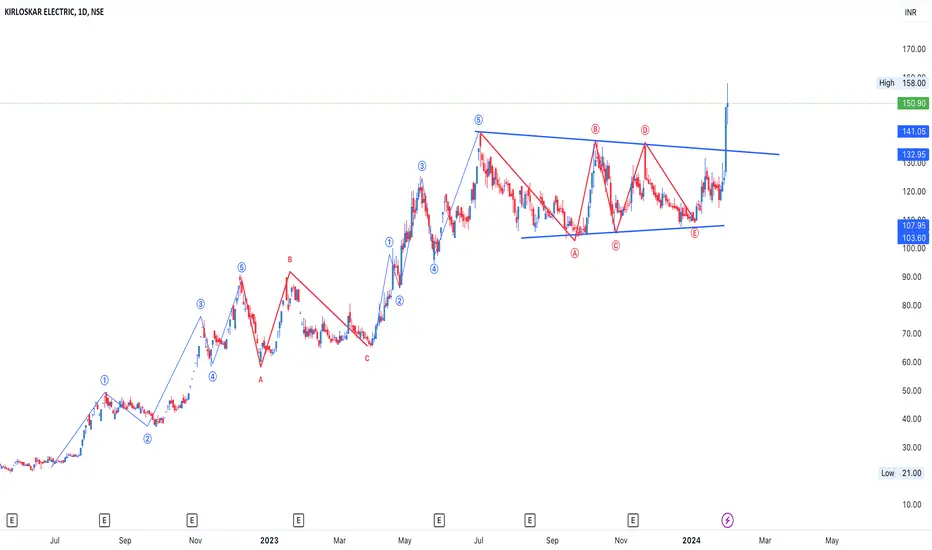
A triangle appears to reflect a balance of forces, causing a sideways movement that is usually associated with decreasing volume and volatility. The triangle pattern contains five overlapping waves that subdivide 3-3-3-3-3 and are labeled A-B-C-D-E. A triangle is delineated by connecting the termination points of waves A and C, and B and D. Wave E can undershoot or overshoot the A-C line, and in fact, our experience tells us that it happens more often than not.
Types of Triangles
There are three varieties of triangles: contracting, barrier and expanding, as illustrated in Figure 1. Elliott contended that the horizontal line of a barrier triangle could occur on either side of the triangle, but such is not the case; it always occurs on the side that the next wave will exceed. Elliott’s terms, “ascending” and “descending,” are nevertheless useful shorthand in communicating whether the barrier triangle occurs in a bull or bear market, respectively.
Figure 1 depicts contracting and barrier triangles as taking place entirely within the area of preceding price action, which may be termed a regular triangle. Yet, it is extremely common for wave B of a contracting triangle to exceed the start of wave A in what may be termed a running triangle, as shown in Figure 2. Despite their sideways appearance, all triangles, including running triangles, effect a net retracement of the preceding wave at wave E’s end.
Types of Triangles
There are three varieties of triangles: contracting, barrier and expanding, as illustrated in Figure 1. Elliott contended that the horizontal line of a barrier triangle could occur on either side of the triangle, but such is not the case; it always occurs on the side that the next wave will exceed. Elliott’s terms, “ascending” and “descending,” are nevertheless useful shorthand in communicating whether the barrier triangle occurs in a bull or bear market, respectively.
Figure 1 depicts contracting and barrier triangles as taking place entirely within the area of preceding price action, which may be termed a regular triangle. Yet, it is extremely common for wave B of a contracting triangle to exceed the start of wave A in what may be termed a running triangle, as shown in Figure 2. Despite their sideways appearance, all triangles, including running triangles, effect a net retracement of the preceding wave at wave E’s end.

Elliott BABA
면책사항
해당 정보와 게시물은 금융, 투자, 트레이딩 또는 기타 유형의 조언이나 권장 사항으로 간주되지 않으며, 트레이딩뷰에서 제공하거나 보증하는 것이 아닙니다. 자세한 내용은 이용 약관을 참조하세요.
Elliott BABA
면책사항
해당 정보와 게시물은 금융, 투자, 트레이딩 또는 기타 유형의 조언이나 권장 사항으로 간주되지 않으며, 트레이딩뷰에서 제공하거나 보증하는 것이 아닙니다. 자세한 내용은 이용 약관을 참조하세요.