
About six years ago, I was first introduced to TradingView. The moment I discovered that TradingView had its own scripting language, Pine Script, I became very interested. I even took a two-week Pine Script class so I could learn how to code my own indicators and strategies.
I have always been fascinated by the performance of moving averages in time series models. Moving averages are simple on the surface, but they can be very powerful when used correctly. There are many types: simple moving average, exponential moving average, weighted moving average, and many customized variations.
But one of the most interesting ones I have worked with is the Hull Moving Average, or HMA.
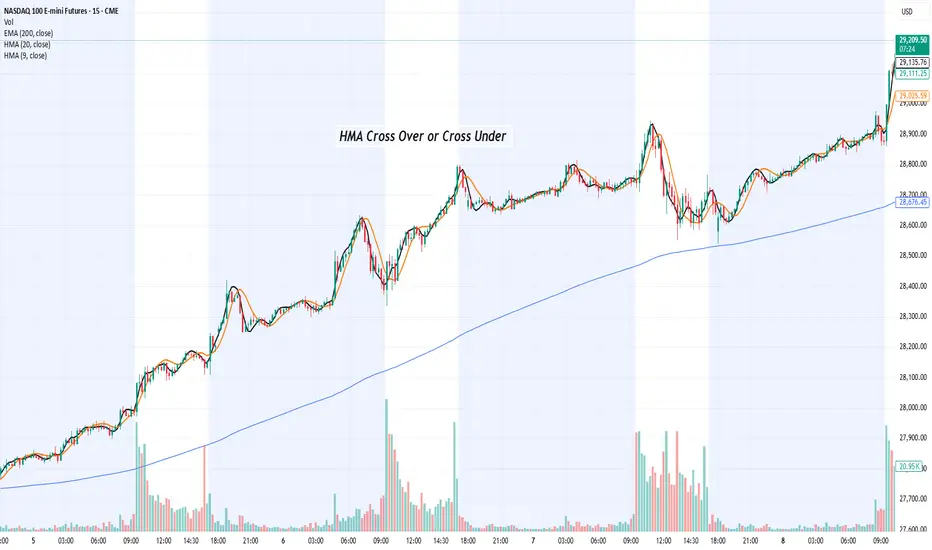
The Hull Moving Average was designed to reduce lag while still keeping the line smooth. Traditional moving averages often react slowly to price changes because they average past data. The HMA tries to solve this by using weighted moving averages and a square-root-based smoothing period. In simple terms, it responds faster to price movement while avoiding some of the noise you might see in a very short moving average.
That is why HMA has become the backbone of many of my trading strategies. I use it because it gives me a smoother view of market direction while still reacting quickly enough to be useful in fast-moving markets like futures.
Now, when you look at the result of this strategy inside TradingView, you may think, “This strategy is losing money.” But there is an important point to understand.
What you see on TradingView is usually one fixed set of parameters applied over a long period, like 12 months. That is not how I actually use the strategy.
My approach is based on walk-forward optimization. That means I train the strategy on one period of data, then test it on the next period. For example, I may train the model on one month of data and then use those selected parameters for the following month.
So the parameters are not fixed for the entire year. They change over time based on the most recent market behavior. This is important because markets change. A parameter set that works well in one regime may not work well in another.
That is why I do not recommend using one fixed set of parameters for 12 months without adjustment. The real value of this strategy comes from the process: training, testing, adjusting, and repeating the process as market conditions evolve.
I have always been fascinated by the performance of moving averages in time series models. Moving averages are simple on the surface, but they can be very powerful when used correctly. There are many types: simple moving average, exponential moving average, weighted moving average, and many customized variations.
But one of the most interesting ones I have worked with is the Hull Moving Average, or HMA.
The Hull Moving Average was designed to reduce lag while still keeping the line smooth. Traditional moving averages often react slowly to price changes because they average past data. The HMA tries to solve this by using weighted moving averages and a square-root-based smoothing period. In simple terms, it responds faster to price movement while avoiding some of the noise you might see in a very short moving average.
That is why HMA has become the backbone of many of my trading strategies. I use it because it gives me a smoother view of market direction while still reacting quickly enough to be useful in fast-moving markets like futures.
Now, when you look at the result of this strategy inside TradingView, you may think, “This strategy is losing money.” But there is an important point to understand.
What you see on TradingView is usually one fixed set of parameters applied over a long period, like 12 months. That is not how I actually use the strategy.
My approach is based on walk-forward optimization. That means I train the strategy on one period of data, then test it on the next period. For example, I may train the model on one month of data and then use those selected parameters for the following month.
So the parameters are not fixed for the entire year. They change over time based on the most recent market behavior. This is important because markets change. A parameter set that works well in one regime may not work well in another.
That is why I do not recommend using one fixed set of parameters for 12 months without adjustment. The real value of this strategy comes from the process: training, testing, adjusting, and repeating the process as market conditions evolve.

면책사항
해당 정보와 게시물은 금융, 투자, 트레이딩 또는 기타 유형의 조언이나 권장 사항으로 간주되지 않으며, 트레이딩뷰에서 제공하거나 보증하는 것이 아닙니다. 자세한 내용은 이용 약관을 참조하세요.
면책사항
해당 정보와 게시물은 금융, 투자, 트레이딩 또는 기타 유형의 조언이나 권장 사항으로 간주되지 않으며, 트레이딩뷰에서 제공하거나 보증하는 것이 아닙니다. 자세한 내용은 이용 약관을 참조하세요.