
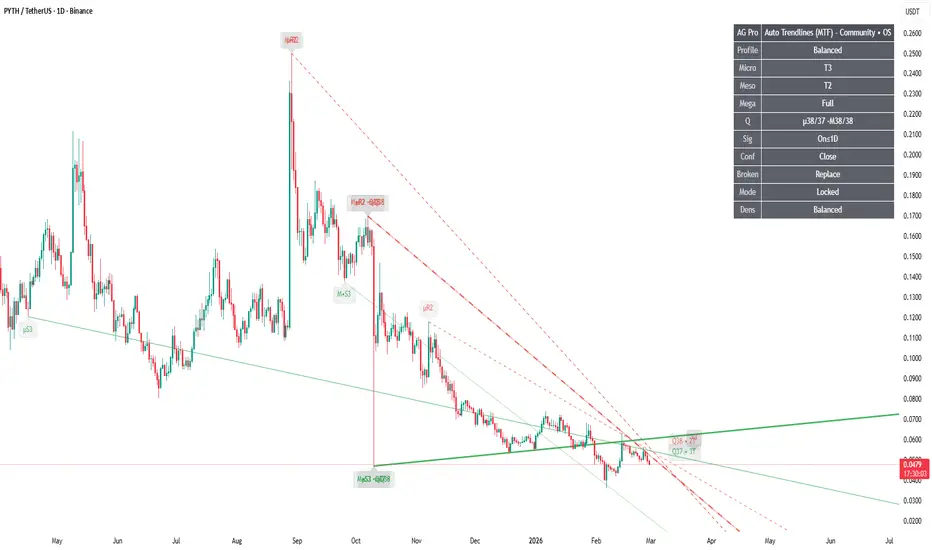
Break vs Retest - Clean Definitions, Conservative Confirmation, Better Decisions
“Break and retest” is one of the most misused phrases in trading.
People treat it like an entry recipe. In reality, breaks and retests are context events — attention markers.
This script treats Break/Retest as an interpretation layer:
- Break: price violates the trendline under your chosen confirmation rule
- Retest (optional): price revisits the trendline zone after a break
Important: many retests fail or overshoot.
The most important setting is confirmation:
- Intrabar (touch/cross): faster, noisier, more false positives in chop
- Bar-close confirmation: slower, usually cleaner, reduces whipsaws
A practical “safe default” approach:
1) Use Close confirmation for breaks
- You get fewer events, but they are more meaningful.
- Retests become more interpretable because the break is confirmed.
2) Treat retests as observation zones, not orders
Ask:
- Did the broken line flip role (support ↔ resistance)?
- Did price accept or reject around the line?
- Is the broader regime trending or ranging?
3) Use cooldown (if available) to reduce spam
Repeated triggers in chop are a feature of the market, not a bug. Cooldown helps you keep focus.
Limitations:
In ranging markets, breaks happen frequently and are less informative. In volatile markets, overshoots are normal.
Risk disclosure:
Educational content only. Not financial advice.

면책사항
해당 정보와 게시물은 금융, 투자, 트레이딩 또는 기타 유형의 조언이나 권장 사항으로 간주되지 않으며, 트레이딩뷰에서 제공하거나 보증하는 것이 아닙니다. 자세한 내용은 이용 약관을 참조하세요.
면책사항
해당 정보와 게시물은 금융, 투자, 트레이딩 또는 기타 유형의 조언이나 권장 사항으로 간주되지 않으며, 트레이딩뷰에서 제공하거나 보증하는 것이 아닙니다. 자세한 내용은 이용 약관을 참조하세요.