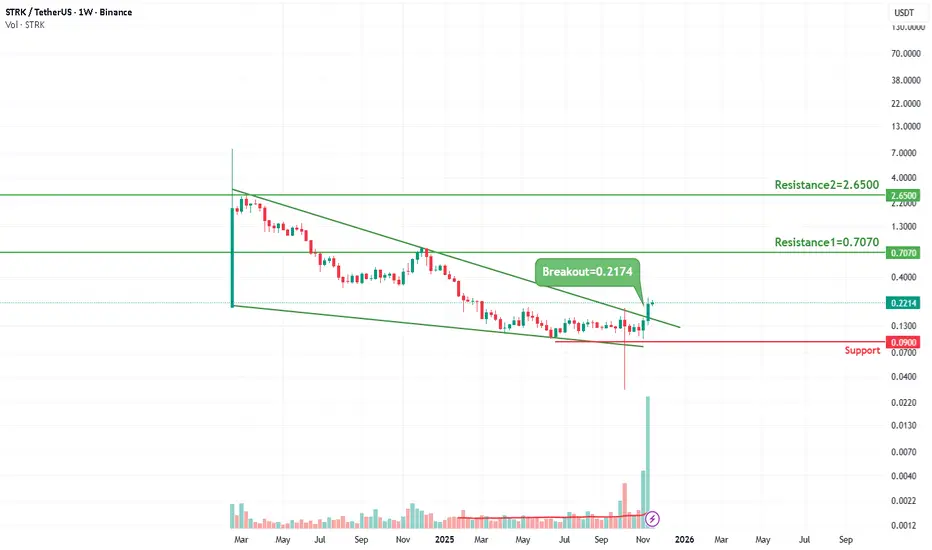

 STRKUSDT
 Charts are self-explanatory. Levels of breakout, possible up-moves (where stock may find resistances) and support (close below which, setup will be invalidated) are clearly defined.
1. What Is STRK / Strike
- Strike is a decentralized lending / money-market protocol on Ethereum.
- Users can supply assets (e.g., ETH, ERC-20s) and receive sTokens in return (like sETH). These sTokens accrue interest.
- Tokenomics:
- Max supply = ~6,540,888 STRK
- Some STRK is distributed via “liquidity mining” over time. According to the whitepaper, ~3.5 million STRK to be mined over ~8 years
- According to the Medium post, there was no ICO / token sale — STRK was distributed to users (mined) rather than sold in a public sale
- The protocol is open-source; its smart-contract code is on GitHub.
2. Strengths / Key Positives (Fundamentals)
- Decentralized Governance: STRK holders have real voting power; the Governor model enables scalability in decision-making.
- Proven Money-Market Design: Strike is based on a model similar to Compound, a well-established DeFi lending protocol, The idea of sTokens (interest-bearing) is simple and tested.
- Limited Supply: With a capped supply (~6.54M), there is some scarcity.
- Smart-Contract Transparency: The protocol’s code is publicly auditable, Governance processes are clearly defined (voting, timelocks).
3. Key Risks / Challenges
- Adoption Risk
- Governance Centralization Risk
- Emission / Distribution Risk
- Smart Contract / Protocol Risk
- Market Risk

면책사항
해당 정보와 게시물은 금융, 투자, 트레이딩 또는 기타 유형의 조언이나 권장 사항으로 간주되지 않으며, 트레이딩뷰에서 제공하거나 보증하는 것이 아닙니다. 자세한 내용은 이용 약관을 참조하세요.
면책사항
해당 정보와 게시물은 금융, 투자, 트레이딩 또는 기타 유형의 조언이나 권장 사항으로 간주되지 않으며, 트레이딩뷰에서 제공하거나 보증하는 것이 아닙니다. 자세한 내용은 이용 약관을 참조하세요.