

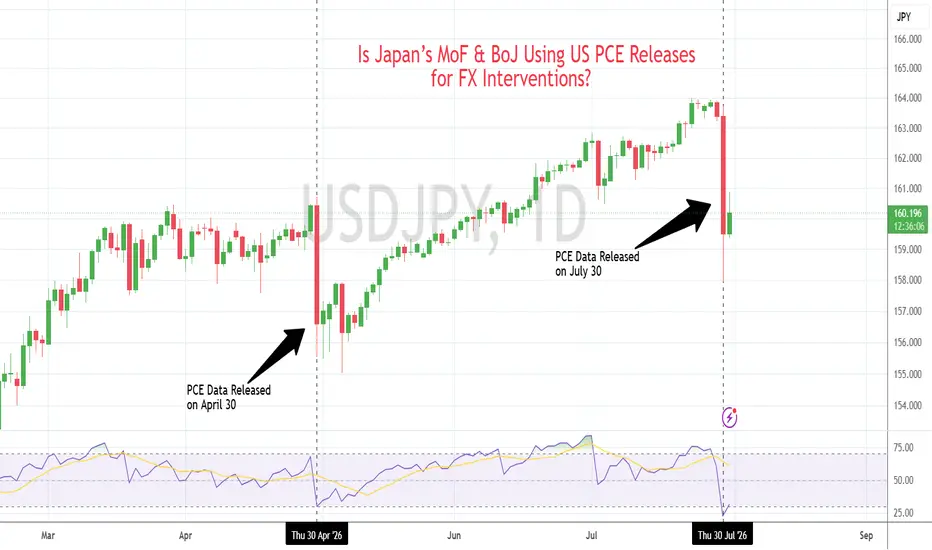
Take a close look at the daily chart of USDJPY.
The massive red candles on April 30 and July 30 highlights a clear, tactical correlation.
The Bottom Line:
It could not be just a coincidence. Japanese authorities seem to actively weaponize the heavy trading volume and volatility that occurs during U.S. PCE releases to hide or compound their market intervention footprint.
Keep a very close eye on the calendar for upcoming U.S. inflation data drops—they have officially become prime territory for major Yen reversals.
The massive red candles on April 30 and July 30 highlights a clear, tactical correlation.
- The Action: Sharp Japanese Yen-buying interventions to suppress a runaway USDJPY exchange rate.
- The Funding: Tokyo funding the operation by bulk-purchasing JPY and dumping U.S. Treasuries.
- The Timing: Both instances landed exactly on days when the U.S. Bureau of Economic Analysis (BEA) dropped its PCE inflation data.
The Bottom Line:
It could not be just a coincidence. Japanese authorities seem to actively weaponize the heavy trading volume and volatility that occurs during U.S. PCE releases to hide or compound their market intervention footprint.
Keep a very close eye on the calendar for upcoming U.S. inflation data drops—they have officially become prime territory for major Yen reversals.

면책사항
해당 정보와 게시물은 금융, 투자, 트레이딩 또는 기타 유형의 조언이나 권장 사항으로 간주되지 않으며, 트레이딩뷰에서 제공하거나 보증하는 것이 아닙니다. 자세한 내용은 이용 약관을 참조하세요.
면책사항
해당 정보와 게시물은 금융, 투자, 트레이딩 또는 기타 유형의 조언이나 권장 사항으로 간주되지 않으며, 트레이딩뷰에서 제공하거나 보증하는 것이 아닙니다. 자세한 내용은 이용 약관을 참조하세요.