
Most traders see a candlestick.
Experienced traders see a conversation.
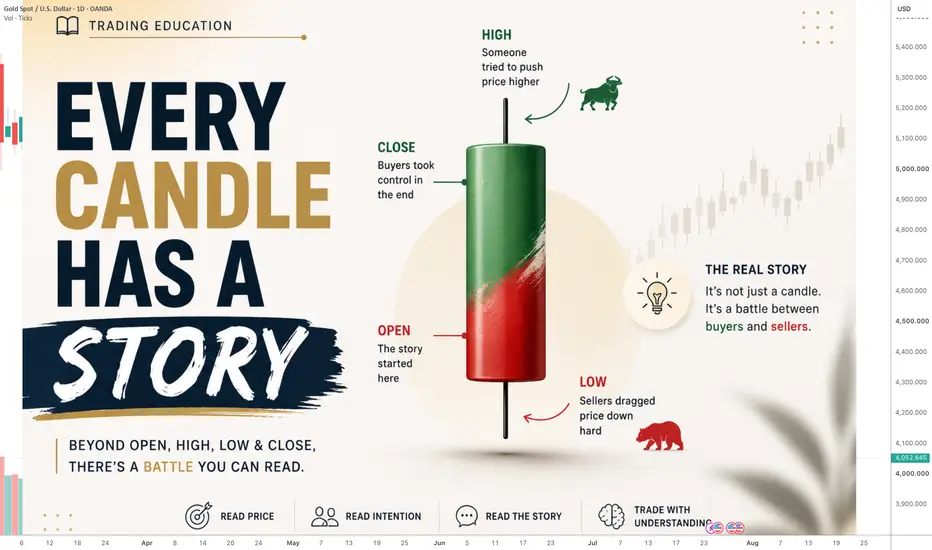
Every candle on your chart is the result of thousands of decisions made by buyers and sellers in real time. Behind every open, high, low, and close lies a battle between confidence and doubt, patience and panic, accumulation and distribution. A candle isn't just a price bar—it's a snapshot of market psychology.
When I first started trading, I focused on memorizing candlestick patterns. Hammers, Dojis, Engulfing Candles—I knew their names, but I didn't truly understand what they represented. It wasn't until I began asking "Why did this candle form?" instead of "What is this pattern called?" that my perspective completely changed.
A long upper wick often tells the story of buyers who pushed prices higher, only to meet aggressive selling. A strong bullish candle reveals conviction. A small-bodied candle after a large move may signal hesitation rather than certainty. Every candle records a struggle, and learning to read that struggle is often more valuable than memorizing dozens of patterns.
The market speaks through price, but it rarely speaks in words. It speaks through momentum, rejection, acceptance, and imbalance. The more you understand the story behind each candle, the less you'll rely on mechanical pattern recognition and the more you'll begin to understand the intentions driving market movement.
In this article, we'll look beyond the shape of candlesticks and explore the message they carry. Instead of simply identifying candles, we'll learn to interpret the emotions, decisions, and order flow that created them.
Because the best traders don't just read candles.
"They read the story the market is trying to tell."
Experienced traders see a conversation.
Every candle on your chart is the result of thousands of decisions made by buyers and sellers in real time. Behind every open, high, low, and close lies a battle between confidence and doubt, patience and panic, accumulation and distribution. A candle isn't just a price bar—it's a snapshot of market psychology.
When I first started trading, I focused on memorizing candlestick patterns. Hammers, Dojis, Engulfing Candles—I knew their names, but I didn't truly understand what they represented. It wasn't until I began asking "Why did this candle form?" instead of "What is this pattern called?" that my perspective completely changed.
A long upper wick often tells the story of buyers who pushed prices higher, only to meet aggressive selling. A strong bullish candle reveals conviction. A small-bodied candle after a large move may signal hesitation rather than certainty. Every candle records a struggle, and learning to read that struggle is often more valuable than memorizing dozens of patterns.
The market speaks through price, but it rarely speaks in words. It speaks through momentum, rejection, acceptance, and imbalance. The more you understand the story behind each candle, the less you'll rely on mechanical pattern recognition and the more you'll begin to understand the intentions driving market movement.
In this article, we'll look beyond the shape of candlesticks and explore the message they carry. Instead of simply identifying candles, we'll learn to interpret the emotions, decisions, and order flow that created them.
Because the best traders don't just read candles.
"They read the story the market is trying to tell."

관련 발행물
면책사항
해당 정보와 게시물은 금융, 투자, 트레이딩 또는 기타 유형의 조언이나 권장 사항으로 간주되지 않으며, 트레이딩뷰에서 제공하거나 보증하는 것이 아닙니다. 자세한 내용은 이용 약관을 참조하세요.
관련 발행물
면책사항
해당 정보와 게시물은 금융, 투자, 트레이딩 또는 기타 유형의 조언이나 권장 사항으로 간주되지 않으며, 트레이딩뷰에서 제공하거나 보증하는 것이 아닙니다. 자세한 내용은 이용 약관을 참조하세요.