
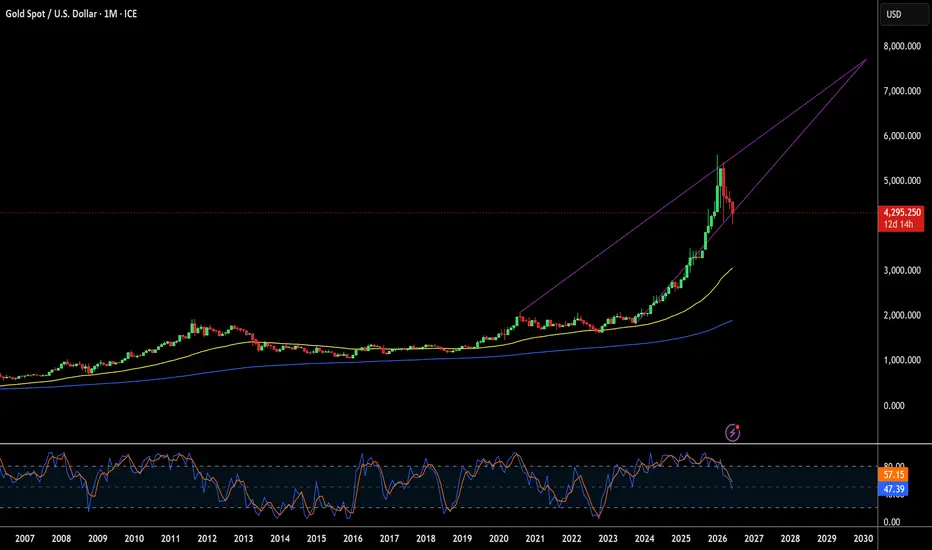
Gold trades near $4,340 an ounce after a historic run that briefly pushed it above $5,000, with an intraday peak around $5,594. The striking part is what it is holding through. The preliminary US-Iran accord reopened the Strait of Hormuz and cooled oil and inflation fears, the kind of de-risking that normally pressures a safe-haven asset. Gold's resilience suggests the bid is structural, not merely a fear trade.
That structural bid rests on official-sector demand and de-dollarization. Central banks have bought more than 1,000 tonnes a year since 2022, led by China, India, Poland, and Turkey diversifying reserves away from the dollar and insulating against sanctions. These flows are strategic rather than tactical, which is why dips keep getting bought. The backdrop helps: Fed Chair Kevin Warsh is holding rates at 3.50% to 3.75%, and with inflation fears easing, real rates stay contained enough to support the metal.
The forecasts are bullish but far from unanimous. The LBMA's own 2026 view calls $4,500 to $5,000 entirely reasonable, its survey consensus sits near $4,742, and Wall Street targets cluster higher, with JPMorgan at $6,300 and Goldman at $6,000. The headline $7,000-by-2030 figure is real, but it is one analyst's rational-case scenario published in the LBMA's Alchemist on a 4% inflation assumption, not a house view. The counterweight matters: forecast dispersion is extreme, and the LBMA survey itself warns that fading geopolitical stress and post-midterm stability could pull gold back below $4,000.
The honest read is that gold's secular case is the strongest in a generation, anchored by relentless central bank buying and mounting sovereign debt, yet the near-term price carries a heavy risk premium that the US-Iran thaw is already starting to deflate. A pullback toward or below $4,000 is a live risk even inside a structural bull market. Treat gold as a strategic hedge against debt and de-dollarization, size the position for volatility, and view $7,000 as a plausible long-term scenario rather than a base case. Near term, the swing factor is simply whether the risk premium holds.
That structural bid rests on official-sector demand and de-dollarization. Central banks have bought more than 1,000 tonnes a year since 2022, led by China, India, Poland, and Turkey diversifying reserves away from the dollar and insulating against sanctions. These flows are strategic rather than tactical, which is why dips keep getting bought. The backdrop helps: Fed Chair Kevin Warsh is holding rates at 3.50% to 3.75%, and with inflation fears easing, real rates stay contained enough to support the metal.
The forecasts are bullish but far from unanimous. The LBMA's own 2026 view calls $4,500 to $5,000 entirely reasonable, its survey consensus sits near $4,742, and Wall Street targets cluster higher, with JPMorgan at $6,300 and Goldman at $6,000. The headline $7,000-by-2030 figure is real, but it is one analyst's rational-case scenario published in the LBMA's Alchemist on a 4% inflation assumption, not a house view. The counterweight matters: forecast dispersion is extreme, and the LBMA survey itself warns that fading geopolitical stress and post-midterm stability could pull gold back below $4,000.
The honest read is that gold's secular case is the strongest in a generation, anchored by relentless central bank buying and mounting sovereign debt, yet the near-term price carries a heavy risk premium that the US-Iran thaw is already starting to deflate. A pullback toward or below $4,000 is a live risk even inside a structural bull market. Treat gold as a strategic hedge against debt and de-dollarization, size the position for volatility, and view $7,000 as a plausible long-term scenario rather than a base case. Near term, the swing factor is simply whether the risk premium holds.

The5ers Funding Forex Traders & Growth Program. Get Funded with up to $2.56M
We Trade Forex - Come Join Us!
the5ers.com
We Trade Forex - Come Join Us!
the5ers.com
면책사항
해당 정보와 게시물은 금융, 투자, 트레이딩 또는 기타 유형의 조언이나 권장 사항으로 간주되지 않으며, 트레이딩뷰에서 제공하거나 보증하는 것이 아닙니다. 자세한 내용은 이용 약관을 참조하세요.
The5ers Funding Forex Traders & Growth Program. Get Funded with up to $2.56M
We Trade Forex - Come Join Us!
the5ers.com
We Trade Forex - Come Join Us!
the5ers.com
면책사항
해당 정보와 게시물은 금융, 투자, 트레이딩 또는 기타 유형의 조언이나 권장 사항으로 간주되지 않으며, 트레이딩뷰에서 제공하거나 보증하는 것이 아닙니다. 자세한 내용은 이용 약관을 참조하세요.