OPEN-SOURCE SCRIPT
Momentum Covenant Bias [JOAT]
Momentum Covenant Bias [JOAT]
Introduction
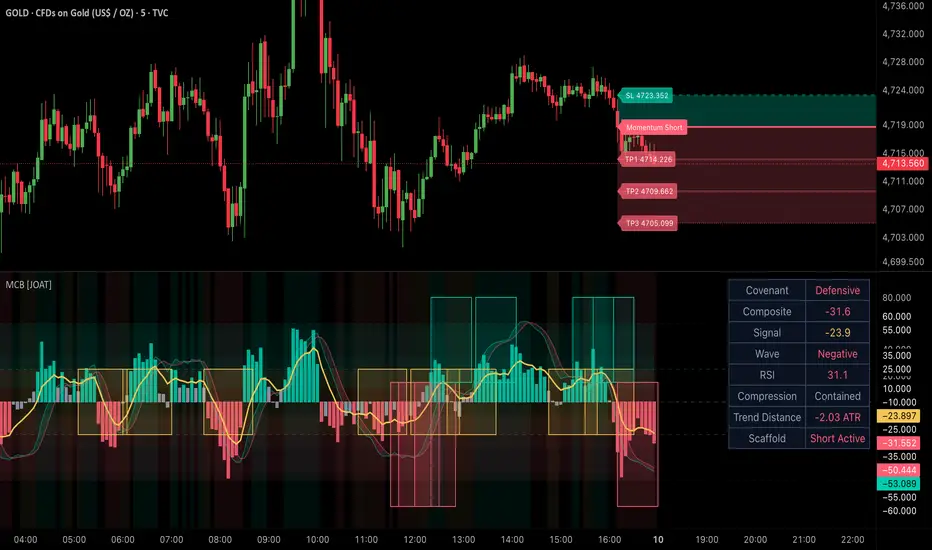
Momentum Covenant Bias is an open-source momentum pane designed to classify whether the market is in a constructive, defensive, balanced, or compressed state. It blends WaveTrend timing, RSI displacement, normalized trend distance, compression logic, layered state bands, pane boxes, and an optional force-overlay TP/SL scaffold when fresh confirmed momentum shifts occur.
This indicator is meant to solve timing. Trend and auction context can describe where the market is, but they do not always tell you whether momentum is actually participating in the current move. Momentum Covenant Bias translates several independent momentum dimensions into one composite state engine and presents them in a clean, institutional-style pane.

Core Concepts
1. WaveTrend Timing
WaveTrend serves as the primary turning-point rhythm engine. The script uses the relationship between the main line and signal line to measure timing pressure.
2. RSI Displacement
RSI is evaluated not only relative to 50, but also relative to its own smoothed mean. This helps distinguish raw strength from persistent displacement.
3. Normalized Trend Distance
Price distance from the slower trend baseline is normalized by ATR so the output remains portable across markets with different price scales.
4. Compression State
Compression logic compares recent range behavior to a slower baseline. This helps identify lower-energy conditions before expansion.
5. State Boxes and Overlay Scaffold
The pane includes positive, negative, and compression zones, and can project a force-overlay TP/SL scaffold on the chart when a fresh momentum shift is confirmed.
Features
How to Use This Indicator
Step 1: Read the composite state first. Balanced states should be interpreted differently from impulse states.
Step 2: Compare the composite score to the signal line. Fresh separation often matters more than absolute level alone.
Step 3: Watch compression zones. These can help explain why a market is not yet extending despite directional context elsewhere.
Step 4: If using the optional scaffold, treat it as a planning aid that reflects momentum state, not as a standalone trade system.
Indicator Limitations
Originality Statement
Momentum Covenant Bias is original in the way it combines multi-source momentum confirmation, pane state boxes, gradient regime presentation, and force-overlay planning rails in one open-source script. The indicator is intended as a timing layer that complements structure and auction context instead of replacing them.
Disclaimer
This indicator is provided for educational and informational purposes only. It is not financial advice. Momentum conditions are derived from historical price behavior and may fail or reverse without warning. Use proper risk management and independent validation.
-Made with passion by jackofalltrades
Introduction
Momentum Covenant Bias is an open-source momentum pane designed to classify whether the market is in a constructive, defensive, balanced, or compressed state. It blends WaveTrend timing, RSI displacement, normalized trend distance, compression logic, layered state bands, pane boxes, and an optional force-overlay TP/SL scaffold when fresh confirmed momentum shifts occur.
This indicator is meant to solve timing. Trend and auction context can describe where the market is, but they do not always tell you whether momentum is actually participating in the current move. Momentum Covenant Bias translates several independent momentum dimensions into one composite state engine and presents them in a clean, institutional-style pane.
Core Concepts
1. WaveTrend Timing
WaveTrend serves as the primary turning-point rhythm engine. The script uses the relationship between the main line and signal line to measure timing pressure.
2. RSI Displacement
RSI is evaluated not only relative to 50, but also relative to its own smoothed mean. This helps distinguish raw strength from persistent displacement.
3. Normalized Trend Distance
Price distance from the slower trend baseline is normalized by ATR so the output remains portable across markets with different price scales.
4. Compression State
Compression logic compares recent range behavior to a slower baseline. This helps identify lower-energy conditions before expansion.
5. State Boxes and Overlay Scaffold
The pane includes positive, negative, and compression zones, and can project a force-overlay TP/SL scaffold on the chart when a fresh momentum shift is confirmed.
Features
- Composite momentum score: Combines WaveTrend, RSI, trend distance, and compression context
- Signal line: Smoothed line for momentum transitions
- Layered state bands: Positive, negative, and extension zones rendered as gradients
- Compression boxes: Visual isolation of low-energy conditions
- Top-right dashboard: Displays composite score, signal, wave state, RSI, compression, trend distance, and scaffold status
- Force-overlay TP/SL scaffold: Optional informational rails on fresh positive or negative momentum shifts
- Confirmed-bar state promotion: Uses confirmed bars for event states instead of unstable intrabar triggers
How to Use This Indicator
Step 1: Read the composite state first. Balanced states should be interpreted differently from impulse states.
Step 2: Compare the composite score to the signal line. Fresh separation often matters more than absolute level alone.
Step 3: Watch compression zones. These can help explain why a market is not yet extending despite directional context elsewhere.
Step 4: If using the optional scaffold, treat it as a planning aid that reflects momentum state, not as a standalone trade system.
Indicator Limitations
- Momentum state can reverse quickly in whipsaw markets
- Compression logic can remain active for extended periods in slow markets
- WaveTrend and RSI are still derivatives of price and can lag during violent reversals
- The overlay scaffold is informational and does not execute orders
Originality Statement
Momentum Covenant Bias is original in the way it combines multi-source momentum confirmation, pane state boxes, gradient regime presentation, and force-overlay planning rails in one open-source script. The indicator is intended as a timing layer that complements structure and auction context instead of replacing them.
Disclaimer
This indicator is provided for educational and informational purposes only. It is not financial advice. Momentum conditions are derived from historical price behavior and may fail or reverse without warning. Use proper risk management and independent validation.
-Made with passion by jackofalltrades
오픈 소스 스크립트
트레이딩뷰의 진정한 정신에 따라, 이 스크립트의 작성자는 이를 오픈소스로 공개하여 트레이더들이 기능을 검토하고 검증할 수 있도록 했습니다. 작성자에게 찬사를 보냅니다! 이 코드는 무료로 사용할 수 있지만, 코드를 재게시하는 경우 하우스 룰이 적용된다는 점을 기억하세요.

The AI Trading Ecosystem, Built to win trades 📈
Get Full Access 👇
jackofalltrades.vip 🌐
t.me/jackofalltradesvip 🃏
Get Full Access 👇
jackofalltrades.vip 🌐
t.me/jackofalltradesvip 🃏
면책사항
해당 정보와 게시물은 금융, 투자, 트레이딩 또는 기타 유형의 조언이나 권장 사항으로 간주되지 않으며, 트레이딩뷰에서 제공하거나 보증하는 것이 아닙니다. 자세한 내용은 이용 약관을 참조하세요.
오픈 소스 스크립트
트레이딩뷰의 진정한 정신에 따라, 이 스크립트의 작성자는 이를 오픈소스로 공개하여 트레이더들이 기능을 검토하고 검증할 수 있도록 했습니다. 작성자에게 찬사를 보냅니다! 이 코드는 무료로 사용할 수 있지만, 코드를 재게시하는 경우 하우스 룰이 적용된다는 점을 기억하세요.
The AI Trading Ecosystem, Built to win trades 📈
Get Full Access 👇
jackofalltrades.vip 🌐
t.me/jackofalltradesvip 🃏
Get Full Access 👇
jackofalltrades.vip 🌐
t.me/jackofalltradesvip 🃏
면책사항
해당 정보와 게시물은 금융, 투자, 트레이딩 또는 기타 유형의 조언이나 권장 사항으로 간주되지 않으며, 트레이딩뷰에서 제공하거나 보증하는 것이 아닙니다. 자세한 내용은 이용 약관을 참조하세요.