OPEN-SOURCE SCRIPT
Regime Execution Strategy [JOAT]
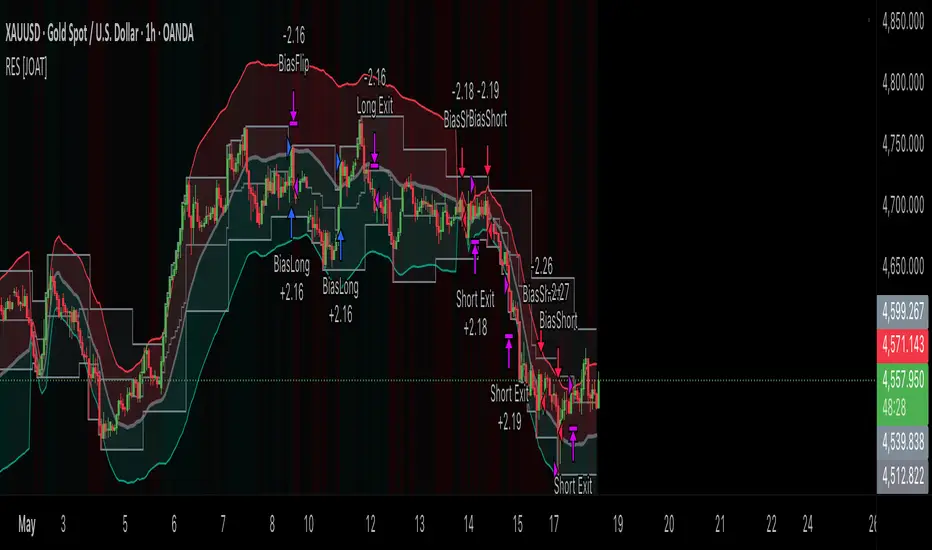
Regime Execution Strategy [JOAT]
Introduction
Regime Execution Strategy is an open-source TradingView strategy that integrates adaptive forecast context, extreme-channel state, trend pressure, relative volume, and EMA structure into a single rule-based execution model. The strategy is designed to be realistic, non-repainting, and readable rather than curve-fit to one symbol.
The problem it solves is trade filtering. A single signal source can trigger too often in poor conditions. Regime Execution Strategy requires multiple independent votes before entries are allowed, then uses ATR-based stop and target logic for consistent risk framing.
Core Concepts
1. Adaptive Forecast Bias
The strategy estimates a dynamic mean and band structure. Price above or below the adaptive mean contributes to directional bias.
2. Extreme Channel Bias
Persistent upper and lower channel levels define a midpoint and directional state. The channel contributes a second independent vote.
3. Pressure and Structure Gate
Momentum, pullback location, and fast/slow EMA structure contribute to the regime score. A minimum vote count and relative-volume filter are required before entry.
Pine Script®
4. ATR-Based Risk Management
Stops and targets are derived from ATR and position average price. The strategy also includes max drawdown and max intraday filled order risk controls.
Features
Input Parameters
Forecast:
Regime:
Risk:
How to Use This Strategy
Step 1: Read the dashboard regime before judging entries.
Step 2: Use votes and pressure to understand why a setup qualified.
Step 3: Review stop and target settings for the symbol and timeframe being tested.
Step 4: Evaluate results across multiple markets and date ranges, not one optimized window.
Strategy Limitations
Originality Statement
Regime Execution Strategy is original in its integration of adaptive forecast bias, extreme-channel state, pressure voting, relative volume gating, EMA structure, ATR exits, and dashboard reporting into one open-source strategy. It does not copy third-party source code.
Disclaimer
This open-source strategy is for educational and informational purposes only. It is not financial advice or a recommendation to buy or sell any instrument. Backtested results do not predict future performance. Trading involves substantial risk, and users are responsible for their own risk management.
-Made with passion by jackofalltrades
Introduction
Regime Execution Strategy is an open-source TradingView strategy that integrates adaptive forecast context, extreme-channel state, trend pressure, relative volume, and EMA structure into a single rule-based execution model. The strategy is designed to be realistic, non-repainting, and readable rather than curve-fit to one symbol.
The problem it solves is trade filtering. A single signal source can trigger too often in poor conditions. Regime Execution Strategy requires multiple independent votes before entries are allowed, then uses ATR-based stop and target logic for consistent risk framing.
Core Concepts
1. Adaptive Forecast Bias
The strategy estimates a dynamic mean and band structure. Price above or below the adaptive mean contributes to directional bias.
2. Extreme Channel Bias
Persistent upper and lower channel levels define a midpoint and directional state. The channel contributes a second independent vote.
3. Pressure and Structure Gate
Momentum, pullback location, and fast/slow EMA structure contribute to the regime score. A minimum vote count and relative-volume filter are required before entry.
4. ATR-Based Risk Management
Stops and targets are derived from ATR and position average price. The strategy also includes max drawdown and max intraday filled order risk controls.
Features
- Integrated regime detection: Forecast, channel, pressure, and EMA structure combine into a regime score
- Multi-vote entry logic: Entries require several independent components to align
- More active defaults: Default RVOL and regime thresholds are permissive enough to participate across many timeframes
- ATR stop and target: Risk is framed with volatility-adjusted exits
- Bias-flip exits: Positions can close when the opposing regime gains enough votes
- Risk controls: Max drawdown and max intraday filled orders are included
- Overlay visuals: Forecast bands and adaptive channel context can be displayed on chart
- Top-right dashboard: Regime, score, pressure, RVOL, votes, position, band width, and setup
- Alerts: Long and short setup events
Input Parameters
Forecast:
- Source, Forgetting Factor, Regression Horizon, Band Multiplier, ATR Blend, and Rebase Interval
Regime:
- Fast EMA and Slow EMA: Trend structure references
- Pressure Length: Momentum and pullback window
- Pressure Threshold: Minimum pressure vote threshold
- Min RVOL: Participation filter
- Min Votes: Minimum number of aligned components for entries
Risk:
- Stop ATR: Stop distance multiplier
- Target ATR: Target distance multiplier
- Max Drawdown %: Strategy risk halt setting
- Max Intraday Filled Orders: Limits daily trade frequency
How to Use This Strategy
Step 1: Read the dashboard regime before judging entries.
Step 2: Use votes and pressure to understand why a setup qualified.
Step 3: Review stop and target settings for the symbol and timeframe being tested.
Step 4: Evaluate results across multiple markets and date ranges, not one optimized window.
Strategy Limitations
- This strategy is not optimized for a specific symbol or timeframe
- More active defaults can increase trade count and also increase exposure to choppy periods
- Backtest fills are simulated by TradingView and may not match live execution
- All entry signals use confirmed-bar logic, so entries can occur after the intrabar move has begun
- Strategy performance should be evaluated with realistic commission, slippage, and position sizing
Originality Statement
Regime Execution Strategy is original in its integration of adaptive forecast bias, extreme-channel state, pressure voting, relative volume gating, EMA structure, ATR exits, and dashboard reporting into one open-source strategy. It does not copy third-party source code.
Disclaimer
This open-source strategy is for educational and informational purposes only. It is not financial advice or a recommendation to buy or sell any instrument. Backtested results do not predict future performance. Trading involves substantial risk, and users are responsible for their own risk management.
-Made with passion by jackofalltrades
오픈 소스 스크립트
트레이딩뷰의 진정한 정신에 따라, 이 스크립트의 작성자는 이를 오픈소스로 공개하여 트레이더들이 기능을 검토하고 검증할 수 있도록 했습니다. 작성자에게 찬사를 보냅니다! 이 코드는 무료로 사용할 수 있지만, 코드를 재게시하는 경우 하우스 룰이 적용된다는 점을 기억하세요.

The Institutional Grade Trading Ecosystem, Built to win trades 📈
Get Access 👇
jackofalltrades.vip 🌐
t.me/jackofalltradesvip 🃏
Get Access 👇
jackofalltrades.vip 🌐
t.me/jackofalltradesvip 🃏
면책사항
해당 정보와 게시물은 금융, 투자, 트레이딩 또는 기타 유형의 조언이나 권장 사항으로 간주되지 않으며, 트레이딩뷰에서 제공하거나 보증하는 것이 아닙니다. 자세한 내용은 이용 약관을 참조하세요.
오픈 소스 스크립트
트레이딩뷰의 진정한 정신에 따라, 이 스크립트의 작성자는 이를 오픈소스로 공개하여 트레이더들이 기능을 검토하고 검증할 수 있도록 했습니다. 작성자에게 찬사를 보냅니다! 이 코드는 무료로 사용할 수 있지만, 코드를 재게시하는 경우 하우스 룰이 적용된다는 점을 기억하세요.
The Institutional Grade Trading Ecosystem, Built to win trades 📈
Get Access 👇
jackofalltrades.vip 🌐
t.me/jackofalltradesvip 🃏
Get Access 👇
jackofalltrades.vip 🌐
t.me/jackofalltradesvip 🃏
면책사항
해당 정보와 게시물은 금융, 투자, 트레이딩 또는 기타 유형의 조언이나 권장 사항으로 간주되지 않으며, 트레이딩뷰에서 제공하거나 보증하는 것이 아닙니다. 자세한 내용은 이용 약관을 참조하세요.