OPEN-SOURCE SCRIPT
Range Break v1 - Session Bias + Scale Outs
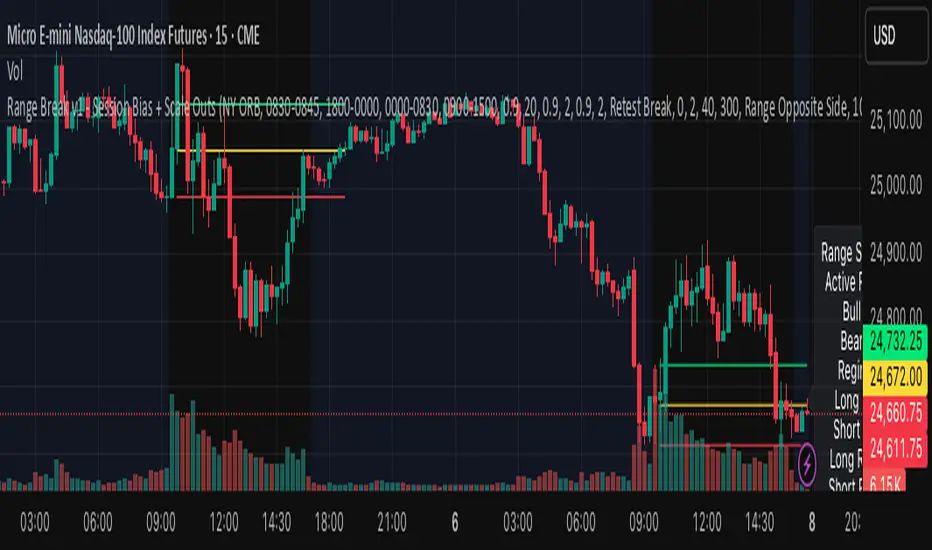
Range Break Strategy – Session-Biased Breakout Model
Overview
This strategy is a session-aware range breakout system designed to capture expansion moves when global market activity aligns across major trading sessions.
Instead of trading every breakout, the system uses inter-session price behavior to determine whether the market is more likely to trend or remain range-bound.
The model evaluates three key sessions:
Asia session – establishes early structure
London session – reveals directional intent
New York session – provides liquidity for expansion
When conditions align, the strategy trades a breakout of a defined price range in the direction of the dominant session bias.
Core Concept
Most breakout systems fail because they treat every breakout equally.
This strategy attempts to solve that problem by asking two questions:
Is the market showing directional intent across sessions?
Is price breaking an important structural range in that same direction?
Trades are only taken when both conditions are satisfied.
Session Confirmation Logic
The strategy analyzes how the London session behaves relative to the Asia session.
The goal is to determine whether London has established a dominant directional move or whether the market remains balanced.
The model evaluates:
London directional strength relative to the Asia range
Whether London closed outside the Asia range
Volatility regime conditions between sessions
These rules create a bullish or bearish session bias.
Bullish Bias
Conditions suggest buyers are in control.
The strategy will only consider long breakouts.
Bearish Bias
Conditions suggest sellers are in control.
The strategy will only consider short breakouts.
Neutral
If session behavior is unclear, the system can optionally avoid trading.
Range Break Engine
Once the directional bias is established, the strategy waits for price to break a key range.
The range can be selected by the user:
New York Opening Range
Asia session range
London session range
A breakout of this range signals a potential volatility expansion move.
Entry Models
Three breakout entry models are included:
Direct Break
Trade immediately when price breaks the range boundary.
This is the classic breakout approach.
Retest Break
Wait for price to break the range, pull back toward the breakout level, then break again.
This helps filter false breakouts.
Sweep Then Break
Require a liquidity sweep of the opposite side of the range before the breakout occurs.
This model attempts to capture stop-run reversals that lead to strong directional moves.
Risk Management
The strategy includes several configurable risk controls.
Stop Placement Options
Stops can be placed relative to:
Opposite side of the breakout range
Midpoint of the range
Opposite session extreme
Fixed distance
Scaling Out
Positions can be scaled out using up to three targets:
TP1
TP2
TP3
Targets can be defined using:
R-multiple risk units
Fixed price distances
Break-Even Logic
After TP1 is reached, the stop can automatically move to the entry price to protect remaining position size.
Trade Management
Additional controls include:
One trade per day option
Optional VWAP confirmation
Range size filters
Forced position closure at a specific time
These features allow the system to adapt to different markets and volatility environments.
Intended Use
This script is designed primarily for research and systematic strategy development.
It can be used to study:
Session-based market structure
Breakout continuation behavior
Liquidity sweep patterns
Volatility expansion across global trading sessions
The framework is intentionally modular so that traders can test different combinations of:
session bias filters
range definitions
breakout models
risk management approaches
Important Note
This script is provided for educational and research purposes only. It is not financial advice and should not be used for live trading without proper testing and risk management.
Overview
This strategy is a session-aware range breakout system designed to capture expansion moves when global market activity aligns across major trading sessions.
Instead of trading every breakout, the system uses inter-session price behavior to determine whether the market is more likely to trend or remain range-bound.
The model evaluates three key sessions:
Asia session – establishes early structure
London session – reveals directional intent
New York session – provides liquidity for expansion
When conditions align, the strategy trades a breakout of a defined price range in the direction of the dominant session bias.
Core Concept
Most breakout systems fail because they treat every breakout equally.
This strategy attempts to solve that problem by asking two questions:
Is the market showing directional intent across sessions?
Is price breaking an important structural range in that same direction?
Trades are only taken when both conditions are satisfied.
Session Confirmation Logic
The strategy analyzes how the London session behaves relative to the Asia session.
The goal is to determine whether London has established a dominant directional move or whether the market remains balanced.
The model evaluates:
London directional strength relative to the Asia range
Whether London closed outside the Asia range
Volatility regime conditions between sessions
These rules create a bullish or bearish session bias.
Bullish Bias
Conditions suggest buyers are in control.
The strategy will only consider long breakouts.
Bearish Bias
Conditions suggest sellers are in control.
The strategy will only consider short breakouts.
Neutral
If session behavior is unclear, the system can optionally avoid trading.
Range Break Engine
Once the directional bias is established, the strategy waits for price to break a key range.
The range can be selected by the user:
New York Opening Range
Asia session range
London session range
A breakout of this range signals a potential volatility expansion move.
Entry Models
Three breakout entry models are included:
Direct Break
Trade immediately when price breaks the range boundary.
This is the classic breakout approach.
Retest Break
Wait for price to break the range, pull back toward the breakout level, then break again.
This helps filter false breakouts.
Sweep Then Break
Require a liquidity sweep of the opposite side of the range before the breakout occurs.
This model attempts to capture stop-run reversals that lead to strong directional moves.
Risk Management
The strategy includes several configurable risk controls.
Stop Placement Options
Stops can be placed relative to:
Opposite side of the breakout range
Midpoint of the range
Opposite session extreme
Fixed distance
Scaling Out
Positions can be scaled out using up to three targets:
TP1
TP2
TP3
Targets can be defined using:
R-multiple risk units
Fixed price distances
Break-Even Logic
After TP1 is reached, the stop can automatically move to the entry price to protect remaining position size.
Trade Management
Additional controls include:
One trade per day option
Optional VWAP confirmation
Range size filters
Forced position closure at a specific time
These features allow the system to adapt to different markets and volatility environments.
Intended Use
This script is designed primarily for research and systematic strategy development.
It can be used to study:
Session-based market structure
Breakout continuation behavior
Liquidity sweep patterns
Volatility expansion across global trading sessions
The framework is intentionally modular so that traders can test different combinations of:
session bias filters
range definitions
breakout models
risk management approaches
Important Note
This script is provided for educational and research purposes only. It is not financial advice and should not be used for live trading without proper testing and risk management.
오픈 소스 스크립트
트레이딩뷰의 진정한 정신에 따라, 이 스크립트의 작성자는 이를 오픈소스로 공개하여 트레이더들이 기능을 검토하고 검증할 수 있도록 했습니다. 작성자에게 찬사를 보냅니다! 이 코드는 무료로 사용할 수 있지만, 코드를 재게시하는 경우 하우스 룰이 적용된다는 점을 기억하세요.

면책사항
해당 정보와 게시물은 금융, 투자, 트레이딩 또는 기타 유형의 조언이나 권장 사항으로 간주되지 않으며, 트레이딩뷰에서 제공하거나 보증하는 것이 아닙니다. 자세한 내용은 이용 약관을 참조하세요.
오픈 소스 스크립트
트레이딩뷰의 진정한 정신에 따라, 이 스크립트의 작성자는 이를 오픈소스로 공개하여 트레이더들이 기능을 검토하고 검증할 수 있도록 했습니다. 작성자에게 찬사를 보냅니다! 이 코드는 무료로 사용할 수 있지만, 코드를 재게시하는 경우 하우스 룰이 적용된다는 점을 기억하세요.
면책사항
해당 정보와 게시물은 금융, 투자, 트레이딩 또는 기타 유형의 조언이나 권장 사항으로 간주되지 않으며, 트레이딩뷰에서 제공하거나 보증하는 것이 아닙니다. 자세한 내용은 이용 약관을 참조하세요.