업데이트됨
Historical AAII Sentiment Spread (1987 - Present)
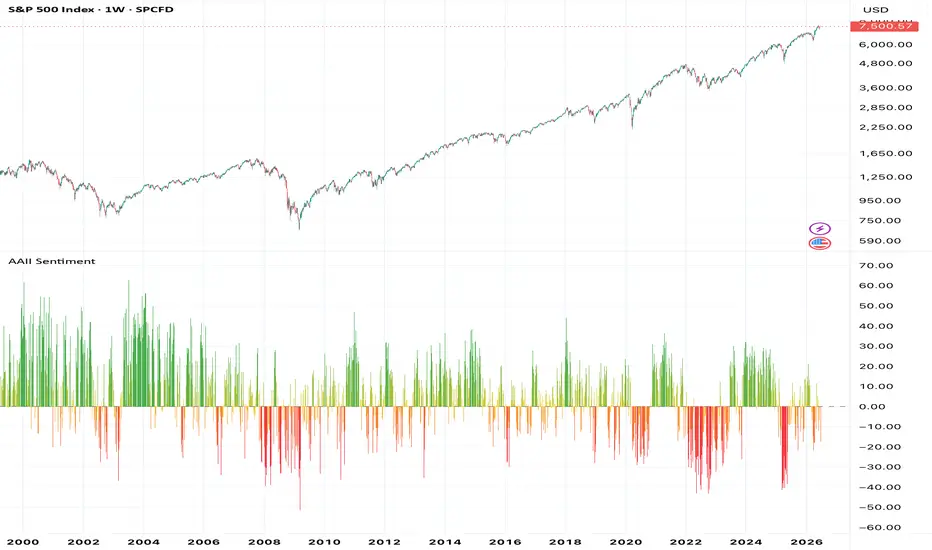
What is it?
This indicator brings nearly 40 years of weekly American Association of Individual Investors (AAII) Sentiment Survey data directly to your TradingView charts.
The AAII survey is a widely followed metric that measures the percentage of individual investors who are bullish, bearish, or neutral on the stock market for the next six months.
Many traders use this data as a contrarian indicator—when the crowd gets overwhelmingly bullish, a market top may be near, and when the crowd panics into extreme bearishness, a bottom may be forming.
How it works:
Rather than plotting three separate messy lines, this tool calculates the Bull-Bear Spread (Bullish % minus Bearish %).
A positive spread means bulls are in control.
A negative spread means bears are in control.
The histogram uses a dynamic color gradient to easily spot extremes at a glance:
Green: Extreme Bullishness (Spread >=30)
Yellow: Neutral Sentiment (Spread near 0)
Red: Extreme Bearishness (Spread <= -30)
Under the Hood:
Because TradingView limits how much data a script can process on a single bar, rendering thousands of historical data points usually causes a script to crash. This indicator solves that by using a highly efficient, custom "walk-forward" loop. It perfectly maps every weekly AAII data point from 1987 to the present without slowing down your chart, making it fully functional for long-term strategy backtesting. It also features auto-scaling logic, so it instantly adapts to whatever chart timeframe you are viewing.
How to use it:
Overlay this on the S&P 500 (SPY) or overall market indices. Look for moments when the histogram hits deep, bright red—historically, these moments of peak fear have aligned with excellent buying opportunities. Conversely, bright green peaks often signal complacency and a time to tighten risk management.
릴리즈 노트
UPDATE 01: Updated screenshot
면책사항
해당 정보와 게시물은 금융, 투자, 트레이딩 또는 기타 유형의 조언이나 권장 사항으로 간주되지 않으며, 트레이딩뷰에서 제공하거나 보증하는 것이 아닙니다. 자세한 내용은 이용 약관을 참조하세요.
면책사항
해당 정보와 게시물은 금융, 투자, 트레이딩 또는 기타 유형의 조언이나 권장 사항으로 간주되지 않으며, 트레이딩뷰에서 제공하거나 보증하는 것이 아닙니다. 자세한 내용은 이용 약관을 참조하세요.