업데이트됨
ml_dsp Ehlers DSP smoothing toolkit
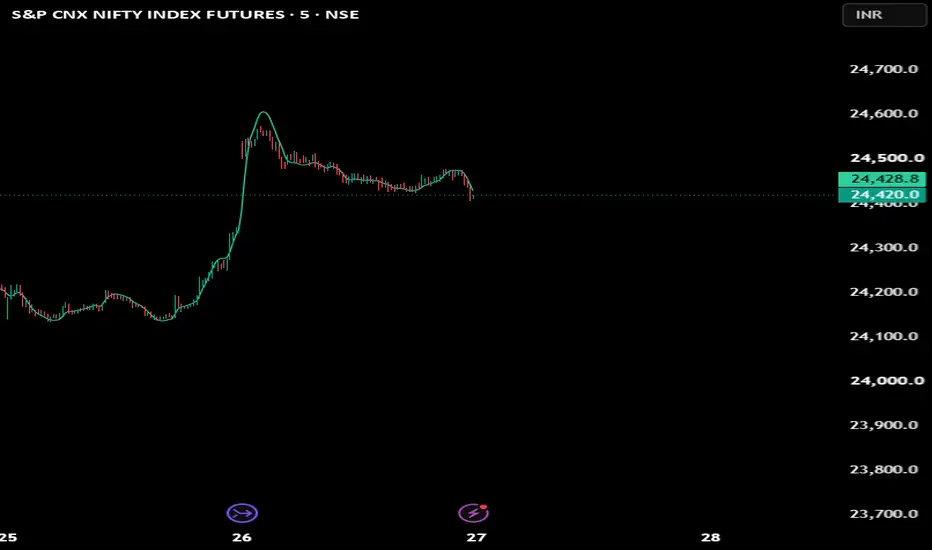
ml_dsp is a small, dependency-free library of digital-signal-processing filters for Pine v6, built around John Ehlers' filter designs. It exists to solve one recurring problem: EMA and SMA reject noise only by adding lag, so a smoother oscillator or score line always turns late. The filters here reject the same bar-to-bar noise with far less phase delay, so smoothed lines keep their timing.
Everything is exported for reuse via import, and every function takes a series float source and a simple int length, so they slot in wherever you currently call ta.ema(src, len) or ta.sma(src, len).
What's inside
superSmoother(src, period) — Ehlers' 2-pole SuperSmoother low-pass. A direct replacement for ta.ema with substantially less lag for comparable smoothing. Good general-purpose smoother for price, oscillators, and score lines.
ultimateSmoother(src, period) — Ehlers' UltimateSmoother (all-pass minus high-pass). Near-zero lag in the passband — the best default when you want to de-jitter an oscillator or signal line without pushing its turns later. This is the smoother most oscillators should use in place of a display EMA.
highPass(src, period) — Ehlers' 2-pole high-pass filter. Removes the slow trend and leaves the cyclic component — a detrender / cycle extractor for building oscillators, or for isolating short-term deviation from a drifting series.
hann(src, length) — Hann-window FIR smoother. A cosine-tapered moving average with a clean frequency response and minimal ringing; a smooth alternative to SMA when you want gentle, artefact-free smoothing.
rms(src, length) — root-mean-square amplitude of a series over a window. The natural amplitude scale for normalization.
rmsNorm(src, length) — the source divided by its own RMS, giving an approximately unit-amplitude series. A robust alternative to min/max or fixed-range scaling when you need a portable amplitude across symbols and regimes.
How to use
Import the library, then call the filter you need:
//version=6
indicator("Example — UltimateSmoother RSI", overlay = false)
import Market_Logic_India/ml_dsp/1 as dsp
length = input.int(14, "RSI length")
smooth = input.int(6, "Smoothing")
raw = ta.rsi(close, length)
smooth_rsi = dsp.ultimateSmoother(raw, smooth) // lag-minimal vs ta.ema(raw, smooth)
plot(raw, "RSI", color = color.new(color.gray, 60))
plot(smooth_rsi, "UltimateSmoother", color = color.new(#2ecc9b, 0))
Swap ultimateSmoother for superSmoother or hann depending on how aggressive you want the smoothing, or use highPass to detrend and rmsNorm to put a series onto a portable amplitude scale.
Notes
Non-repainting: all filters use only closed historical bars (src, src[1], src[2], and their own feedback). No request.*, no future references. The last bar updates intrabar like any indicator, and settles on close.
Warm-up: the recursive filters (SuperSmoother, UltimateSmoother, High-Pass) seed on the first few bars and converge within a handful of bars; treat the very start of history as warm-up.
Types: pass a simple int length (a plain input or constant), not a series int.
Concept credits
The SuperSmoother, UltimateSmoother, and 2-pole High-Pass filter designs are the work of John F. Ehlers (see his books and articles on cycle analysis and DSP for trading). The Hann-window smoother and RMS normalization are standard signal-processing techniques. This library is an original Pine v6 implementation of those public techniques, packaged for reuse; it is not affiliated with, nor endorsed by, the originators.
License
Mozilla Public License 2.0 — as required for TradingView libraries (open source). You are free to import and build on it.
릴리즈 노트
v2Added:
olsBeta(y, x, len)
Parameters:
y (float)
x (float)
len (simple int)
olsAlpha(y, x, len)
Parameters:
y (float)
x (float)
len (simple int)
olsR2(y, x, len)
Parameters:
y (float)
x (float)
len (simple int)
olsResid(y, x, len)
Parameters:
y (float)
x (float)
len (simple int)
olsResidZ(y, x, len)
Parameters:
y (float)
x (float)
len (simple int)
릴리즈 노트
v3 update noteAdds a regression & KDE toolkit for profiles and fair-value: logReg (log-regression fair value — correct for %-scaled NIFTY), polyReg (degree 1–4 curved fair value via normal equations), binomialSmooth (discrete-Gaussian FIR), epanechnikov (KDE kernel), silvermanBW (Silverman auto-bandwidth). All v1/v2 functions unchanged; import bumps to /3.
v3
Added:
logReg(src, len)
Parameters:
src (float)
len (simple int)
polyReg(src, len, degree)
Parameters:
src (float)
len (simple int)
degree (simple int)
binomialSmooth(src, length)
Parameters:
src (float)
length (simple int)
epanechnikov(u)
Parameters:
u (float)
silvermanBW(sd, n)
Parameters:
sd (float)
n (simple int)

면책사항
해당 정보와 게시물은 금융, 투자, 트레이딩 또는 기타 유형의 조언이나 권장 사항으로 간주되지 않으며, 트레이딩뷰에서 제공하거나 보증하는 것이 아닙니다. 자세한 내용은 이용 약관을 참조하세요.
면책사항
해당 정보와 게시물은 금융, 투자, 트레이딩 또는 기타 유형의 조언이나 권장 사항으로 간주되지 않으며, 트레이딩뷰에서 제공하거나 보증하는 것이 아닙니다. 자세한 내용은 이용 약관을 참조하세요.