
Is David Tepper’s Big Bet on American Airlines a Signal for Your Portfolio?
When a billionaire hedge fund manager makes a significant move, the investment world pays attention. Recently, David Tepper’s Appaloosa Management placed a substantial bet on a major U.S. carrier, American Airlines Group (AAL). This raises a compelling question for everyday investors: should you follow Tepper’s lead and add AAL stock to your portfolio? To answer that, it’s crucial to examine not just the fund's activity, but also the airline's market position, recent financial health, and the broader challenges facing the industry.
An Industry Giant Facing Turbulence
As the parent company of American Airlines and its regional affiliates—Envoy, Piedmont, and PSA—American Airlines Group stands as a behemoth in the sky. It is the world's largest airline by both passengers carried and flights operated, managing a staggering network of nearly 6,800 daily flights to more than 350 destinations across the globe. From its headquarters in Fort Worth, Texas, the company, formed by the 2013 merger of AMR Corporation and US Airways Group, oversees a vast operation that spans over 60 countries, connecting passengers throughout North America, Latin America, Europe, and Asia-Pacific. The company has been strategically focused on enhancing the travel experience through investments in premium cabins, expanding its industry-leading AAdvantage loyalty program, and upgrading in-flight amenities like Wi-Fi and airport lounges.
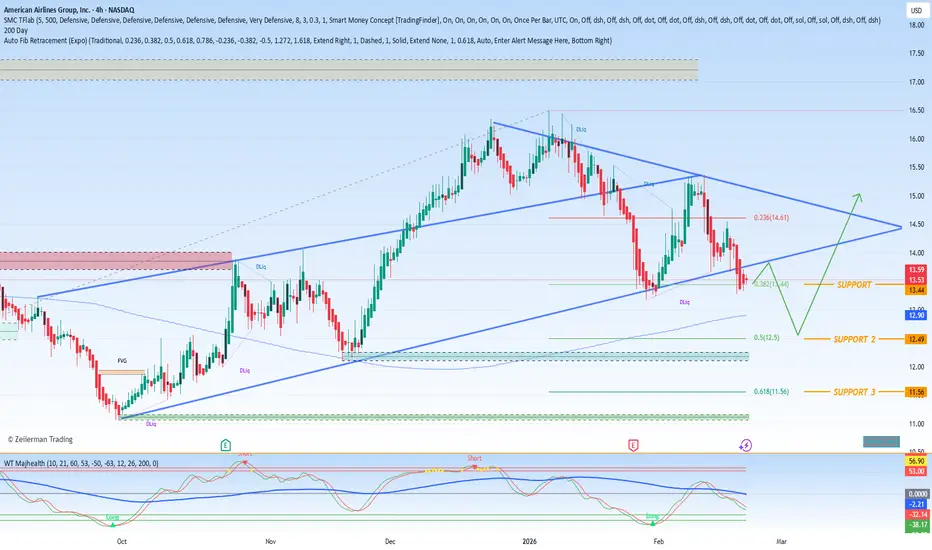
Despite this dominant footprint, the stock has faced significant headwinds. While it posted a 14% gain over the last quarter, the more recent picture is one of volatility and underperformance. The stock has dipped 6% over the last five days and tumbled 12% in the past month, reflecting broad pressure on the airline sector. Over a 52-week period, shares are down 16% and remain 16% off their annual high. This performance lags dramatically behind the tech-heavy Nasdaq Composite, which has gained 12% over the same year-long period, underscoring how airlines continue to grapple with fuel price volatility and fluctuating demand that tech giants have managed to navigate more smoothly.
A Look Inside the Q4 Earnings Report
On January 27, 2026, American Airlines released its fourth-quarter results, presenting a mixed picture of record-breaking achievements alongside earnings shortfalls. The airline reported a historic quarterly revenue of $14.0 billion, a 2.5% increase year-over-year, a feat made more impressive given a $325 million revenue hit attributed to a government shutdown. However, the bottom line told a different story. Adjusted earnings per share (EPS) came in at just $0.16, significantly missing analyst expectations of $0.38—a 58% miss.
For the full year 2025, revenue reached an unprecedented $54.6 billion. The growth was fueled by key strategic areas: premium cabin revenue outpaced the main cabin by 7 percentage points year-over-year, and revenue from managed corporate travel surged by 12%. On the balance sheet, the company made progress in deleveraging, reducing its total debt by $2.1 billion to under $40 billion.
Looking ahead, the company’s guidance offers a roadmap for potential recovery. For the first quarter of 2026, American Airlines projects revenue growth of 7-10% compared to the previous year, with capacity (available seat miles) expected to increase by 3-5%. While the company forecasts a first-quarter adjusted loss per share between ($0.10) and ($0.50), the outlook for the full year is considerably brighter. Management projects full-year 2026 adjusted EPS in the range of $1.70 to $2.70 and, crucially, expects to generate over $2 billion in free cash flow. This forecast is predicated on sustained premium demand and the benefits of ongoing debt reduction.
The Tepper Thesis: Why Appaloosa is Buying
It is against this backdrop of recent underperformance and cautiously optimistic guidance that David Tepper's Appaloosa Management made its move. In the fourth quarter of 2025, the hedge fund dramatically increased its stake in American Airlines, acquiring 4.9 million shares to bring its total holdings to over 14 million shares.
This significant investment suggests a contrarian view that the current market price undervalues the airline's potential. Tepper’s bet implies confidence that the post-pandemic surge in premium leisure and corporate travel demand is not just sustainable but will continue to drive revenue growth and margin expansion for a legacy carrier with a massive network. His firm also added to positions in major tech players like Alphabet, Meta, and Microsoft during the same period, indicating that this is not a sector-wide play, but a specific conviction in AAL's ability to capitalize on the recovery and its operational turnaround efforts.
The Verdict: Weighing Risk and Reward
So, should you follow a billionaire into an airline stock? The consensus on Wall Street is cautiously optimistic. Analysts have assigned American Airlines a "Moderate Buy" rating, based on 23 analyst ratings that break down into 13 "Strong Buy," nine "Hold," and a single "Strong Sell."
The average analyst price target of $17.90 suggests a potential upside of 26% from current levels, presenting a compelling case for value-oriented investors. This optimism is likely tied to the company's record revenues, the projected rebound in profitability for 2026, and the promise of significant free cash flow generation.
However, potential investors must also weigh the considerable risks. The airline industry is notoriously capital-intensive and sensitive to economic cycles, fuel price shocks, and geopolitical events. The Q4 earnings miss serves as a stark reminder of how quickly external factors like a government shutdown can impact performance. The company’s significant debt load, even after recent reductions, remains a long-term concern.
Ultimately, David Tepper’s large stake is a powerful vote of confidence, but it shouldn't be the sole reason to invest. For those with a higher risk tolerance and a belief in the enduring strength of travel demand, AAL’s current valuation, coupled with its ambitious 2026 guidance, could represent a worthwhile long-term opportunity. For more conservative investors, the industry's volatility and the stock's recent performance might be reasons to remain on the tarmac and wait for more consistent signs of a smooth takeoff.
When a billionaire hedge fund manager makes a significant move, the investment world pays attention. Recently, David Tepper’s Appaloosa Management placed a substantial bet on a major U.S. carrier, American Airlines Group (AAL). This raises a compelling question for everyday investors: should you follow Tepper’s lead and add AAL stock to your portfolio? To answer that, it’s crucial to examine not just the fund's activity, but also the airline's market position, recent financial health, and the broader challenges facing the industry.
An Industry Giant Facing Turbulence
As the parent company of American Airlines and its regional affiliates—Envoy, Piedmont, and PSA—American Airlines Group stands as a behemoth in the sky. It is the world's largest airline by both passengers carried and flights operated, managing a staggering network of nearly 6,800 daily flights to more than 350 destinations across the globe. From its headquarters in Fort Worth, Texas, the company, formed by the 2013 merger of AMR Corporation and US Airways Group, oversees a vast operation that spans over 60 countries, connecting passengers throughout North America, Latin America, Europe, and Asia-Pacific. The company has been strategically focused on enhancing the travel experience through investments in premium cabins, expanding its industry-leading AAdvantage loyalty program, and upgrading in-flight amenities like Wi-Fi and airport lounges.
Despite this dominant footprint, the stock has faced significant headwinds. While it posted a 14% gain over the last quarter, the more recent picture is one of volatility and underperformance. The stock has dipped 6% over the last five days and tumbled 12% in the past month, reflecting broad pressure on the airline sector. Over a 52-week period, shares are down 16% and remain 16% off their annual high. This performance lags dramatically behind the tech-heavy Nasdaq Composite, which has gained 12% over the same year-long period, underscoring how airlines continue to grapple with fuel price volatility and fluctuating demand that tech giants have managed to navigate more smoothly.
A Look Inside the Q4 Earnings Report
On January 27, 2026, American Airlines released its fourth-quarter results, presenting a mixed picture of record-breaking achievements alongside earnings shortfalls. The airline reported a historic quarterly revenue of $14.0 billion, a 2.5% increase year-over-year, a feat made more impressive given a $325 million revenue hit attributed to a government shutdown. However, the bottom line told a different story. Adjusted earnings per share (EPS) came in at just $0.16, significantly missing analyst expectations of $0.38—a 58% miss.
For the full year 2025, revenue reached an unprecedented $54.6 billion. The growth was fueled by key strategic areas: premium cabin revenue outpaced the main cabin by 7 percentage points year-over-year, and revenue from managed corporate travel surged by 12%. On the balance sheet, the company made progress in deleveraging, reducing its total debt by $2.1 billion to under $40 billion.
Looking ahead, the company’s guidance offers a roadmap for potential recovery. For the first quarter of 2026, American Airlines projects revenue growth of 7-10% compared to the previous year, with capacity (available seat miles) expected to increase by 3-5%. While the company forecasts a first-quarter adjusted loss per share between ($0.10) and ($0.50), the outlook for the full year is considerably brighter. Management projects full-year 2026 adjusted EPS in the range of $1.70 to $2.70 and, crucially, expects to generate over $2 billion in free cash flow. This forecast is predicated on sustained premium demand and the benefits of ongoing debt reduction.
The Tepper Thesis: Why Appaloosa is Buying
It is against this backdrop of recent underperformance and cautiously optimistic guidance that David Tepper's Appaloosa Management made its move. In the fourth quarter of 2025, the hedge fund dramatically increased its stake in American Airlines, acquiring 4.9 million shares to bring its total holdings to over 14 million shares.
This significant investment suggests a contrarian view that the current market price undervalues the airline's potential. Tepper’s bet implies confidence that the post-pandemic surge in premium leisure and corporate travel demand is not just sustainable but will continue to drive revenue growth and margin expansion for a legacy carrier with a massive network. His firm also added to positions in major tech players like Alphabet, Meta, and Microsoft during the same period, indicating that this is not a sector-wide play, but a specific conviction in AAL's ability to capitalize on the recovery and its operational turnaround efforts.
The Verdict: Weighing Risk and Reward
So, should you follow a billionaire into an airline stock? The consensus on Wall Street is cautiously optimistic. Analysts have assigned American Airlines a "Moderate Buy" rating, based on 23 analyst ratings that break down into 13 "Strong Buy," nine "Hold," and a single "Strong Sell."
The average analyst price target of $17.90 suggests a potential upside of 26% from current levels, presenting a compelling case for value-oriented investors. This optimism is likely tied to the company's record revenues, the projected rebound in profitability for 2026, and the promise of significant free cash flow generation.
However, potential investors must also weigh the considerable risks. The airline industry is notoriously capital-intensive and sensitive to economic cycles, fuel price shocks, and geopolitical events. The Q4 earnings miss serves as a stark reminder of how quickly external factors like a government shutdown can impact performance. The company’s significant debt load, even after recent reductions, remains a long-term concern.
Ultimately, David Tepper’s large stake is a powerful vote of confidence, but it shouldn't be the sole reason to invest. For those with a higher risk tolerance and a belief in the enduring strength of travel demand, AAL’s current valuation, coupled with its ambitious 2026 guidance, could represent a worthwhile long-term opportunity. For more conservative investors, the industry's volatility and the stock's recent performance might be reasons to remain on the tarmac and wait for more consistent signs of a smooth takeoff.

Penafian
Maklumat dan penerbitan adalah tidak bertujuan, dan tidak membentuk, nasihat atau cadangan kewangan, pelaburan, dagangan atau jenis lain yang diberikan atau disahkan oleh TradingView. Baca lebih dalam Terma Penggunaan.
Penafian
Maklumat dan penerbitan adalah tidak bertujuan, dan tidak membentuk, nasihat atau cadangan kewangan, pelaburan, dagangan atau jenis lain yang diberikan atau disahkan oleh TradingView. Baca lebih dalam Terma Penggunaan.