
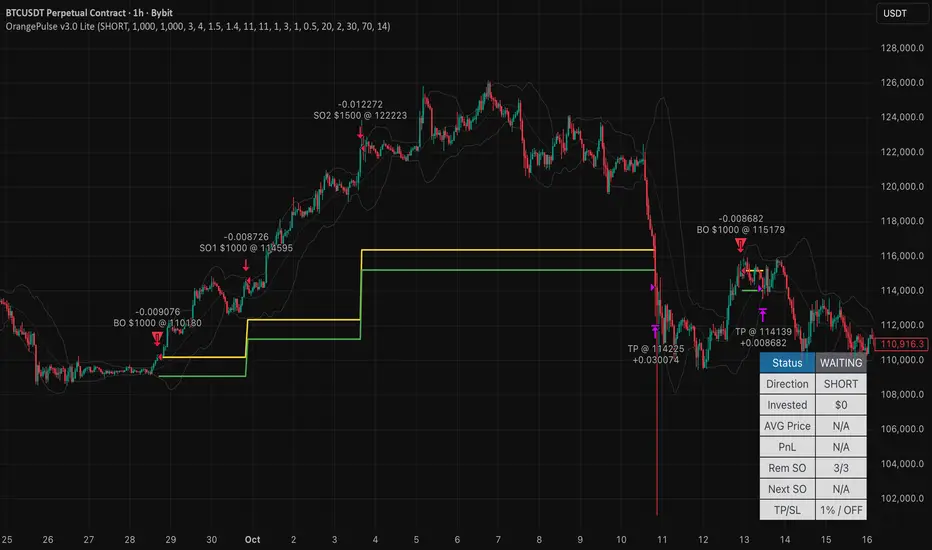
Dollar Cost Averaging (DCA) is usually associated with "buying the dip." But in a professional trading environment, the same mathematical principles can be applied to Shorting overextended rallies.
Today we are looking at how to use OrangePulse Lite to capture "Mean Reversion" moves to the downside.
1. Identifying the "Exhaustion" Instead of just shorting blindly, we look for Confluence:
Price is above the Upper Bollinger Band (statistically overextended).
RSI is in the Overbought zone (>70). This suggests the "pump" is losing steam and a return to the mean (average price) is likely.
2. Building the Short Position Shorting a strong rally is dangerous because of "short squeezes." This is where DCA shines:
We enter a small Base Order (BO) at the first sign of weakness.
If the price continues to push higher, we add to our position via Safety Orders (SO).
This moves our "Short Average Price" higher, making it much easier to exit in profit on the first minor retracement.
3. Psychology of a Short DCA While most traders are "FOMO-ing" into the top, the DCA bot is mechanically building a position. The goal isn't to pick the exact top, but to create an average entry that is higher than the eventual "Mean Reversion" point.
4. Risk Management Shorting has theoretically unlimited risk, so Max Safety Orders and a clear Stop Loss are mandatory. The Lite script allows you to visualize exactly where your "danger zone" starts.
Conclusion: DCA is a tool for volatility management, not just for long-term investing. By applying it to the short side, you can stay profitable even when the macro trend is bearish.

🤖 OrangePulse v3.0 - Professional DCA Trading Bot
✅ Fully automated
✅ WunderTrading/3Commas integration
🌐 Get access: orangepulse.net
📧 Questions: support@orangepulse.net
✅ Fully automated
✅ WunderTrading/3Commas integration
🌐 Get access: orangepulse.net
📧 Questions: support@orangepulse.net
Penafian
Maklumat dan penerbitan adalah tidak bertujuan, dan tidak membentuk, nasihat atau cadangan kewangan, pelaburan, dagangan atau jenis lain yang diberikan atau disahkan oleh TradingView. Baca lebih dalam Terma Penggunaan.
🤖 OrangePulse v3.0 - Professional DCA Trading Bot
✅ Fully automated
✅ WunderTrading/3Commas integration
🌐 Get access: orangepulse.net
📧 Questions: support@orangepulse.net
✅ Fully automated
✅ WunderTrading/3Commas integration
🌐 Get access: orangepulse.net
📧 Questions: support@orangepulse.net
Penafian
Maklumat dan penerbitan adalah tidak bertujuan, dan tidak membentuk, nasihat atau cadangan kewangan, pelaburan, dagangan atau jenis lain yang diberikan atau disahkan oleh TradingView. Baca lebih dalam Terma Penggunaan.