

1. Round numbers act as psychological levels because they are easy to remember, communicate, and use in order instructions. Traders may place entries, profit-taking orders, or protective stops around these prices simply because they stand out. This can create temporary liquidity and hesitation, but it does not make a round number a reliable support or resistance level by itself.
2. Observe whether the round number has independent structural confirmation. A reaction based mainly on psychology may appear as a brief pause, a wick, or a short-lived reversal. A reaction at a structural level is usually supported by evidence such as repeated tests, a prior swing, a clear rejection, or meaningful time spent trading around that area. A clean close beyond the level followed by continued acceptance suggests that clustered orders were not strong enough to hold it.
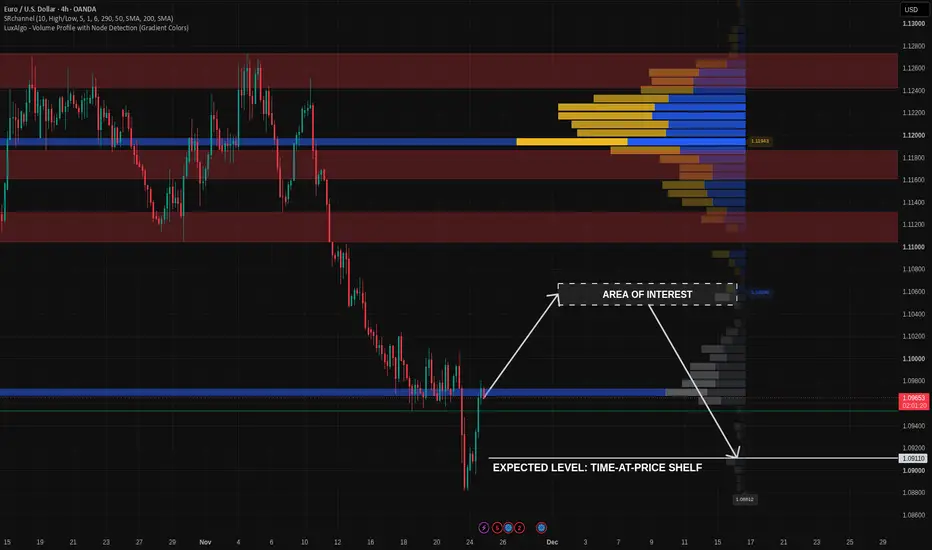
3. The EUR/USD 4-hour chart illustrates the distinction. The calculated price is 1.0969, while the supplied area of interest is 1.1048-1.1067. That area is not being selected because it is a round price. Its relevance comes from being the largest time-at-price shelf in the supplied profile, representing 1.9% of the profile, and from being confirmed by chart extremes. This is structural evidence; a nearby round-number effect would be secondary.
4. To check the idea, mark the obvious round-number area without assigning it directional meaning. Then mark structural zones independently. Ask four questions:
- Did price merely touch the psychological level, or did a 4-hour candle close there?
- Was there rejection followed by movement back into the prior range, or acceptance beyond the level?
- Does the round number overlap a structural zone, or is it standing alone?
- Is the apparent reaction large relative to normal movement? The supplied 4-hour ATR(14) is 0.0029, or 0.26% of price, so a small movement around a round number may be ordinary candle noise rather than a meaningful reversal.
For the supplied framework, the assessment is intended to be made from 1.1048-1.1067 rather than from the calculated price of 1.0969. If a scenario were evaluated from that zone, the stated cancellation level would be 1.1090, beyond the zone's far boundary. The listed objectives also have separate structural reasons: 1.0911 is supported by a 1.4% time-at-price shelf and a swing; 1.0784 is supported by a 161.8% projection; and 1.0621 is supported by a 261.8% projection. Their distances from the zone are stated as 4.8 ATR, 9.2 ATR, and 14.9 ATR respectively. These structural references are more informative than the presence of a visually attractive round price alone.
5. A common mistake is to treat a round number as the complete trade thesis: "price is near an obvious number, so it must reverse." This ignores trend, candle acceptance, nearby structure, and the possibility that clustered stops may accelerate a move through the level. Another mistake is to confuse a single wick with confirmation. A psychological level can produce a reaction without producing a durable change in structure.
6. Practice this concept without placing a live trade. Review historical 4-hour EUR/USD charts and record whether each round-number reaction also had structural confirmation. For every example, define the observation area, the condition that would confirm acceptance or rejection, and the level that would invalidate the interpretation before judging the outcome. Keep the risk predetermined and small enough to tolerate a series of failed observations; do not widen the cancellation point to rescue a thesis based only on a round number.

SIGNAL INDICATOR
NO REDESIGNING
✅Buy&Sell according to 7 strategies
✅Technical analysis according to 30+ parameters
✅WinRate of signals up to 75%
✅RR 1k3, no deep drawdowns!
Free test drive using my link:
👉midas-club.com/go/tla
NO REDESIGNING
✅Buy&Sell according to 7 strategies
✅Technical analysis according to 30+ parameters
✅WinRate of signals up to 75%
✅RR 1k3, no deep drawdowns!
Free test drive using my link:
👉midas-club.com/go/tla
Penafian
Maklumat dan penerbitan adalah tidak bertujuan, dan tidak membentuk, nasihat atau cadangan kewangan, pelaburan, dagangan atau jenis lain yang diberikan atau disahkan oleh TradingView. Baca lebih dalam Terma Penggunaan.