
🔵 WHERE THE NAME COMES FROM
The COT report was born in the agricultural markets. The CFTC needed to know what the big grain players were doing — and the biggest players were farmers and grain merchants protecting their harvests. That is what "commercial" means in this report: a business with a real interest in the physical commodity. Not a trader. A gold miner, a farmer, an airline, a refiner.
🔵 HEDGING IS INSURANCE, NOT OPINION
A farmer sells futures against the crop still in the ground. He locks in today's price, because he needs to know what he will get paid — his business depends on it. An airline buys futures against next year's fuel. A gold miner sells futures against next quarter's production. None of them is predicting where price goes. They are transferring risk to whoever wants it.
That whoever is the speculator. The hedger pays a small premium (the basis), and the speculator carries the risk. That is the deal: insurance, not forecast.
🔵 WHY THAT MAKES THEM THE "SMART" SIDE
Not because they are smarter. Because their positions are driven by business necessity, not by sentiment. When prices are high, it is good business to sell forward — so they sell. When prices are low, it is good business to buy forward — so they buy. They are systematically on the opposite side of emotion. That is why studies of COT data have shown commercials as a group to be profitable over decades, while the trend-following crowd pays for their positions.
🔵 THE CONTRARIAN READ
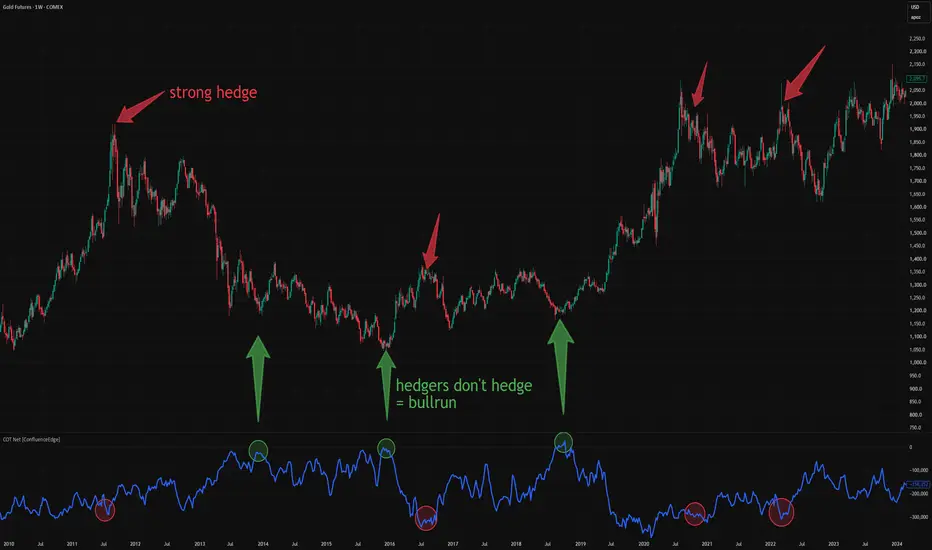
So when commercials are heavily short, read it exactly like this: prices are high enough that producers want to lock them in. That is supply coming into the market — and it is a warning, not a crash signal. Short into strength is business, not bearish.
And when commercials are heavily long, prices are low enough that producers and consumers want to secure them. Buying weakness is business, not bullish.
Same rule as Lesson 01, applied: the hedger sells strength and buys weakness. You read that against the price, not with it.
🔵 WHAT THE CHART SHOWS
On this chart you see the two markers: where commercial net positioning hit its extreme short and gold was near its highs, and where commercial positioning was extreme long while gold sat at the lows. Same pattern, repeated over years.
Next lesson: the other side of the trade — non-commercials, the trend-following crowd, and why their extremes mark turning points.
Educational content only. Not investment advice.

Full multi-TF zones + COT + Macro Bias + Seasonality → confluenceedge.net
Penafian
Maklumat dan penerbitan adalah tidak bertujuan, dan tidak membentuk, nasihat atau cadangan kewangan, pelaburan, dagangan atau jenis lain yang diberikan atau disahkan oleh TradingView. Baca lebih dalam Terma Penggunaan.
Full multi-TF zones + COT + Macro Bias + Seasonality → confluenceedge.net
Penafian
Maklumat dan penerbitan adalah tidak bertujuan, dan tidak membentuk, nasihat atau cadangan kewangan, pelaburan, dagangan atau jenis lain yang diberikan atau disahkan oleh TradingView. Baca lebih dalam Terma Penggunaan.