
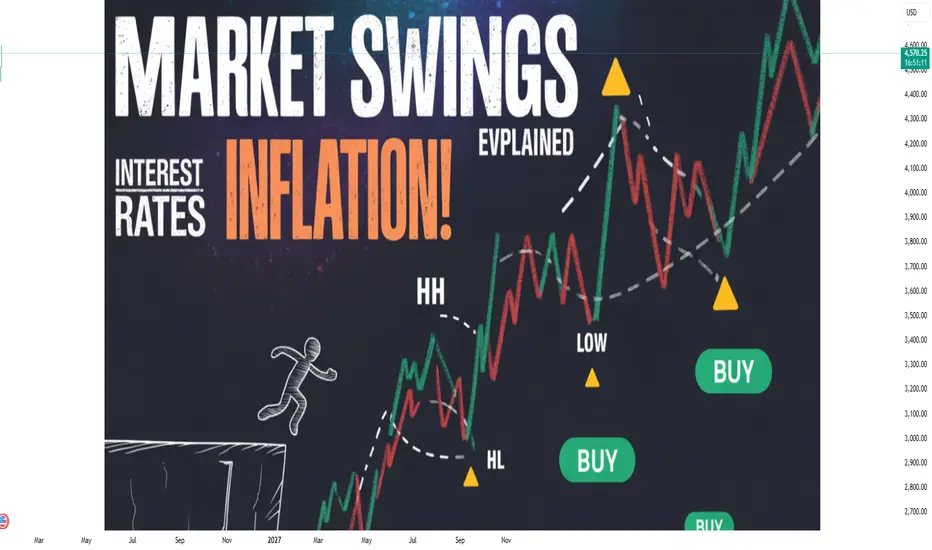
Understanding Market Swings
Market swings refer to significant short- to medium-term fluctuations in asset prices across equities, bonds, commodities, currencies, and alternative investments. These swings can be triggered by economic data releases, central bank announcements, geopolitical events, or shifts in investor sentiment. While markets are inherently forward-looking, they are also highly sensitive to uncertainty. Inflation and interest rates introduce uncertainty because they affect both future cash flows and the discount rates used to value assets.
When markets anticipate stability in inflation and rates, price movements tend to be smoother. Conversely, when inflation accelerates unexpectedly or interest rates change rapidly, volatility rises, often leading to sharp corrections or rallies.
Inflation: The Silent Driver of Volatility
Inflation represents the rate at which the general level of prices for goods and services rises, eroding purchasing power. Moderate inflation is often seen as a sign of healthy economic growth. However, high or unpredictable inflation can destabilize markets.
When inflation rises beyond expectations, input costs increase for companies, squeezing profit margins. Consumers face higher living costs, reducing discretionary spending. As earnings expectations weaken, equity markets may correct. At the same time, inflation reduces the real value of fixed income payments, causing bond prices to fall and yields to rise.
Inflation also reshapes sectoral performance. Commodities, energy, metals, and inflation-hedged assets such as gold often outperform during high-inflation periods. In contrast, growth-oriented sectors that depend heavily on future earnings—like technology—can face pressure because inflation diminishes the real value of those future cash flows.
Interest Rates: The Market’s Steering Wheel
Interest rates, primarily set or influenced by central banks, are the primary tool used to control inflation and manage economic growth. Changes in interest rates affect borrowing costs, savings behavior, investment decisions, and currency values.
When central banks raise interest rates to combat inflation, borrowing becomes more expensive. This slows consumer spending, corporate expansion, and speculative activity. Equity markets often react negatively in the short term because higher rates increase discount rates used in valuations, leading to lower present values of stocks.
On the other hand, falling interest rates usually stimulate markets. Lower rates encourage borrowing, boost liquidity, and push investors toward riskier assets in search of higher returns. This environment often leads to equity rallies, rising real estate prices, and stronger capital flows into emerging markets.
The Inflation–Interest Rate Feedback Loop
Inflation and interest rates are deeply interconnected. Rising inflation pressures central banks to increase interest rates, while aggressive rate hikes can slow the economy and eventually reduce inflation. Markets constantly attempt to price in where inflation will peak and how far interest rates will go.
This feedback loop is a major source of market swings. For example, if inflation data comes in hotter than expected, markets may anticipate more rate hikes, triggering sell-offs in equities and bonds simultaneously. Conversely, signs of easing inflation can spark powerful relief rallies as investors expect rate cuts or policy pauses.
Impact Across Asset Classes
Equities: Stocks are sensitive to both inflation and interest rates. Value stocks may perform better during inflationary periods, while growth stocks tend to benefit from low-rate environments. Sudden shifts in rate expectations often cause sharp rotations between sectors.
Bonds: Bonds are directly impacted by interest rates. Rising rates lead to falling bond prices, while falling rates support bond rallies. Inflation-linked bonds gain importance during high-inflation phases.
Commodities: Commodities often act as inflation hedges. Energy, metals, and agricultural products may experience strong uptrends during inflationary cycles.
Currencies: Interest rate differentials drive currency movements. Higher rates can strengthen a currency, impacting export competitiveness and capital flows.
Alternative Assets: Real estate, infrastructure, and precious metals often attract attention as inflation-protective assets, though higher rates can pressure leveraged segments like property.
Investor Psychology and Market Sentiment
Beyond fundamentals, market swings are amplified by investor psychology. Fear of inflation eroding wealth or anxiety over aggressive rate hikes can lead to panic selling. Conversely, optimism about inflation cooling or rates peaking can trigger rapid buying.
Media narratives, central bank communication, and global economic signals play a crucial role in shaping sentiment. Even small changes in wording from policymakers can cause outsized market reactions, highlighting how sensitive markets are to inflation and rate expectations.
Strategic Implications for Investors
Navigating market swings driven by inflation and interest rates requires discipline and adaptability. Diversification across asset classes helps manage volatility. Focusing on quality companies with strong balance sheets, pricing power, and stable cash flows can provide resilience during uncertain periods.
Long-term investors benefit from understanding economic cycles rather than reacting emotionally to short-term fluctuations. Tactical investors and traders, meanwhile, often look for opportunities created by volatility, using inflation data and interest rate signals as key inputs in decision-making.
Conclusion
Market swings are an inevitable feature of financial systems, but inflation and interest rates are among their most influential drivers. Inflation shapes purchasing power and profitability, while interest rates determine the cost of capital and investment attractiveness. Together, they create cycles of expansion, contraction, optimism, and fear.
In an era marked by rapid policy shifts, global interconnectedness, and evolving economic challenges, understanding how inflation and interest rates influence market behavior is no longer optional—it is essential. Those who grasp this dynamic are better equipped to manage risk, identify opportunities, and stay aligned with long-term financial goals despite the inevitable ups and downs of the market.

Penerbitan berkaitan
Penafian
Maklumat dan penerbitan adalah tidak bertujuan, dan tidak membentuk, nasihat atau cadangan kewangan, pelaburan, dagangan atau jenis lain yang diberikan atau disahkan oleh TradingView. Baca lebih dalam Terma Penggunaan.
Penerbitan berkaitan
Penafian
Maklumat dan penerbitan adalah tidak bertujuan, dan tidak membentuk, nasihat atau cadangan kewangan, pelaburan, dagangan atau jenis lain yang diberikan atau disahkan oleh TradingView. Baca lebih dalam Terma Penggunaan.