
One of the biggest misconceptions in trading is believing that a good chart automatically deserves a trade.
It doesn't.
A market can look beautiful. It can be trending perfectly, sitting at support, respecting moving averages, printing textbook candlestick patterns, or doing everything your favorite trading book says it should do.
None of that matters until you have a complete plan.
Professional traders don't ask, "Does this chart look good?"
They ask a much better question:
"Can I answer every important question before risking my money?"
If the answer is no, the trade simply doesn't exist yet.
Before risking even a single dollar, every trading idea should survive the following six questions.
1. Why am I watching this market?
Every trade starts with a reason.
- Not because Gold is moving.
- Not because Bitcoin is trending on social media.
- Not because someone on YouTube said a altcoin it's about to explode.
There has to be a setup.
Maybe you're looking at a trend continuation after a healthy pullback. Maybe it's a range breakout. Maybe it's a false break, a liquidity sweep, or a reversal from a major support zone.
The setup is the story that attracted your attention in the first place.
Without a setup, you're not trading a strategy.
You're simply reacting to movement.
2. What has to happen before I enter?
This is where patience separates professionals from everyone else.
Having a setup doesn't automatically give you permission to enter.
- Every setup needs confirmation.
- What exactly are you waiting for?
- A candle close above resistance?
- A rejection from support?
- A break and retest?
- A higher low?
- A lower high?
Whatever your trigger is, it should be defined before the market gets there.
And here's the difficult part.
If that trigger never appears...
You don't trade.
Many traders believe discipline means managing a position well.
In reality, discipline often means never opening the position at all.
3. What would prove me wrong?
This may be the single most important question in trading.
Every trade should begin with a sentence:
"This idea is wrong if..."
Notice the wording.
Not "I hope it doesn't..."
Not "It probably won't..."
Simply:
"My analysis stops making sense if price reaches this level."
That level is not chosen because losing money hurts there.
It is chosen because your original idea no longer exists beyond it.
Too many traders place stops based on how much they are willing to lose instead of where their analysis actually becomes invalid.
Your stop should protect your logic, not your emotions.
4. Is the risk acceptable?
Even the best trading idea can become a terrible trade if the risk doesn't make sense.
Imagine finding the perfect setup, only to realize that your stop needs to be 1000 pips away while your realistic target is only 400.
Can it still work?
Maybe.
Should you trade it?
Probably not.
Risk management isn't about finding winning trades.
It's about making sure the winners are worth the losers.
Ask yourself:
- Does this stop fit my money management?
- Can I keep my position size where it should be?
- Does the potential reward justify taking the trade?
If the answer is no, don't try to force it.
The market will always create another opportunity.
Your capital is much harder to replace.
5. How will I manage the position?
Most traders spend hours looking for entries and only seconds thinking about what happens afterward.
That's backwards.
What if price immediately moves in your favor?
Will you move your stop?
Take partial profits?
Do nothing?
What if the market goes sideways for two days?
What if it comes within ten pips of your target before reversing?
These aren't questions you should answer while watching every candle.
By then, emotions are already involved.
Every important management decision should be made before you click Buy or Sell.
The less you have to improvise during the trade, the less likely you are to sabotage yourself.
6. How will I judge this trade afterward?
This is probably the most neglected question in trading.
Most traders evaluate one thing.
Did I make money?
That's understandable.
But it's also the wrong metric.
A winning trade can be poorly executed.
A losing trade can be executed perfectly.
The questions that matter are different.
- Did I follow my rules?
- Was my entry according to plan?
- Did I respect my stop loss?
- Did I let emotions change my decisions?
- Would I take exactly the same trade again tomorrow?
That's how professionals improve.
Not by counting winning days.
By reviewing decision quality.
Because over hundreds of trades, good decisions tend to produce good results.
Bad decisions eventually produce exactly what they deserve.
A Real Example From Gold

Let's make this practical.
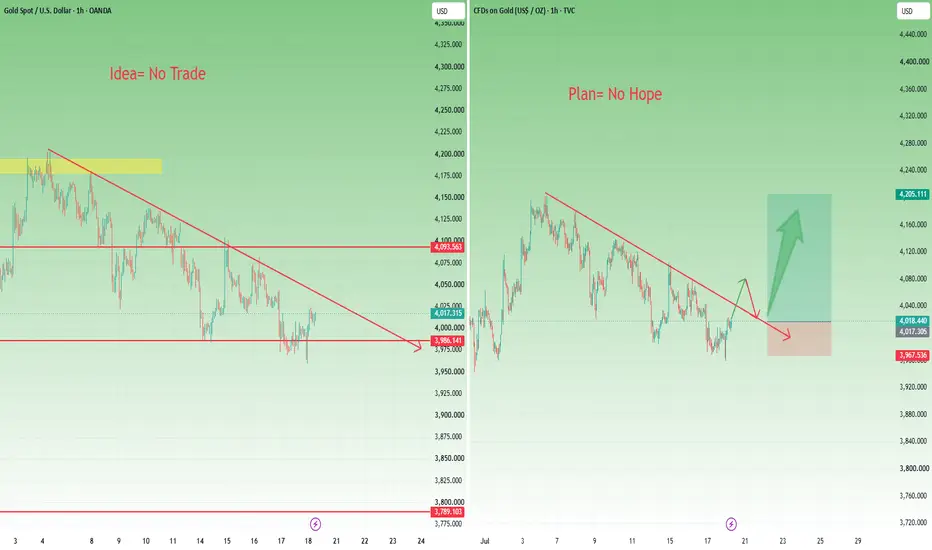
Yesterday I wrote that, despite Gold being in a very clear downtrend, I believed the next major move would eventually be a bullish reversal, with the potential to reach the 4200 area.
Did I immediately open a long position?
No.
Why?
Because I only had an idea.
I had a directional bias and I had a target, but a trading idea is not the same as a trading setup.
Could I have bought an intraday dip and made money?
Absolutely.
Maybe I would have caught the exact bottom.
Maybe I would have made 3-400 pips.
But that wouldn't have made it a good trade.
It would have made it a lucky one.
The problem wasn't the idea.
The problem was everything I didn't have.
I had no confirmation that buyers were actually taking control.
More importantly, I had no clear point where I could honestly say:
"My idea is wrong."
Without that, where does the stop go?
How much do I risk?
How do I calculate my position size?
How do I know whether I'm still trading my original idea or simply hoping the market eventually reverses?
I couldn't answer those questions.
So I stayed out.
Now let's imagine how that exact same idea could become a real trading opportunity.
Following the way I trade, the first thing I would want to see is Gold breaking its descending trendline and, more importantly, establishing itself above the 4050 area.
Not just a quick spike.
Acceptance.
Then I would like to see a small pullback that holds above the breakout area, followed by buyers stepping in again and starting a fresh impulsive move higher.
Only then does the picture change.
Now I still have my original idea and objective around 4200, but I also have something much more valuable.
I have confirmation.
And because I have confirmation, I also have invalidation.
If Gold loses that newly created support, then my bullish thesis is no longer valid.
That level naturally becomes my stop-loss area.
Suddenly, everything starts falling into place.
- I know why I'm entering.
- I know what confirmed the trade.
- I know where I'm wrong.
- I know exactly how much I'm risking.
And only then can I calculate whether the reward justifies taking the position.
Notice something important.
The market itself didn't change very much.
What changed was the quality of the information available to me.
That's the difference between trading an opinion and trading a plan.
Professional traders don't get paid for predicting reversals.
They get paid for waiting until a prediction becomes a high-probability setup with clearly defined risk.
And sometimes that means entering hundreds of pips above the bottom.
That's perfectly fine.
I'd rather miss the first part of a move and trade a confirmed trend than catch the exact low with nothing more than hope supporting my position.
The Best Traders Skip More Than They Trade
One lesson took me years to truly understand is that doing nothing is often a trading decision.
A professional trader can spend the entire day watching a market without opening a single position.
Not because they're afraid.
Not because they're indecisive.
Because the conditions they defined in advance never appeared.
Beginners often feel frustrated when they don't trade.
They think they've wasted the day.
Professionals think differently.
Every bad trade they avoid is money they didn't have to lose.
Sometimes staying flat is the highest-return trade you'll make all week.
The Goal Was Never to Trade Every Opportunity
The markets generate hundreds of interesting charts every single week.
You don't need them all.
In fact, trying to catch everything is one of the fastest ways to destroy consistency.
Your goal isn't to trade every breakout, every reversal, every news event, or every trend.
Your goal is much simpler.
Trade only the ideas you completely understand.
The ones where you know:
- why you're entering,
- what confirms the entry,
- where you're wrong,
- how much you're risking,
- how you'll manage the trade,
- and how you'll evaluate yourself afterward.
Everything else is just noise disguised as opportunity.
Final Thoughts
The next time you open your platform, don't ask yourself:
"What can I trade today?"
Ask something much more valuable:
"Which of these ideas deserves my money?"
If you can't answer all six questions, the market isn't telling you to trade.
It's telling you to wait.
And waiting isn't a weakness.
It's one of the few advantages retail traders still have.
Because in trading, patience isn't what happens before the opportunity.
Patience is part of the strategy itself.
Have a nice weekend!
Mihai Iacob
It doesn't.
A market can look beautiful. It can be trending perfectly, sitting at support, respecting moving averages, printing textbook candlestick patterns, or doing everything your favorite trading book says it should do.
None of that matters until you have a complete plan.
Professional traders don't ask, "Does this chart look good?"
They ask a much better question:
"Can I answer every important question before risking my money?"
If the answer is no, the trade simply doesn't exist yet.
Before risking even a single dollar, every trading idea should survive the following six questions.
1. Why am I watching this market?
Every trade starts with a reason.
- Not because Gold is moving.
- Not because Bitcoin is trending on social media.
- Not because someone on YouTube said a altcoin it's about to explode.
There has to be a setup.
Maybe you're looking at a trend continuation after a healthy pullback. Maybe it's a range breakout. Maybe it's a false break, a liquidity sweep, or a reversal from a major support zone.
The setup is the story that attracted your attention in the first place.
Without a setup, you're not trading a strategy.
You're simply reacting to movement.
2. What has to happen before I enter?
This is where patience separates professionals from everyone else.
Having a setup doesn't automatically give you permission to enter.
- Every setup needs confirmation.
- What exactly are you waiting for?
- A candle close above resistance?
- A rejection from support?
- A break and retest?
- A higher low?
- A lower high?
Whatever your trigger is, it should be defined before the market gets there.
And here's the difficult part.
If that trigger never appears...
You don't trade.
Many traders believe discipline means managing a position well.
In reality, discipline often means never opening the position at all.
3. What would prove me wrong?
This may be the single most important question in trading.
Every trade should begin with a sentence:
"This idea is wrong if..."
Notice the wording.
Not "I hope it doesn't..."
Not "It probably won't..."
Simply:
"My analysis stops making sense if price reaches this level."
That level is not chosen because losing money hurts there.
It is chosen because your original idea no longer exists beyond it.
Too many traders place stops based on how much they are willing to lose instead of where their analysis actually becomes invalid.
Your stop should protect your logic, not your emotions.
4. Is the risk acceptable?
Even the best trading idea can become a terrible trade if the risk doesn't make sense.
Imagine finding the perfect setup, only to realize that your stop needs to be 1000 pips away while your realistic target is only 400.
Can it still work?
Maybe.
Should you trade it?
Probably not.
Risk management isn't about finding winning trades.
It's about making sure the winners are worth the losers.
Ask yourself:
- Does this stop fit my money management?
- Can I keep my position size where it should be?
- Does the potential reward justify taking the trade?
If the answer is no, don't try to force it.
The market will always create another opportunity.
Your capital is much harder to replace.
5. How will I manage the position?
Most traders spend hours looking for entries and only seconds thinking about what happens afterward.
That's backwards.
What if price immediately moves in your favor?
Will you move your stop?
Take partial profits?
Do nothing?
What if the market goes sideways for two days?
What if it comes within ten pips of your target before reversing?
These aren't questions you should answer while watching every candle.
By then, emotions are already involved.
Every important management decision should be made before you click Buy or Sell.
The less you have to improvise during the trade, the less likely you are to sabotage yourself.
6. How will I judge this trade afterward?
This is probably the most neglected question in trading.
Most traders evaluate one thing.
Did I make money?
That's understandable.
But it's also the wrong metric.
A winning trade can be poorly executed.
A losing trade can be executed perfectly.
The questions that matter are different.
- Did I follow my rules?
- Was my entry according to plan?
- Did I respect my stop loss?
- Did I let emotions change my decisions?
- Would I take exactly the same trade again tomorrow?
That's how professionals improve.
Not by counting winning days.
By reviewing decision quality.
Because over hundreds of trades, good decisions tend to produce good results.
Bad decisions eventually produce exactly what they deserve.
A Real Example From Gold
Let's make this practical.
Yesterday I wrote that, despite Gold being in a very clear downtrend, I believed the next major move would eventually be a bullish reversal, with the potential to reach the 4200 area.
Did I immediately open a long position?
No.
Why?
Because I only had an idea.
I had a directional bias and I had a target, but a trading idea is not the same as a trading setup.
Could I have bought an intraday dip and made money?
Absolutely.
Maybe I would have caught the exact bottom.
Maybe I would have made 3-400 pips.
But that wouldn't have made it a good trade.
It would have made it a lucky one.
The problem wasn't the idea.
The problem was everything I didn't have.
I had no confirmation that buyers were actually taking control.
More importantly, I had no clear point where I could honestly say:
"My idea is wrong."
Without that, where does the stop go?
How much do I risk?
How do I calculate my position size?
How do I know whether I'm still trading my original idea or simply hoping the market eventually reverses?
I couldn't answer those questions.
So I stayed out.
Now let's imagine how that exact same idea could become a real trading opportunity.
Following the way I trade, the first thing I would want to see is Gold breaking its descending trendline and, more importantly, establishing itself above the 4050 area.
Not just a quick spike.
Acceptance.
Then I would like to see a small pullback that holds above the breakout area, followed by buyers stepping in again and starting a fresh impulsive move higher.
Only then does the picture change.
Now I still have my original idea and objective around 4200, but I also have something much more valuable.
I have confirmation.
And because I have confirmation, I also have invalidation.
If Gold loses that newly created support, then my bullish thesis is no longer valid.
That level naturally becomes my stop-loss area.
Suddenly, everything starts falling into place.
- I know why I'm entering.
- I know what confirmed the trade.
- I know where I'm wrong.
- I know exactly how much I'm risking.
And only then can I calculate whether the reward justifies taking the position.
Notice something important.
The market itself didn't change very much.
What changed was the quality of the information available to me.
That's the difference between trading an opinion and trading a plan.
Professional traders don't get paid for predicting reversals.
They get paid for waiting until a prediction becomes a high-probability setup with clearly defined risk.
And sometimes that means entering hundreds of pips above the bottom.
That's perfectly fine.
I'd rather miss the first part of a move and trade a confirmed trend than catch the exact low with nothing more than hope supporting my position.
The Best Traders Skip More Than They Trade
One lesson took me years to truly understand is that doing nothing is often a trading decision.
A professional trader can spend the entire day watching a market without opening a single position.
Not because they're afraid.
Not because they're indecisive.
Because the conditions they defined in advance never appeared.
Beginners often feel frustrated when they don't trade.
They think they've wasted the day.
Professionals think differently.
Every bad trade they avoid is money they didn't have to lose.
Sometimes staying flat is the highest-return trade you'll make all week.
The Goal Was Never to Trade Every Opportunity
The markets generate hundreds of interesting charts every single week.
You don't need them all.
In fact, trying to catch everything is one of the fastest ways to destroy consistency.
Your goal isn't to trade every breakout, every reversal, every news event, or every trend.
Your goal is much simpler.
Trade only the ideas you completely understand.
The ones where you know:
- why you're entering,
- what confirms the entry,
- where you're wrong,
- how much you're risking,
- how you'll manage the trade,
- and how you'll evaluate yourself afterward.
Everything else is just noise disguised as opportunity.
Final Thoughts
The next time you open your platform, don't ask yourself:
"What can I trade today?"
Ask something much more valuable:
"Which of these ideas deserves my money?"
If you can't answer all six questions, the market isn't telling you to trade.
It's telling you to wait.
And waiting isn't a weakness.
It's one of the few advantages retail traders still have.
Because in trading, patience isn't what happens before the opportunity.
Patience is part of the strategy itself.
Have a nice weekend!
Mihai Iacob

📈 Forex & XAU/USD Channel:
t.me/intradaytradingsignals
💎 Crypto Channel:
t.me/FanCryptocurrency
Penerbitan berkaitan
Penafian
Maklumat dan penerbitan adalah tidak bertujuan, dan tidak membentuk, nasihat atau cadangan kewangan, pelaburan, dagangan atau jenis lain yang diberikan atau disahkan oleh TradingView. Baca lebih dalam Terma Penggunaan.
📈 Forex & XAU/USD Channel:
t.me/intradaytradingsignals
💎 Crypto Channel:
t.me/FanCryptocurrency
Penerbitan berkaitan
Penafian
Maklumat dan penerbitan adalah tidak bertujuan, dan tidak membentuk, nasihat atau cadangan kewangan, pelaburan, dagangan atau jenis lain yang diberikan atau disahkan oleh TradingView. Baca lebih dalam Terma Penggunaan.