
Henry Hub: The Surprise Isn't the Heat — It's How Long It Lasts.
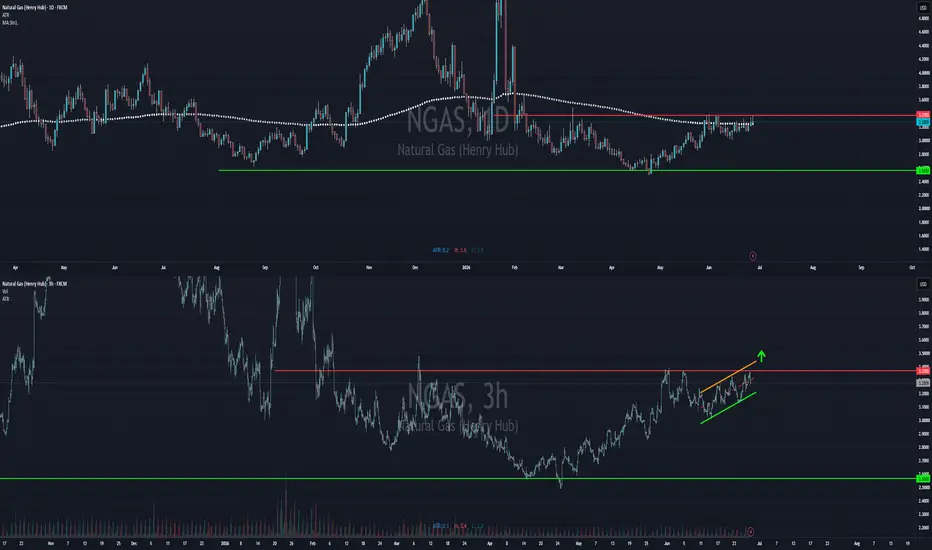
# The U.S. Natural Gas Market Has Entered a Rare Phase
The U.S. natural gas market has entered a rare phase, where weather models, actual demand, and participant positioning are beginning to combine into a potentially explosive mix.
Forecast gas-weighted demand for the late-June to first-half-of-July period is among the highest in all available recorded history: the current 14-day forecast ranks as roughly the second-strongest in about 49 years. Every day of the forecast window is above normal, and the heat is no longer confined to a short period through July 5 — GFS keeps it going until roughly July 13, and ECMWF confirms elevated demand at least through July 12.
However, the market's main feature is not the heat itself. Price has repeatedly shown that a hot forecast alone is not enough. For a truly large move to begin, the weather threat must turn into a physical reduction of gas available for storage, and then break the sellers' psychology.
Over the past 2 weeks the market has repeated the same pattern several times:
hot news or fundamental improvement → sharp rally → partial short covering → selling at resistance → testing of real physical demand.
This means traders are not yet ready to buy forecasts alone unconditionally. They want to see confirmation in actual powerburn, production, LNG, and future EIA reports.
What has appeared now that wasn't there Thursday and Friday
As recently as the end of last week, the market mostly saw a single heat wave through July 5–6. After that, models allowed for a westward shift of the hot ridge and cooling in the eastern U.S.
Now the situation has changed qualitatively.
The hot regime has extended by roughly another week. ECMWF keeps temperatures above normal through July 12, GFS through about July 13. Moreover, the heat is now present not only in the unreliable far tail, but simultaneously in the near term, in Days 6–10, and in Days 11–15.
This is more important than a single extreme forecast. One hot day may barely change the weekly balance, especially with strong wind and solar generation. But two weeks of sustained above-normal readings gradually raise gas burn by power plants and reduce the volumes available for injection.
Physical confirmation has also appeared: powerburn rose today to roughly 40 Bcf/d versus the prior week's average of about 36.9 Bcf/d. Going forward, part of the effect may be offset by wind, solar generation, increased production, or imports. But the scale is already enough for the market to start reassessing future injections.
The main psychological battle
Two camps with opposing convictions have now formed in the market.
Bears still see a storage surplus of about +152 Bcf to the five-year norm. The latest EIA showed +76 Bcf versus expectations of roughly +66–69 Bcf, which confirmed: the physical balance is not yet as tight as the most optimistic participants assumed.
Their psychological stance looks like this:
The models are too hot. Part of the CDDs will be lost. High storage, rising production, and renewable generation will cap price again, and the $3.35–3.37 area will remain the ceiling.
That is why many sellers keep opening shorts precisely on rallies.
Bulls see the opposite setup:
The forecast is one of the hottest in decades, the heat has become more prolonged, powerburn has already reached 40 Bcf/d, production around 106.3 Bcf/d does not look excessive, and the market is overloaded with short positions.
Their bet is not only on lower future injections. They are counting on sellers being forced to buy gas to close their shorts.
COT: bears keep adding risk
Per the latest CFTC report, speculative participants held about 247.8 thousand long contracts and 425.1 thousand short. The net position was approximately:
−177 thousand contracts.
At the same time, over the week the number of shorts grew more than the number of longs. That is, even amid improving weather, part of the market continued to increase bets on a decline.
A large net short by itself is not a signal to rally. Bears can stay right for a long time if weather cools or physical demand disappoints.
But such positions create asymmetry. Every short must eventually be closed with a purchase. If the key bearish hypothesis breaks, the number of potential buyers suddenly becomes very large.
What would be a genuine surprise
A high overall model Total is already ceasing to be a surprise. The market sees the heat and has partly priced it in.
A new bullish surprise would be not the addition of one more distant hot day from a shift of the forecast window, but the simultaneous fulfillment of several conditions:
• GFS and ECMWF keep the heat on the same dates, especially July 1–10;
• models do not give back 10–15 CDDs;
• powerburn holds around 40–42 Bcf/d for several days in a row;
• production stays in the 106–106.5 Bcf/d area;
• LNG does not decline and ideally approaches 19–20 Bcf/d;
• forecasts of future EIA builds start to decline noticeably;
• price holds above the $3.35–3.37 area.
The last condition is the psychologically decisive one.
For now, $3.35–3.37 remains a zone where sellers are confident in being right. They view every rise there as another opportunity to sell.
But if the market breaks through this area, the pullback is shallow, and price stays above resistance, shorts will start getting trapped. First short-term sellers will close, then systematic and trend positions. Then the rally will start being fueled not only by heat, but by forced buying.
The sequence of a possible climax looks like this:
heat persists → powerburn holds above 40 Bcf/d → injection forecasts decline → price passes $3.37 → sellers cannot push the market back below → accelerated short covering begins.
The climax is still ahead
Almost all elements of a potential large move are already present:
• one of the hottest forecasts in about 49 years;
• heat above normal across the entire 14-day horizon;
• its duration has extended into mid-July;
• powerburn has risen toward 40 Bcf/d;
• production remains moderate;
• LNG supports demand;
• the speculative market is overloaded with shorts.
But the final confirmation is missing — the market's acceptance of a higher price.
That is why the $3.35–3.37 area becomes not just technical resistance, but a border between two psychological regimes.
Conclusion: the market has reached a point where the next surprise could break the equilibrium
Almost all elements of a move are in place: heat among the strongest in decades, its duration extended into mid-July (the main fresh surprise), powerburn at 40, the market overloaded with shorts.
The main change of recent days is not just another increase in temperature forecasts, but the extension of the heat's duration. As recently as Thursday and Friday, the main hot period was concentrated through about July 5–6, after which the market feared cooling in the eastern U.S. Now GFS and ECMWF keep temperatures above normal through approximately July 12–13, and the heat is present simultaneously in the near Days 1–5, in Days 6–10, and even in the far part of the forecast.
This is a qualitatively different scenario. The market can weather one short temperature peak without a serious change in the seasonal balance. But two weeks of sustained cooling demand can already affect several EIA reporting periods and noticeably reduce the volume of gas available for injection.
The second surprise was that the models began to be confirmed by the physical market. Powerburn rose to 40 Bcf/d versus the weekly average of 36.9 Bcf/d. However, this is not yet a proven new sustained level.
The third surprise is the resilience of the European ensemble. The ECMWF Ensemble does not confirm the most extreme values of the hot operational models, but it also does not show a collapse of the heat. Its central estimate of around +55 remains very bullish, and high temperatures persist through mid-July. This means the market is dealing not just with a single extreme GFS run, but with broader cross-model confirmation of a prolonged hot regime.
If another warming of the models coincides with powerburn above 40 Bcf/d, sustained moderate production, and declining future injection forecasts, and price does not fall back below $3.37 after breaking it, the market structure will change. Sellers will lose their main psychological confirmation — the ability to hold the ceiling.
Then COT will come into play. The speculative market maintains a net short of roughly 177 thousand contracts. This is not the maximum historical extreme, but positioning remains noticeably overloaded to the bearish side. To close these positions, funds will have to buy contracts, so after a confirmed breakout the rally may accelerate not only because of weather, but because of forced short covering.
A likely sequence of a bullish climax:
heat extends → powerburn holds around 40–42 Bcf/d → injection forecasts are revised down → price passes $3.37 → sellers try to push the market back below but cannot → short covering begins → the move accelerates toward $3.39 and potentially toward $3.50.
What will be especially important is not the break of resistance itself, but the absence of a deep pullback after it. If the market withstands renewed selling and stays above $3.37, this will be a sign that a large buyer is absorbing supply and the bearish market model is beginning to break down.
A reverse surprise is also capable of causing a strong move. If GFS and ECMWF lose 10–15 or more CDDs on the nearest calendar dates, powerburn returns below 37 Bcf/d, production is revised up, and price again fails to hold above $3.35–3.37, large sellers will get confirmation. Then the hot narrative will become a source of liquidity for large participants to exit, and late buyers will start closing.
Thus, the market has reached a point where known factors are already insufficient. The heat, the surplus, and the large short are known to everyone. For a strong move, a new unexpected element is needed:
• even more prolonged heat;
• sustained powerburn above 40 Bcf/d;
• a noticeable decline in injection forecasts;
• rising LNG or further declining production;
• or, conversely, a sharp reversal of the models and weakening physical demand.
While price is below $3.37, the large seller retains control of the upper boundary. A close above it will show that the market is starting to price not today's storage surplus, but the future deficit of the summer balance.
That is precisely why the next reaction to a surprise matters more than the surprise itself. If strong news does not lift price — the market is weak. If even a small additional improvement triggers a breakout and a hold — sellers are already overloaded, and the move may quickly shift into a short-squeeze phase.
The U.S. natural gas market has entered a rare phase, where weather models, actual demand, and participant positioning are beginning to combine into a potentially explosive mix.
Forecast gas-weighted demand for the late-June to first-half-of-July period is among the highest in all available recorded history: the current 14-day forecast ranks as roughly the second-strongest in about 49 years. Every day of the forecast window is above normal, and the heat is no longer confined to a short period through July 5 — GFS keeps it going until roughly July 13, and ECMWF confirms elevated demand at least through July 12.
However, the market's main feature is not the heat itself. Price has repeatedly shown that a hot forecast alone is not enough. For a truly large move to begin, the weather threat must turn into a physical reduction of gas available for storage, and then break the sellers' psychology.
Over the past 2 weeks the market has repeated the same pattern several times:
hot news or fundamental improvement → sharp rally → partial short covering → selling at resistance → testing of real physical demand.
This means traders are not yet ready to buy forecasts alone unconditionally. They want to see confirmation in actual powerburn, production, LNG, and future EIA reports.
What has appeared now that wasn't there Thursday and Friday
As recently as the end of last week, the market mostly saw a single heat wave through July 5–6. After that, models allowed for a westward shift of the hot ridge and cooling in the eastern U.S.
Now the situation has changed qualitatively.
The hot regime has extended by roughly another week. ECMWF keeps temperatures above normal through July 12, GFS through about July 13. Moreover, the heat is now present not only in the unreliable far tail, but simultaneously in the near term, in Days 6–10, and in Days 11–15.
This is more important than a single extreme forecast. One hot day may barely change the weekly balance, especially with strong wind and solar generation. But two weeks of sustained above-normal readings gradually raise gas burn by power plants and reduce the volumes available for injection.
Physical confirmation has also appeared: powerburn rose today to roughly 40 Bcf/d versus the prior week's average of about 36.9 Bcf/d. Going forward, part of the effect may be offset by wind, solar generation, increased production, or imports. But the scale is already enough for the market to start reassessing future injections.
The main psychological battle
Two camps with opposing convictions have now formed in the market.
Bears still see a storage surplus of about +152 Bcf to the five-year norm. The latest EIA showed +76 Bcf versus expectations of roughly +66–69 Bcf, which confirmed: the physical balance is not yet as tight as the most optimistic participants assumed.
Their psychological stance looks like this:
The models are too hot. Part of the CDDs will be lost. High storage, rising production, and renewable generation will cap price again, and the $3.35–3.37 area will remain the ceiling.
That is why many sellers keep opening shorts precisely on rallies.
Bulls see the opposite setup:
The forecast is one of the hottest in decades, the heat has become more prolonged, powerburn has already reached 40 Bcf/d, production around 106.3 Bcf/d does not look excessive, and the market is overloaded with short positions.
Their bet is not only on lower future injections. They are counting on sellers being forced to buy gas to close their shorts.
COT: bears keep adding risk
Per the latest CFTC report, speculative participants held about 247.8 thousand long contracts and 425.1 thousand short. The net position was approximately:
−177 thousand contracts.
At the same time, over the week the number of shorts grew more than the number of longs. That is, even amid improving weather, part of the market continued to increase bets on a decline.
A large net short by itself is not a signal to rally. Bears can stay right for a long time if weather cools or physical demand disappoints.
But such positions create asymmetry. Every short must eventually be closed with a purchase. If the key bearish hypothesis breaks, the number of potential buyers suddenly becomes very large.
What would be a genuine surprise
A high overall model Total is already ceasing to be a surprise. The market sees the heat and has partly priced it in.
A new bullish surprise would be not the addition of one more distant hot day from a shift of the forecast window, but the simultaneous fulfillment of several conditions:
• GFS and ECMWF keep the heat on the same dates, especially July 1–10;
• models do not give back 10–15 CDDs;
• powerburn holds around 40–42 Bcf/d for several days in a row;
• production stays in the 106–106.5 Bcf/d area;
• LNG does not decline and ideally approaches 19–20 Bcf/d;
• forecasts of future EIA builds start to decline noticeably;
• price holds above the $3.35–3.37 area.
The last condition is the psychologically decisive one.
For now, $3.35–3.37 remains a zone where sellers are confident in being right. They view every rise there as another opportunity to sell.
But if the market breaks through this area, the pullback is shallow, and price stays above resistance, shorts will start getting trapped. First short-term sellers will close, then systematic and trend positions. Then the rally will start being fueled not only by heat, but by forced buying.
The sequence of a possible climax looks like this:
heat persists → powerburn holds above 40 Bcf/d → injection forecasts decline → price passes $3.37 → sellers cannot push the market back below → accelerated short covering begins.
The climax is still ahead
Almost all elements of a potential large move are already present:
• one of the hottest forecasts in about 49 years;
• heat above normal across the entire 14-day horizon;
• its duration has extended into mid-July;
• powerburn has risen toward 40 Bcf/d;
• production remains moderate;
• LNG supports demand;
• the speculative market is overloaded with shorts.
But the final confirmation is missing — the market's acceptance of a higher price.
That is why the $3.35–3.37 area becomes not just technical resistance, but a border between two psychological regimes.
Conclusion: the market has reached a point where the next surprise could break the equilibrium
Almost all elements of a move are in place: heat among the strongest in decades, its duration extended into mid-July (the main fresh surprise), powerburn at 40, the market overloaded with shorts.
The main change of recent days is not just another increase in temperature forecasts, but the extension of the heat's duration. As recently as Thursday and Friday, the main hot period was concentrated through about July 5–6, after which the market feared cooling in the eastern U.S. Now GFS and ECMWF keep temperatures above normal through approximately July 12–13, and the heat is present simultaneously in the near Days 1–5, in Days 6–10, and even in the far part of the forecast.
This is a qualitatively different scenario. The market can weather one short temperature peak without a serious change in the seasonal balance. But two weeks of sustained cooling demand can already affect several EIA reporting periods and noticeably reduce the volume of gas available for injection.
The second surprise was that the models began to be confirmed by the physical market. Powerburn rose to 40 Bcf/d versus the weekly average of 36.9 Bcf/d. However, this is not yet a proven new sustained level.
The third surprise is the resilience of the European ensemble. The ECMWF Ensemble does not confirm the most extreme values of the hot operational models, but it also does not show a collapse of the heat. Its central estimate of around +55 remains very bullish, and high temperatures persist through mid-July. This means the market is dealing not just with a single extreme GFS run, but with broader cross-model confirmation of a prolonged hot regime.
If another warming of the models coincides with powerburn above 40 Bcf/d, sustained moderate production, and declining future injection forecasts, and price does not fall back below $3.37 after breaking it, the market structure will change. Sellers will lose their main psychological confirmation — the ability to hold the ceiling.
Then COT will come into play. The speculative market maintains a net short of roughly 177 thousand contracts. This is not the maximum historical extreme, but positioning remains noticeably overloaded to the bearish side. To close these positions, funds will have to buy contracts, so after a confirmed breakout the rally may accelerate not only because of weather, but because of forced short covering.
A likely sequence of a bullish climax:
heat extends → powerburn holds around 40–42 Bcf/d → injection forecasts are revised down → price passes $3.37 → sellers try to push the market back below but cannot → short covering begins → the move accelerates toward $3.39 and potentially toward $3.50.
What will be especially important is not the break of resistance itself, but the absence of a deep pullback after it. If the market withstands renewed selling and stays above $3.37, this will be a sign that a large buyer is absorbing supply and the bearish market model is beginning to break down.
A reverse surprise is also capable of causing a strong move. If GFS and ECMWF lose 10–15 or more CDDs on the nearest calendar dates, powerburn returns below 37 Bcf/d, production is revised up, and price again fails to hold above $3.35–3.37, large sellers will get confirmation. Then the hot narrative will become a source of liquidity for large participants to exit, and late buyers will start closing.
Thus, the market has reached a point where known factors are already insufficient. The heat, the surplus, and the large short are known to everyone. For a strong move, a new unexpected element is needed:
• even more prolonged heat;
• sustained powerburn above 40 Bcf/d;
• a noticeable decline in injection forecasts;
• rising LNG or further declining production;
• or, conversely, a sharp reversal of the models and weakening physical demand.
While price is below $3.37, the large seller retains control of the upper boundary. A close above it will show that the market is starting to price not today's storage surplus, but the future deficit of the summer balance.
That is precisely why the next reaction to a surprise matters more than the surprise itself. If strong news does not lift price — the market is weak. If even a small additional improvement triggers a breakout and a hold — sellers are already overloaded, and the move may quickly shift into a short-squeeze phase.
Dagangan aktif
What the gas market may be underestimating: nighttime heat and humidity could keep powerburn above expectationsMost natural gas market participants watch daytime temperatures, CDDs, and the total degree-day count in the latest GFS or ECMWF run closely. But the main surprise of the coming days may come not from a new daytime record, but from the fact that the heat won't release the U.S. at night.
Forecasts from specialized meteorological services point to a combination of three factors: a strong upper-level ridge, high humidity, and unusually warm nights. This configuration is capable of having a more prolonged effect on gas consumption than a market focused primarily on daytime highs assumes.
Daytime heat ends in the evening. Electricity consumption doesn't
Under normal summer weather, temperatures drop after sunset, buildings begin to cool, and the load on air conditioners gradually eases.
The current heat wave may unfold differently.
Under a powerful ridge of high pressure, air sinks, compresses, and warms. At the same time, a humid flow from the Gulf of Mexico raises dew points. As a result, temperatures fall slowly at night, and in large urban areas, concrete, asphalt, and buildings retain additional heat.
If overnight lows stay in the upper 70s or near 80°F, air conditioners have to run almost continuously. With high humidity, they spend additional energy dehumidifying the air.
That is why the actual electrical load can stay high even if daytime highs stop rising.
Why nighttime load is especially important for gas
During the day, part of the additional demand is covered by solar generation. But after sunset, solar quickly disappears from the energy balance, while air conditioners keep running.
An evening and nighttime shortfall of flexible generation emerges. In many U.S. regions, it is precisely gas-fired power plants that can quickly ramp up output and cover such load.
The mechanism looks like this:
a hot day heats buildings → a humid night doesn't let them cool → air conditioners run after sunset → solar generation disappears → the load on gas-fired plants increases.
Because of this, a warm night can matter more for powerburn than an extra degree or two of daytime temperature.
Which dates carry the main risk
The most likely period of strong daytime and nighttime load is roughly June 29 through July 5.
During this time, the main ridge covers the Midwest, the Mississippi and Ohio valleys, the Southeast, the Mid-Atlantic, and part of the Northeast. This is not just a large area: it is precisely where major population centers, the PJM power grid, and a significant share of U.S. air-conditioning demand are located.
Bottom line
The main weather risk for the natural gas market is not simply high daytime temperature.
The market may be underestimating that the current wave is accompanied by humidity, abnormally warm nights, and the absence of full nighttime cooling. This can prolong air-conditioner operation after sunset, when solar generation no longer helps the power system.

Хочешь хороших денег – умей выжидать
Penafian
Maklumat dan penerbitan adalah tidak bertujuan, dan tidak membentuk, nasihat atau cadangan kewangan, pelaburan, dagangan atau jenis lain yang diberikan atau disahkan oleh TradingView. Baca lebih dalam Terma Penggunaan.
Хочешь хороших денег – умей выжидать
Penafian
Maklumat dan penerbitan adalah tidak bertujuan, dan tidak membentuk, nasihat atau cadangan kewangan, pelaburan, dagangan atau jenis lain yang diberikan atau disahkan oleh TradingView. Baca lebih dalam Terma Penggunaan.