
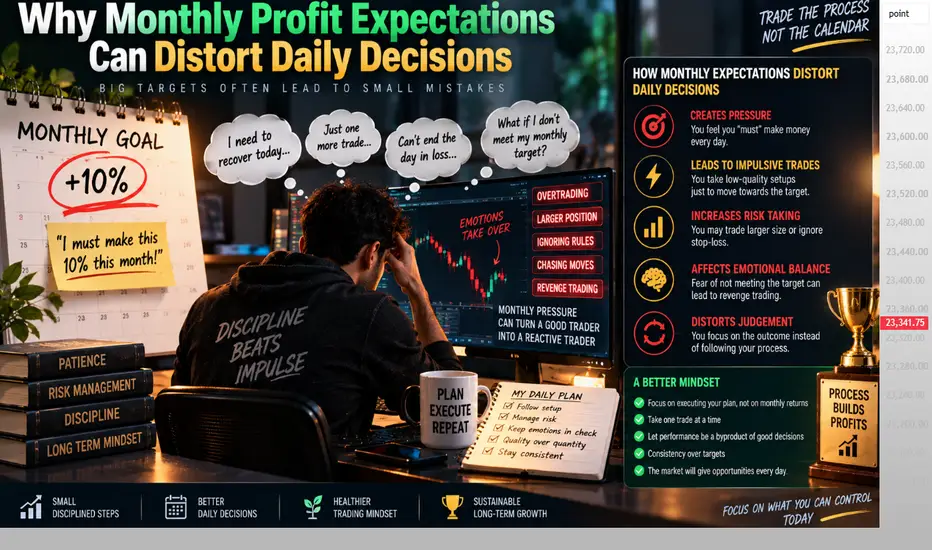
📊 Why Monthly Profit Expectations Can Distort Daily Decisions
Many traders begin the month with a number:
“Make 10%.”
“Earn 50,000.”
“Average 2,000 per day.”
Goals are not automatically bad. But problems begin when a monthly target becomes a daily trading quota.
---------------------------------
📊 Markets Do Not Pay Salaries
Trading returns do not arrive evenly.
A profitable month may include:
• Winning days
• Losing days
• Flat days
• No-trade days
Your edge plays out across a series of trades. Not as a fixed amount every day.
---------------------------------
📊 Being Behind Target Creates Pressure
Suppose your monthly goal is:
+10R
But halfway through the month you are only at:
+2R.
You may start thinking:
“I am behind.”
That can create:
• More trades
• Bigger quantity
• Earlier entries
• Lower-quality setups
• Chasing
Now the target is changing your process.
---------------------------------
📊 Being Ahead Can Be Dangerous Too
Suppose you reach your monthly target early.
You may think:
“I have a cushion.”
Then you:
• Lower setup standards
• Experiment with trades
• Increase frequency
• Take more risk
Being ahead can create overconfidence just as being behind creates pressure.
---------------------------------
📊 Daily Opportunity Is Not Constant
Some sessions may offer: 3 clean setups.
Some may offer: 1.
Some may offer: 0.
Trade frequency should come from opportunity quality. Not from how much money you still want to make this month.
---------------------------------
📊 Watch for P&L Anchoring
If you think:
“I need 3,000 today,”
you may book a good trade early at +2,500... or force another trade after a loss simply to finish green.
Now P&L is controlling trade management.
Manage the trade using:
• Structure
• Target
• Invalidation
• Risk
—not your monthly spreadsheet.
---------------------------------
📊 Options Traders Need Extra Discipline
When traders are behind target, fast-moving options can look like a shortcut.
This often leads to:
• Far OTM trades
• Oversized expiry bets
• Zero-to-hero attempts
• Chasing expanded premiums
Monthly pressure + leverage can become dangerous very quickly.
---------------------------------
📊 Use Process Goals Instead
Instead of:
❌ “I must make 10% this month.”
Focus on:
✅ Take only A-grade setups
✅ Risk consistently
✅ Respect every stop
✅ Avoid no-trade zones
✅ Journal every trade
These are behaviours you can actually control.
---------------------------------
📊 Use a Monthly Risk Plan
A professional monthly framework can define:
• Risk per trade
• Maximum daily loss
• Weekly drawdown limit
• Monthly drawdown limit
This controls what matters most:
**Survival and discipline.**
It does not force the market to produce profit on your schedule.
---------------------------------
📊 Ask One Powerful Question
Before taking a trade:
**“Would I take this setup if I had no monthly profit target?”**
If yes:
Evaluate it normally.
If no:
Your monthly expectation may be distorting the decision.
---------------------------------
📊 Simple Formula
Monthly Target + Daily Quota + Income Pressure
= Forced Trading
But:
Monthly Risk Plan + Daily Process + Flexible Outcomes
= Professional Execution
---------------------------------
📊 Finally, the important point to note is:
A monthly target should be a review tool. Not a daily obligation.
Do not ask:
“How much do I still need to make this month?”
Ask:
“What valid opportunity is the market offering today?”
Let opportunity determine your trades. Let consistency determine your results.
---------------------------------
Educational Purpose Only. Learn stock markets at its best take efforts spend some of your earnings for quality education because its the only way to survive in the markets.

⭐For Live Trading Courses And Trading Community 📈
Contact ⬇️
📱wa.me/919322295961
📱t.me/+UgF9lES_XxA0MTk9
⭐Advanced courses
⭐Fully Automated Algo Trading
⭐Daily F&O Trade tips
📱 t.me/+UgF9lES_XxA0MTk9
Contact ⬇️
📱wa.me/919322295961
📱t.me/+UgF9lES_XxA0MTk9
⭐Advanced courses
⭐Fully Automated Algo Trading
⭐Daily F&O Trade tips
📱 t.me/+UgF9lES_XxA0MTk9
Penerbitan berkaitan
Penafian
Maklumat dan penerbitan adalah tidak bertujuan, dan tidak membentuk, nasihat atau cadangan kewangan, pelaburan, dagangan atau jenis lain yang diberikan atau disahkan oleh TradingView. Baca lebih dalam Terma Penggunaan.