
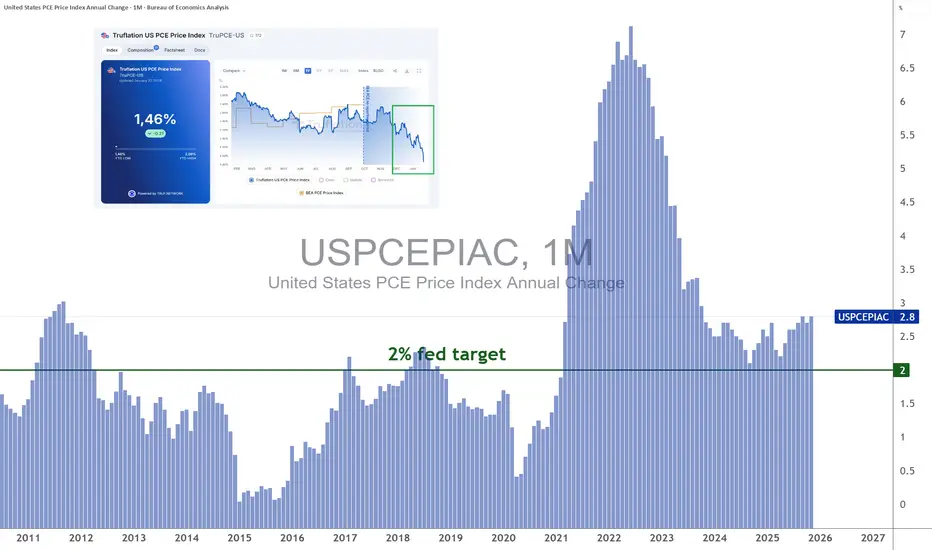
The Fed’s preferred US inflation gauge, PCE inflation, was updated last week, confirming a renewed disinflation trend following the two most recent favorable CPI inflation releases. Both PCE and CPI therefore confirm that the US price regime is once again moving toward the Fed’s well-known 2% target. Reaching this target is absolutely essential for the Fed to resume cuts to the federal funds rate and thereby provide support to the economy and equity markets.
Here are several key fundamental observations regarding US inflation:
• US inflation has resumed its path toward 2% after several months of stagnation around 3%
• Real-time “true” US inflation (according to Truflation) is now falling sharply after dropping below 2%, and this decline in the “true” inflation rate could begin to appear in official data by the end of Q1 2026
• A return to the 2% target is imperative before considering any modification of the Fed’s inflation target (for example, a 1.5%–2.5% range instead of a strict 2%)
• A return to the 2% target is also essential to consider activating the Fed put if conditions require it
In any case, the next Fed Chair should benefit from a far more favorable price environment than Jerome Powell.

Truflation clearly reinforces this diagnosis. After a period of stagnation around 2.5–2.7% during the summer and autumn, real-time PCE inflation has dropped sharply since year-end, quickly falling below 2% and now reaching approximately 1.5%. This dynamic is particularly important, as it suggests not only a return to target but also a potential temporary undershoot.
This rapid decline is typical of advanced disinflation phases, when lagging components such as housing and certain services finally reflect past economic and monetary tightening. In other words, the observed disinflation is no longer marginal or fragile — it is becoming self-sustaining.
If this trend is confirmed, official PCE figures published by the BEA should gradually converge toward these levels over the coming months, reinforcing the credibility of more significant monetary easing in 2026. In such a scenario, the Fed would regain substantial policy flexibility, both to support the economy and to stabilize financial markets in the event of stress.
In summary, the current collapse in “true US inflation” represents a major macroeconomic signal: the fight against inflation is close to being won, and the monetary regime of the next decade could open on far more favorable foundations.
DISCLAIMER:
This content is intended for individuals who are familiar with financial markets and instruments and is for information purposes only. The presented idea (including market commentary, market data and observations) is not a work product of any research department of Swissquote or its affiliates. This material is intended to highlight market action and does not constitute investment, legal or tax advice. If you are a retail investor or lack experience in trading complex financial products, it is advisable to seek professional advice from licensed advisor before making any financial decisions.
This content is not intended to manipulate the market or encourage any specific financial behavior.
Swissquote makes no representation or warranty as to the quality, completeness, accuracy, comprehensiveness or non-infringement of such content. The views expressed are those of the consultant and are provided for educational purposes only. Any information provided relating to a product or market should not be construed as recommending an investment strategy or transaction. Past performance is not a guarantee of future results.
Swissquote and its employees and representatives shall in no event be held liable for any damages or losses arising directly or indirectly from decisions made on the basis of this content.
The use of any third-party brands or trademarks is for information only and does not imply endorsement by Swissquote, or that the trademark owner has authorised Swissquote to promote its products or services.
Swissquote is the marketing brand for the activities of Swissquote Bank Ltd (Switzerland) regulated by FINMA, Swissquote Capital Markets Limited regulated by CySEC (Cyprus), Swissquote Bank Europe SA (Luxembourg) regulated by the CSSF, Swissquote Ltd (UK) regulated by the FCA, Swissquote Financial Services (Malta) Ltd regulated by the Malta Financial Services Authority, Swissquote MEA Ltd. (UAE) regulated by the Dubai Financial Services Authority, Swissquote Pte Ltd (Singapore) regulated by the Monetary Authority of Singapore, Swissquote Asia Limited (Hong Kong) licensed by the Hong Kong Securities and Futures Commission (SFC) and Swissquote South Africa (Pty) Ltd supervised by the FSCA.
Products and services of Swissquote are only intended for those permitted to receive them under local law.
All investments carry a degree of risk. The risk of loss in trading or holding financial instruments can be substantial. The value of financial instruments, including but not limited to stocks, bonds, cryptocurrencies, and other assets, can fluctuate both upwards and downwards. There is a significant risk of financial loss when buying, selling, holding, staking, or investing in these instruments. SQBE makes no recommendations regarding any specific investment, transaction, or the use of any particular investment strategy.
CFDs are complex instruments and come with a high risk of losing money rapidly due to leverage. The vast majority of retail client accounts suffer capital losses when trading in CFDs. You should consider whether you understand how CFDs work and whether you can afford to take the high risk of losing your money.
Digital Assets are unregulated in most countries and consumer protection rules may not apply. As highly volatile speculative investments, Digital Assets are not suitable for investors without a high-risk tolerance. Make sure you understand each Digital Asset before you trade.
Cryptocurrencies are not considered legal tender in some jurisdictions and are subject to regulatory uncertainties.
The use of Internet-based systems can involve high risks, including, but not limited to, fraud, cyber-attacks, network and communication failures, as well as identity theft and phishing attacks related to crypto-assets.
Here are several key fundamental observations regarding US inflation:
• US inflation has resumed its path toward 2% after several months of stagnation around 3%
• Real-time “true” US inflation (according to Truflation) is now falling sharply after dropping below 2%, and this decline in the “true” inflation rate could begin to appear in official data by the end of Q1 2026
• A return to the 2% target is imperative before considering any modification of the Fed’s inflation target (for example, a 1.5%–2.5% range instead of a strict 2%)
• A return to the 2% target is also essential to consider activating the Fed put if conditions require it
In any case, the next Fed Chair should benefit from a far more favorable price environment than Jerome Powell.
Truflation clearly reinforces this diagnosis. After a period of stagnation around 2.5–2.7% during the summer and autumn, real-time PCE inflation has dropped sharply since year-end, quickly falling below 2% and now reaching approximately 1.5%. This dynamic is particularly important, as it suggests not only a return to target but also a potential temporary undershoot.
This rapid decline is typical of advanced disinflation phases, when lagging components such as housing and certain services finally reflect past economic and monetary tightening. In other words, the observed disinflation is no longer marginal or fragile — it is becoming self-sustaining.
If this trend is confirmed, official PCE figures published by the BEA should gradually converge toward these levels over the coming months, reinforcing the credibility of more significant monetary easing in 2026. In such a scenario, the Fed would regain substantial policy flexibility, both to support the economy and to stabilize financial markets in the event of stress.
In summary, the current collapse in “true US inflation” represents a major macroeconomic signal: the fight against inflation is close to being won, and the monetary regime of the next decade could open on far more favorable foundations.
DISCLAIMER:
This content is intended for individuals who are familiar with financial markets and instruments and is for information purposes only. The presented idea (including market commentary, market data and observations) is not a work product of any research department of Swissquote or its affiliates. This material is intended to highlight market action and does not constitute investment, legal or tax advice. If you are a retail investor or lack experience in trading complex financial products, it is advisable to seek professional advice from licensed advisor before making any financial decisions.
This content is not intended to manipulate the market or encourage any specific financial behavior.
Swissquote makes no representation or warranty as to the quality, completeness, accuracy, comprehensiveness or non-infringement of such content. The views expressed are those of the consultant and are provided for educational purposes only. Any information provided relating to a product or market should not be construed as recommending an investment strategy or transaction. Past performance is not a guarantee of future results.
Swissquote and its employees and representatives shall in no event be held liable for any damages or losses arising directly or indirectly from decisions made on the basis of this content.
The use of any third-party brands or trademarks is for information only and does not imply endorsement by Swissquote, or that the trademark owner has authorised Swissquote to promote its products or services.
Swissquote is the marketing brand for the activities of Swissquote Bank Ltd (Switzerland) regulated by FINMA, Swissquote Capital Markets Limited regulated by CySEC (Cyprus), Swissquote Bank Europe SA (Luxembourg) regulated by the CSSF, Swissquote Ltd (UK) regulated by the FCA, Swissquote Financial Services (Malta) Ltd regulated by the Malta Financial Services Authority, Swissquote MEA Ltd. (UAE) regulated by the Dubai Financial Services Authority, Swissquote Pte Ltd (Singapore) regulated by the Monetary Authority of Singapore, Swissquote Asia Limited (Hong Kong) licensed by the Hong Kong Securities and Futures Commission (SFC) and Swissquote South Africa (Pty) Ltd supervised by the FSCA.
Products and services of Swissquote are only intended for those permitted to receive them under local law.
All investments carry a degree of risk. The risk of loss in trading or holding financial instruments can be substantial. The value of financial instruments, including but not limited to stocks, bonds, cryptocurrencies, and other assets, can fluctuate both upwards and downwards. There is a significant risk of financial loss when buying, selling, holding, staking, or investing in these instruments. SQBE makes no recommendations regarding any specific investment, transaction, or the use of any particular investment strategy.
CFDs are complex instruments and come with a high risk of losing money rapidly due to leverage. The vast majority of retail client accounts suffer capital losses when trading in CFDs. You should consider whether you understand how CFDs work and whether you can afford to take the high risk of losing your money.
Digital Assets are unregulated in most countries and consumer protection rules may not apply. As highly volatile speculative investments, Digital Assets are not suitable for investors without a high-risk tolerance. Make sure you understand each Digital Asset before you trade.
Cryptocurrencies are not considered legal tender in some jurisdictions and are subject to regulatory uncertainties.
The use of Internet-based systems can involve high risks, including, but not limited to, fraud, cyber-attacks, network and communication failures, as well as identity theft and phishing attacks related to crypto-assets.

This content is written by Vincent Ganne for Swissquote.
This content is intended for individuals who are familiar with financial markets and instruments and is for information purposes only and does not constitute investment, legal or tax advice.
This content is intended for individuals who are familiar with financial markets and instruments and is for information purposes only and does not constitute investment, legal or tax advice.
Penafian
Maklumat dan penerbitan adalah tidak bertujuan, dan tidak membentuk, nasihat atau cadangan kewangan, pelaburan, dagangan atau jenis lain yang diberikan atau disahkan oleh TradingView. Baca lebih dalam Terma Penggunaan.