Session VWAP Reset Bridge [Pineify]
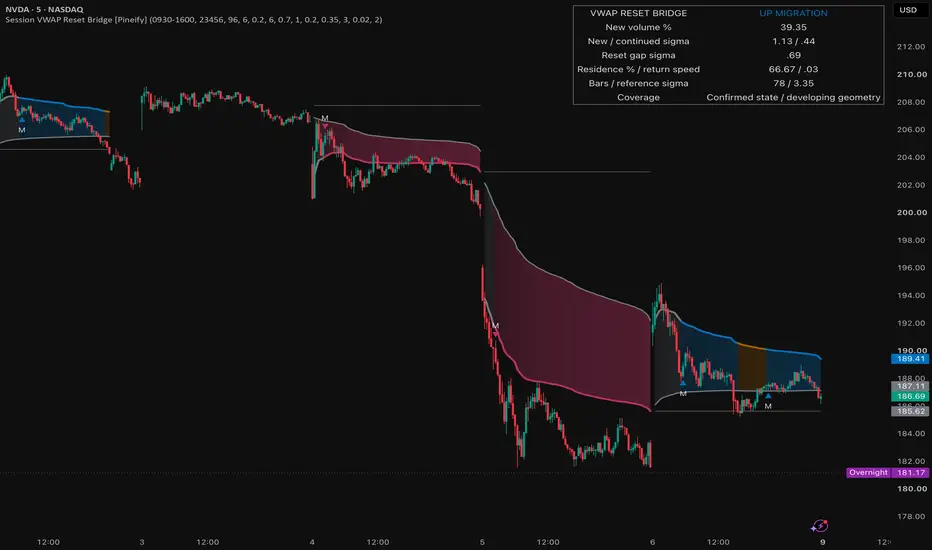
Session VWAP Reset Bridge [Pineify]
Overview
This overlay compares a new session VWAP, a continued prior anchor and the frozen prior equilibrium to separate a reset gap from a volume-supported balance change.
Problem Definition
An early small trade can place VWAP far from yesterday's mean. Comparing those prices alone gives a tiny sample the same status as a full session. Conversely, two VWAPs can converge simply because new volume dilutes the old anchor. A narrower gap is therefore insufficient evidence that price returned to the old equilibrium. The script separates arithmetic dilution, mean displacement and close residence.
Design Rationale
The prior complete session supplies a fixed mean, volume and dispersion scale, keeping today's changes from moving their own yardstick. Continuing that anchor exposes dilution; resetting a second anchor exposes today's balance. A volume share gate prevents early samples from immediately qualifying. Same-side close residence checks whether closes support the mean's direction. Raw crossovers omit maturity. These gates delay classification and can leave sessions unresolved.
Key Features
Thick new-session and thinner continued-anchor rails form the bridge. Blue/rose mean up/down migration, green bridged, amber unresolved and gray immature. Fill, frozen reference, markers and panel are optional.
How It Works
Using HLC3 and nonnegative volume on standard 1-30 minute candles, it requires an exact session open, contiguous timestamps and aligned closing bars. Online weighted moments build the mean and population dispersion. Only an observed complete session with positive volume and dispersion can supply the next reference; its age is limited to 96 hours by default.
Let R and V0 be the frozen old mean and volume, N today's mean and V today's volume. New share q=V/(V0+V). The continued mean is C=R+q*(N-R), so the reset gap N-C=(1-q)*(N-R). Old dispersion, floored at one tick, scales distances; shrinking N-C proves neither return nor migration.
Default maturity requires six session bars, q at least 20%, six close locations and a valid three-bar distance-speed comparison. Migration needs |N-R| of at least one old sigma, |C-R| at least 0.20 sigma and 70% of recent closes beyond 0.35 sigma on N's side. Bridge entry requires an earlier one-sigma separation, return within 0.35 sigma and distance contraction of at least 0.02 sigma per bar. Two consecutive candidates confirm changes. Weaker retention gates reduce chatter; immature evidence clears the state.
How Multiple Indicators Work Together
The rails share an identity, not independent votes. The reference fixes coordinates; new VWAP measures current balance; continuation measures its effect on the combined mean. Residence adds a different observation from closes. Without maturity, a small sample qualifies too soon; without residence, a weighted mean can migrate while recent closes disagree. Convergence speed tests actual return toward R.
Trading Ideas and Insights
Migration describes observed balance; inspect price structure and execution conditions separately. An early gray bridge calls for more evidence. Green follows a prior separation and measured return; it is not a reversal forecast. Continued-anchor movement shows how new-session volume affects combined balance.
Unique Aspects
Beyond two-VWAP crossovers, the reset-gap identity combines with maturity, displacement, residence and speed gates in fixed coordinates. Dilution cannot by itself trigger bridge entry. Migration must move both the new and combined balance, while the prior scale stays fixed. This separates sample restart from a qualified shift without inferring its cause.
How to Use
Match session hours to available chart bars in the exchange timezone. Allow a full reference session, then wait for next-session maturity. Read the thick rail's confirmed state alongside the panel's live geometry. B marks a confirmed bridge; M marks migration. Alerts cover bridge, both migration directions, maturity gained/lost and invalid data. Use once per bar close.
Customization
Session hours, weekday coverage and reference age control eligibility. Minimum bars, new-volume share, residence window/share and displacement gates set evidence requirements. Return distance, speed lookback, minimum speed and candidate count control bridging and delay. Retention uses 70% of migration distance gates and 0.15 less residence; bridging retains within entry plus 0.15 sigma. Defaults are starting choices. Secondary layers can be hidden.
Assumptions and Limitations
HLC3-weighted volume is a bar approximation, not trade-level VWAP or order flow. Zero-volume bars occupy time; missing or negative volume, partial bars and intra-session gaps invalidate that session. Flat references cannot qualify. Unseen whole sessions cannot be detected from an absent feed, so the reference is the last eligible observed session within the age limit. Half-days or misaligned hours prevent eligibility. Gates lag and depend on parameters and comparable volume. Rails/fill move live; persistence and alerts update at close. Opening rails are broken to avoid cross-session joins. Data revisions can recalculate history. No profitability, future acceptance or execution quality is inferred.
Conclusion
The bridge explains a session reset through fixed coordinates, sample share and state evidence. Examine observed equilibrium changes while assessing trading risk separately.

🚀🚀🚀 Pineify - pineify.app
Essential Toolkit for Every Trader
- AI Pine Script Generator
- Finance AI Agent
- AI Stock Picker
- Pine Script Visual Editor
- Invited indicators
- Strategy Optimizer
- Trading Journal
- Backtest Report
Essential Toolkit for Every Trader
- AI Pine Script Generator
- Finance AI Agent
- AI Stock Picker
- Pine Script Visual Editor
- Invited indicators
- Strategy Optimizer
- Trading Journal
- Backtest Report
Penafian
Maklumat dan penerbitan adalah tidak bertujuan, dan tidak membentuk, nasihat atau cadangan kewangan, pelaburan, dagangan atau jenis lain yang diberikan atau disahkan oleh TradingView. Baca lebih dalam Terma Penggunaan.